You found us. Start with what brought you.


SourcesThe studies behind what we say about barrier
Where this comes from.
18 claims · 19 studies · 7 synthesized.
C2-7
In cultured melanocytes and keratinocyte-melanocyte models, tranexamic acid reduces melanin content, tyrosinase activity and tyrosinase protein by acting on signalling upstream of the enzyme, rather than being characterised as a direct tyrosinase-enzyme inhibitor. It does so both through a keratinocyte paracrine route (tranexamic acid raised keratinocyte TGF-beta1, which suppressed melanogenesis in melanocytes) and directly on melanocytes (ERK-MITF degradation; cAMP-PKA-CREB-MITF; VEGF-receptor signalling). The evidence is in vitro; in a 30-patient refractory-melasma series, oral tranexamic acid was followed by lower epidermal pigmentation and Melan-A staining.
VerifiedOne of 5 sources behind this claim · see the others
The record
Kim MS, Bang SH, Kim JH, Shin HJ, Choi JH, Chang SE. Ann Dermatol 2015;27(3):250-6. PMID 26082580
VerifiedOne of 5 sources behind this claim · see the others
The record
Xing X, Xu Z, Chen L, Jin S, Zhang C, Xiang L. Exp Dermatol 2021 Dec 17;31(4):633-640. PMID 34862827
VerifiedOne of 5 sources behind this claim · see the others
The record
Bae YJ, Lee EJ, Kim JY, Park S, Hwang S, Kwon IJ, Alqahtani JM, Oh SH. Exp Dermatol 2025;34(12):e70194. PMID 41392597
VerifiedOne of 5 sources behind this claim · see the others
The record
Zhu JW, Ni YJ, Tong XY, Guo X, Wu XP, Lu ZF. Int J Med Sci 2020;17(7):903-911. PMID 32308543
VerifiedOne of 5 sources behind this claim · see the others
The record
Nagaraju D, Bhattacharjee R, Vinay K, Saikia UN, Parsad D, Kumaran MS. Dermatol Ther 2018;31(5):e12704. PMID 30253023
C5-1
Hard water dramatically increases barrier damage from surfactant cleansers — calcium/magnesium ions bind to surfactants and remain on skin after rinsing.
VerifiedOne source behind this claim
The record
The Effect of Water Hardness on Surfactant Deposition after Washing and Subsequent Skin Irritation in Atopic Dermatitis Patients and Healthy Control Subjects.
C5-2
Skin surface pH averages ~4.7-5.5; acidic pH keeps resident flora attached, alkaline disperses it; below-5 skin is in better barrier condition.
VerifiedOne source behind this claim
The record
Natural skin surface pH is on average below 5, which is beneficial for its resident flora.
C10-3
Sodium hypochlorite solution pH is 11-12; disrupts skin acid mantle on contact.
Verified
C13-4
Skin pH rises after a single wash and takes hours to recover; soap causes the greatest pH rise of any cleanser type tested.
Verified
C14-4
Skin's optimal surface pH sits around 4.5-5.5; a single alkaline exposure measurably raises pH and recovery takes hours.
Verified
C25-1
Ambient humidity and temperature strongly affect the stratum corneum; colder/drier regions show markedly higher population-level dry-skin burden than warm/humid ones.
VerifiedOne of 2 sources behind this claim · see the other
The record
Climate, Humidity, and Population-Level Interest in Dry Skin: Infodemiology Analysis Using Google Trends Across the United States.
VerifiedOne of 2 sources behind this claim · see the other
The record
Ambient humidity and the skin: the impact of air humidity in healthy and diseased states.
C25-2
Humectants (urea, glycerol) increase stratum-corneum hydration; occlusives reduce water loss by sealing the surface.
VerifiedOne source behind this claim
The record
Effects of water activity and low molecular weight humectants on skin permeability and hydration dynamics - a double-blind, randomized and controlled study.
C27-2
Skin's acidic pH supports barrier repair and antimicrobial defense; pH stays raised for hours after even a single wash.
VerifiedOne source behind this claim
C34-1
Skin surface pH rises after a single wash, even water alone; recovery takes up to several hours.
VerifiedOne source behind this claim
C34-5
In elderly dry skin, high TEWL tracks high pH, low hydration, low surface lipid.
VerifiedOne source behind this claim
CFRAG-1
The EU Cosmetics Regulation (EC No 1223/2009, Annex III) requires named fragrance allergens — historically 26, including linalool, limonene, citronellol, geraniol and eugenol — to be individually declared on cosmetic ingredient labels when present above 0.001% in leave-on or 0.01% in rinse-off products; Commission Regulation (EU) 2023/1545 (26 Jul 2023) expands the declarable list to 80+ substances (compliance deadlines Jul 2026 / Jul 2028). A 'fragrance-free' claim does not preclude these compounds appearing on-label under their own names.
Verified
CLIPID-1
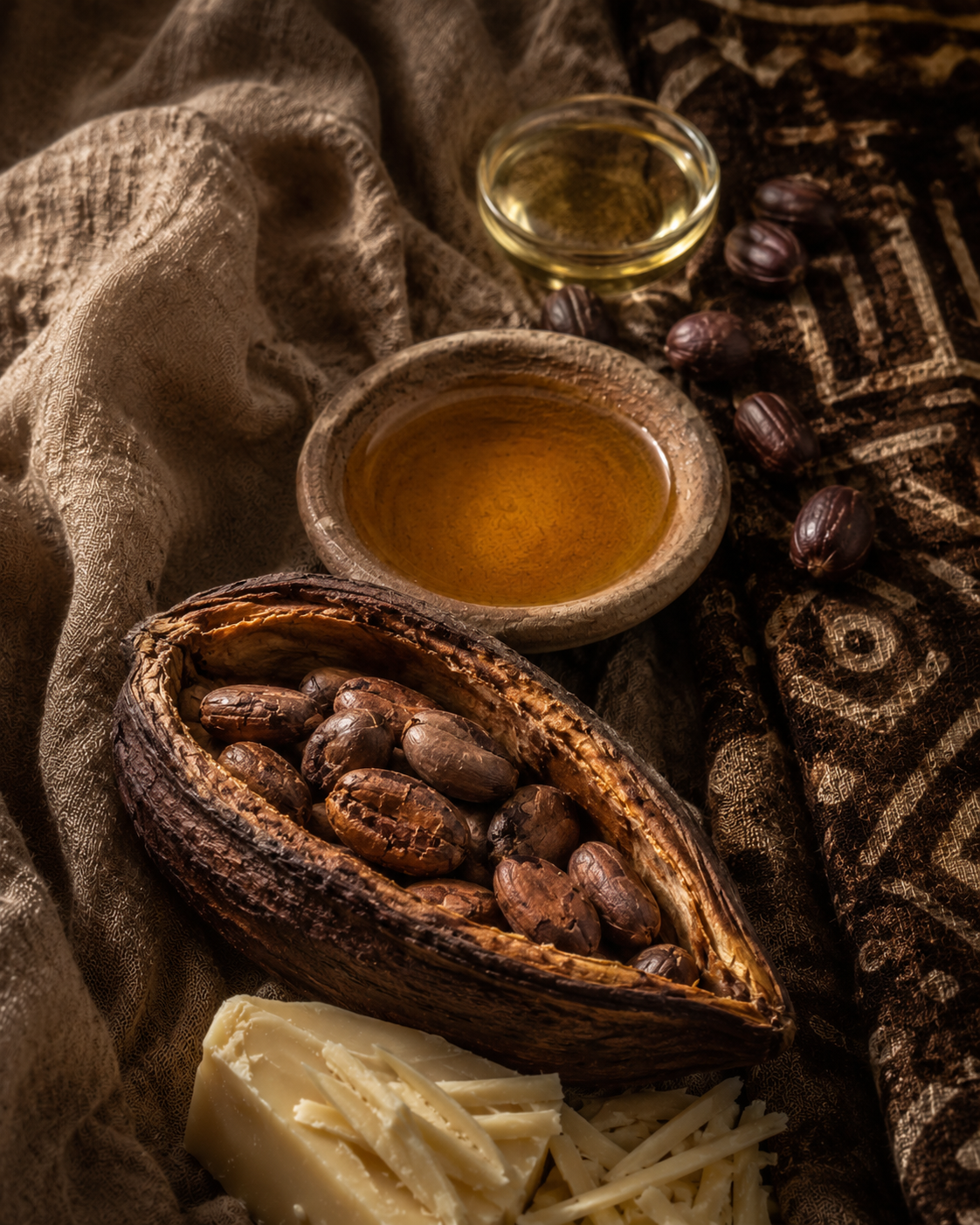
Triterpene constituents of shea butter's unsaponifiable fraction have anti-inflammatory activity.
VerifiedOne source behind this claim
The record
Akihisa T, Kojima N, Kikuchi T, Yasukawa K, Tokuda H, T Masters E, Manosroi A, Manosroi J. J Oleo Sci 2010;59(6):273-80. PMID 20484832
CLIPID-2
Shea butter is a component of evidence-backed eczema barrier formulations.
VerifiedOne source behind this claim
The record
Micali G, Paternò V, Cannarella R, Dinotta F, Lacarrubba F. G Ital Dermatol Venereol 2018 Jan;153(3):396-402. PMID 29368843
CLIPID-3
Traditional wound-healing use of shea butter is documented.
VerifiedOne source behind this claim
The record
Anyanwu EG, Onuchukwu CL, Ojukwu CP, Anyanwu CN. J Ethnopharmacol 2026 Jan;361:121293. PMID 41619863
CMIST-2
The water-transport resistance of a deposited occlusive or emulsion film can increase stratum-corneum hydration and alter permeability and TEWL; the relevant mechanism is the film left on skin.
Verified
CPAN-1
Panthenol (pro-vitamin B5) accelerates post-procedure skin barrier recovery, reduces transepidermal water loss, and improves stratum corneum moisture and barrier markers.
VerifiedOne of 2 sources behind this claim · see the other
VerifiedOne of 2 sources behind this claim · see the other
CSHEA-2
No study located shows shea BUTTER fades hyperpigmentation: the published melanogenesis-inhibition result is for a lab extract of the defatted kernel, not the butter; the Library declines the "shea fades dark spots" claim.
VerifiedOne source behind this claim
The record
Zhang J, Kurita M, Shinozaki T, Ukiya M, Yasukawa K, Shimizu N, Tokuda H, Masters ET, Akihisa M, Akihisa T. Phytochemistry 2014 Oct;108:157-70. PMID 25446237
RBAR-1
A thinned barrier lipid layer plausibly lets water leave faster and lets irritants in more easily; extrapolated from ceramide-profile/barrier-function evidence and the experimental barrier-disruption + UV pigmentation finding; C25-4 is Unconfirmed.
SYNTHESIZED
Synthesized from:
- C29-3 Ceramide subclass composition is tightly linked to barrier function; a skewed or altered ceramide profile correlates with barrier dysfunction. DOI
- CPEEL-9 Experimentally disrupting the epidermal barrier via tape stripping before UV exposure produces significantly more pronounced, longer-lasting pigment darkening and (after UVB) more pronounced delayed erythema and PIH than intact-barrier skin, scaling with barrier-damage severity.
RBAR-2
For skin of color with documented low upper-layer ceramide and prominent xerosis, topical ceramide- or urea-based moisturizers are a reasonable direct response; extrapolated from low-ceramide findings and the barrier-repair evidence; no trial of ceramide top-up specifically in Fitzpatrick IV-VI.
SYNTHESIZED
Synthesized from:
- C29-1 African American skin was characterized by low ceramide levels in the uppermost layers of the stratum corneum, interpretable alongside the high prevalence of xerosis in Black skin. DOI
- C31-10 African American skin is characterized by low ceramide levels and high protein cohesion in the uppermost stratum corneum, interpreted in relation to the high prevalence of xerosis. PMID 20654785 DOI
- C28-2 Evidence-based skin repair rests on gentle pH-balanced cleansing, ceramide- or urea-based moisturizers, and photoprotection. DOI
- C29-3 Ceramide subclass composition is tightly linked to barrier function; a skewed or altered ceramide profile correlates with barrier dysfunction. DOI
RBAR-3
Oils and butters act mainly as occlusives that slow evaporation of water already in the skin and do not add water; applied to dry skin without a humectant or water they may seal dryness in. Extrapolated from the humectant/occlusive mechanism.
SYNTHESIZED
Synthesized from:
- C25-2 Humectants (urea, glycerol) increase stratum-corneum hydration; occlusives reduce water loss by sealing the surface. PMID 24786192 DOI
RBAR-4
Applying a humectant (urea, glycerin) or working the next step into damp skin first, then an occlusive over it, is a reasonable order that follows from the humectant and occlusive mechanisms; no trial of the sequence in Fitzpatrick IV-VI.
SYNTHESIZED
Synthesized from:
- C25-2 Humectants (urea, glycerol) increase stratum-corneum hydration; occlusives reduce water loss by sealing the surface. PMID 24786192 DOI
- CJOJ-1 Jojoba oil (Simmondsia chinensis seed oil) has documented anti-inflammatory and wound-healing activity and functions as a wax-ester sebum-mimetic rather than a true triglyceride oil. PMID 24442052 PMID 29280987
RBAR-5
Sealing harder with an occlusive over a humectant in cold dry air and going lighter in hot humid air follows from climate effects on stratum-corneum hydration; no trial of climate-adjusted routines.
SYNTHESIZED
Synthesized from:
- C25-1 Ambient humidity and temperature strongly affect the stratum corneum; colder/drier regions show markedly higher population-level dry-skin burden than warm/humid ones. PMID 42184334 PMC13200769 DOI PMID 27306376 DOI
- C25-2 Humectants (urea, glycerol) increase stratum-corneum hydration; occlusives reduce water loss by sealing the surface. PMID 24786192 DOI
RBAR-6
A breached barrier plausibly lets irritants in, and the resulting inflammation drives pigment overproduction on skin of color; stands on the injury->melanocyte pathway and the experimental barrier-disruption + UV finding; the barrier-admits-irritants row is Unconfirmed.
SYNTHESIZED
Synthesized from:
- CPEEL-12 Injury or irritation to keratinocytes (from a peel, tape, or other insult) triggers inflammatory cytokine/interleukin release that stimulates neighboring melanocytes to produce more melanin — the general pathway connecting irritation of any kind to increased pigment.
- C8-3 The core PIH mechanism (melanocytes overproduce pigment in response to inflammation on elevated-melanin-density skin). PMID 21348540 DOI
- CPEEL-9 Experimentally disrupting the epidermal barrier via tape stripping before UV exposure produces significantly more pronounced, longer-lasting pigment darkening and (after UVB) more pronounced delayed erythema and PIH than intact-barrier skin, scaling with barrier-damage severity.
RBAR-7
Layering several strong actives or using sharp-particle scrubs adds irritant and mechanical injury; because irritation can trigger PIH on skin of color, starting low and titrating is the clinical approach.
SYNTHESIZED
Synthesized from:
- C21-6 On skin of color, irritation itself can trigger PIH; clinical approach is to start low and titrate up. PMID 15113286 DOI PMID 35720053 PMC9165627 DOI
- C24-2 In skin of color, acne treatment must balance efficacy against irritation, because irritation itself triggers PIH; treat early, titrate gently. PMID 35720053 PMC9165627 DOI PMID 20725554 PMC2921758
- CPEEL-12 Injury or irritation to keratinocytes (from a peel, tape, or other insult) triggers inflammatory cytokine/interleukin release that stimulates neighboring melanocytes to produce more melanin — the general pathway connecting irritation of any kind to increased pigment.