The Fitzpatrick scale is not about how dark your skin looks. It is about what your skin does.
The scale that determines product safety for melanated skin measures how our melanocytes respond to UV — not how we appear.
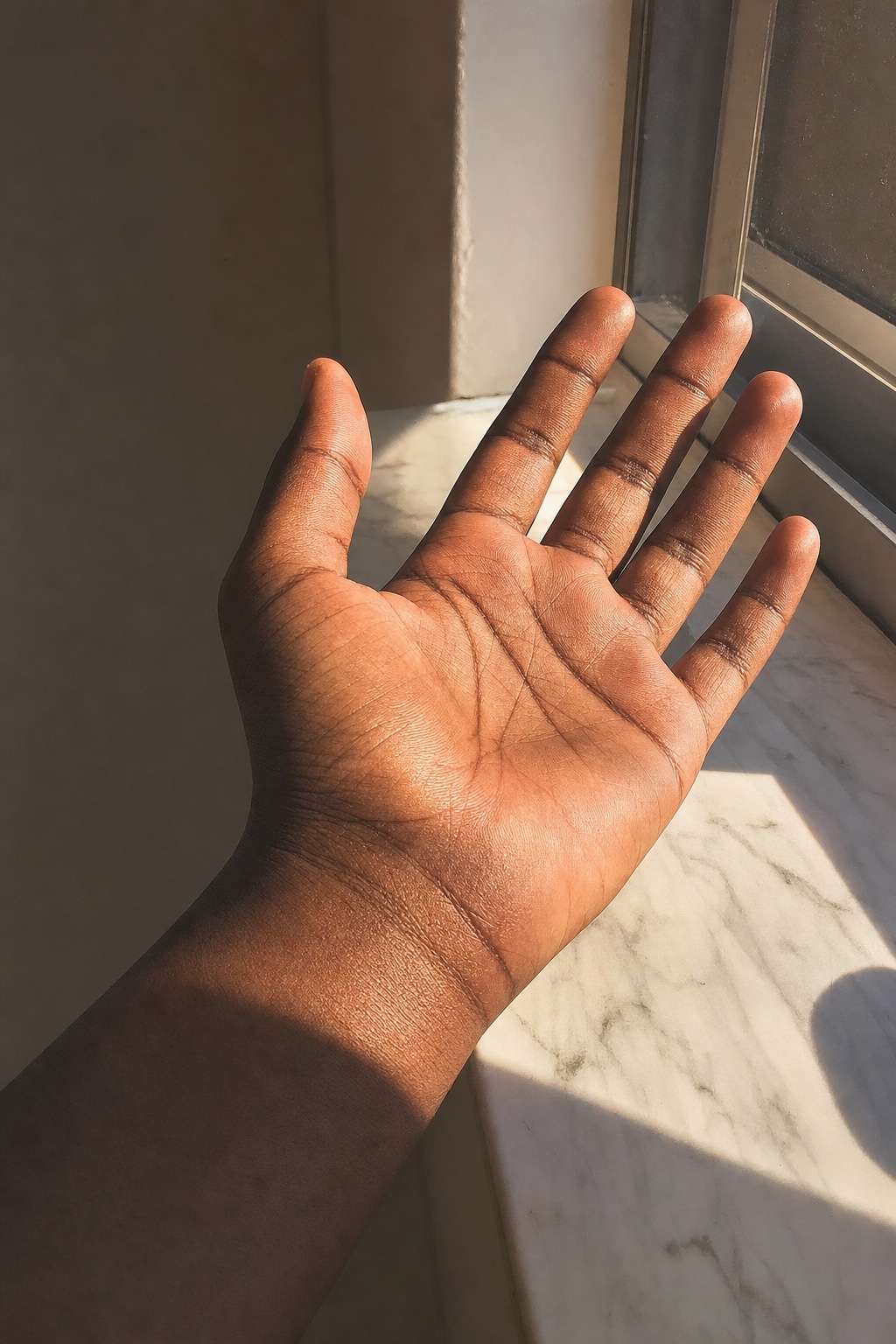
UV response, not appearance.
The Fitzpatrick scale was developed in 1975 by dermatologist Thomas Fitzpatrick to classify how skin responds to ultraviolet radiation. It is not a color chart. Two people who appear to have similar skin tones can have different Fitzpatrick types depending on how their melanocytes behave when exposed to sun — and that behavioral difference, not the appearance difference, is what matters for every skincare decision.
The scale runs from I to VI. Type I always burns, never tans, lowest melanocyte density. Type VI never burns, tans deeply, highest melanocyte density. But high melanocyte density does not mean high sun protection. It means high PIH risk. Those are not the same thing.
Where we fall — and what that means in practice.
Types I–II: Skin that burns readily and tans poorly or not at all. The phototype of most clinical skincare research. Products are typically formulated and tested here. Lowest PIH risk after inflammation.
Types III–IV: Skin that burns moderately and tans gradually. The most undertreated zone in skincare — not considered "skin of color" in many studies, but carrying real PIH risk. Many people in this range discover they are more prone to hyperpigmentation than the products they were sold for assume.
Types V–VI: Skin that rarely burns and tans deeply. The highest melanocyte density. The most active melanosome transfer. The highest PIH risk and the highest keloid risk. This is where the failure of standard dermatological research to include us is most expensive.
A bump that fades in days on Type II skin can leave a mark for a year on Type V skin. That is the expected behavior of a system built to protect us.
More melanin does not mean more protection.
Melanocytes produce melanin. When skin experiences any inflammatory event — a razor bump, a breakout, friction, even aggressive exfoliation — the melanocytes in the area receive a signal. They produce more melanin. The excess pigment transfers to surrounding skin cells and becomes visible as a dark mark.
On Fitzpatrick I–II skin, this response is modest. The mark may fade in days or weeks. On Fitzpatrick V–VI skin, the melanocyte density means the same inflammatory event triggers a larger response. The mark can persist for months or years without intervention. This is the mechanism behind PIH — and it is not a flaw. It is our skin's evolved healing system running exactly as designed. Understanding it is how we work with it instead of against it.
The concentration that resurfaces Type I can inflame Type VI.
When a product is formulated and tested primarily on Fitzpatrick I–III skin, the concentrations of active ingredients are calibrated to that skin's tolerance and melanocyte behavior. Those concentrations are not automatically appropriate for IV–VI skin.
Glycolic acid at high concentrations can cause enough irritation on deep melanated skin to trigger PIH — the exact thing it was supposed to address. Retinoids, when introduced too aggressively, do the same. Even SPF formulas tested primarily on lighter skin sometimes fail to disperse without white cast at full application, which leads to under-application — which means UV protection below the stated SPF.
The Fitzpatrick number is not a limitation. It is the variable that lets us match products to skin instead of the other way around.
Sun response is the question. Not your arm in January.
Skin color in the mirror is not the diagnostic. Sun response is.
What happens to our skin after 30 minutes in direct sun without SPF? Does it burn, pink, or develop irritation quickly? That signals a lower type. Does it tan without visible burn? That signals a higher type. Does it rarely burn even with extended exposure? Fitzpatrick V–VI range.
What is our skin tone in winter, after months without sun exposure? This baseline reflects resting melanin, not tanned melanin, and is the more accurate marker.
Have we ever had a severe sunburn with blistering? Yes suggests a lower Fitzpatrick type, regardless of current skin tone. No across a lifetime of sun exposure, even without SPF, suggests V–VI.
Mixed-race individuals often land in IV–V regardless of whether they present lighter or darker visually. Tanning shifts appearance but not baseline type.
The Fitzpatrick scale isn't about how dark your skin looks — it's about how your melanocytes react to UV, and that's what decides which products and doses are actually safe for you. It runs from Type I (always burns, never tans) to Type VI (never burns, tans deeply), and more melanin doesn't mean more protection — it means more risk of dark marks, because the same inflammation that fades fast on lighter skin can leave a mark for a year on deeper skin. Most skincare is formulated and tested on Types I–III, so the strengths and doses that work there can actually irritate or scar Types IV–VI. To find your real type, don't look in the mirror — look at how you actually respond to sun: whether you burn fast, tan without burning, or almost never burn at all. Mixed-race skin especially can look one way and behave another. The number isn't a hierarchy. It's the information that lets you match products to what your skin actually does.
Reign in your skin
The scale is information. Not hierarchy.
Evaluate your products →Doctor Djeli is an educational resource, not medical advice.