How to apply sunscreen correctly.
Sunscreen is tested at 2 milligrams per square centimeter of skin. That is the amount required to deliver the SPF printed on the label. For the face and neck of an average adult, that works out to approximately one quarter teaspoon of your sunscreen.
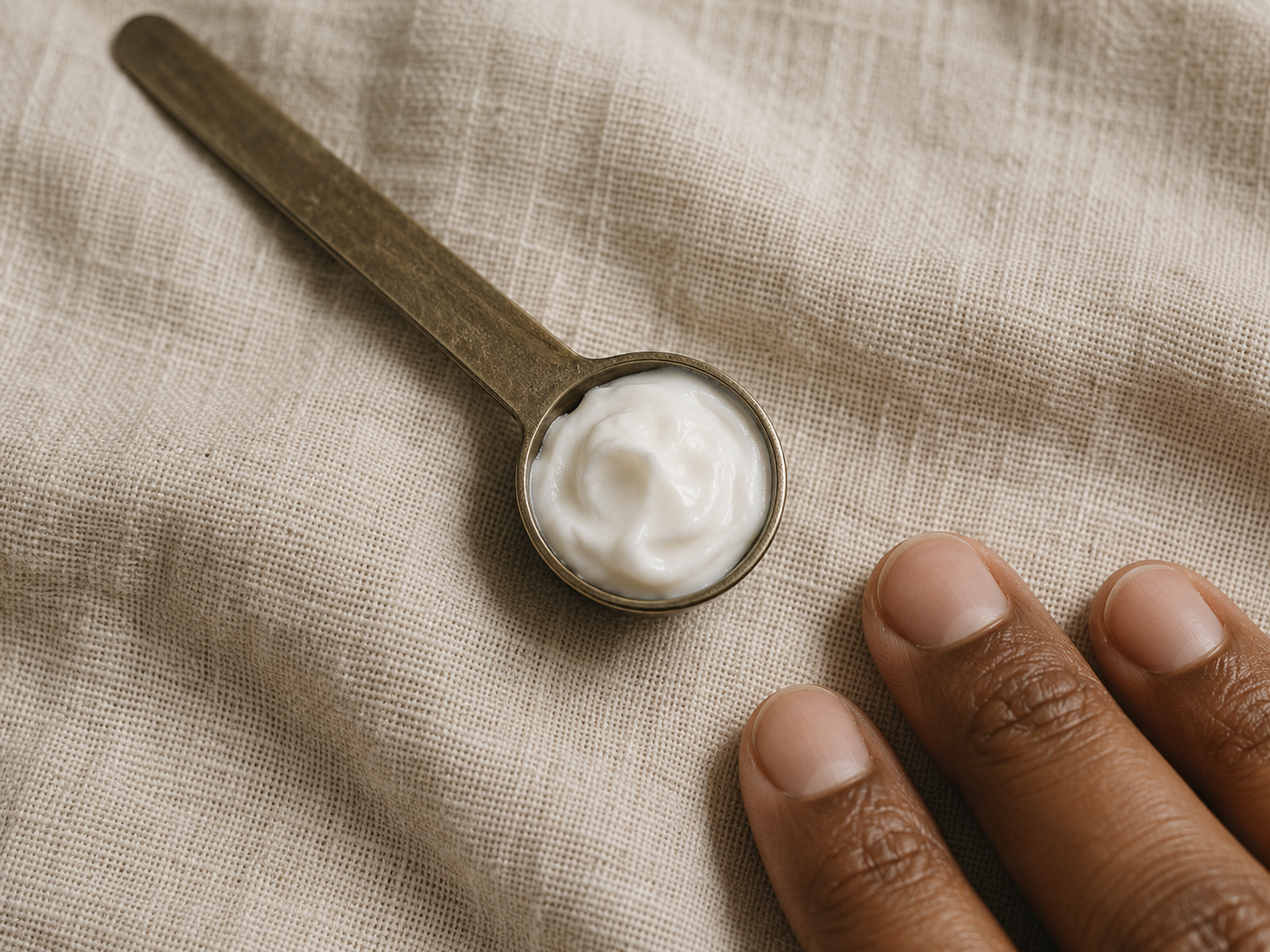
A quarter teaspoon. Of your sunscreen.
Sunscreen is tested at 2 milligrams per square centimeter of skin. That is the amount required to deliver the SPF printed on the label. For the face and neck of an average adult, that works out to approximately one quarter teaspoon of your sunscreen.
Not one quarter teaspoon of a reference liquid. One quarter teaspoon of the specific sunscreen you are using, because density varies. A lightweight Japanese milk sunscreen and a gel-cream formula are not the same volume for the same weight.
Before you apply tomorrow morning, do this once: put the amount you normally use into a quarter teaspoon measuring spoon first. Do not put it on your face yet. Just see how close you are.
Most people are at half. Some are at a third.
If you are actively treating PIH and your sunscreen amount is wrong, your actives are working against UV exposure you were not accounting for. The math is unfavorable.
Cream or liquid is your base layer. Always.
Creams and liquids are your base layer. They are the easiest formats to apply evenly, the easiest to measure, and the formats in which sunscreen testing is most reliably conducted. If you are building your morning routine around sun protection, this is where you start.
Sticks are difficult to dose correctly. It is nearly impossible to apply a quarter teaspoon from a stick with even coverage. If your sunscreen is a stick and your PIH is not responding, this is worth examining.
Sprays have an additional consideration: do not spray directly onto your face. Spray into your hands first, then apply. Never use a spray in an enclosed space or breathe the aerosol.
Sticks, sprays, and SPF foundations have a real role in your routine. That role is reapplication, not your base layer.
A sunscreen that costs enough that you apply it sparingly is not protecting you at its labeled SPF.
You are not working it in. You are laying down a film.
Do not put sunscreen in your palm, rub both hands together, and then rub your face.
When you do that, a significant portion of the product stays on your hands and gets wiped off your face. You have also disrupted the film layer that was beginning to form on your palms before it ever reached your skin.
Sunscreen is not lotion. You are not working it into the skin. You are laying down a film.
Apply with your fingertips. Dispense the sunscreen onto your fingertips, dot it across your forehead, cheeks, nose, chin, and neck, then smooth it outward with light, even strokes. Do not rub. Do not press hard. Do not go back and forth aggressively. Smooth it and let it set.
The best sunscreen is the one applied in the full correct amount.
The most expensive sunscreen is not the best sunscreen. The best sunscreen is the one you will apply in the full correct amount every single day without hesitation.
A sunscreen that costs enough that you apply it sparingly is not protecting you at its labeled SPF. A sunscreen that is affordable enough to use freely, applied correctly, delivers everything on the label.
This is not a case against quality. It is a case against sunscreen being precious. You are going to have too much on your fingertips sometimes. You are going to dispense slightly more than you need. That is fine. The goal is consistent, correct application. Not conservation.
Most people aren't wearing enough sunscreen, and most are applying it wrong. The tested amount for full face and neck coverage is about a quarter teaspoon — worth measuring out what you normally use once, just to see how far off you are (most people land at half or a third). Skip the rub-both-hands-together-then-smear method; a lot of that product stays on your palms instead of your face. Dispense onto your fingertips instead, dot it across your forehead, cheeks, nose, chin, and neck, then smooth it outward gently — you're laying down a film, not rubbing in lotion, so don't press or go back and forth. And the best sunscreen isn't the priciest one, it's the one you'll actually use in the full amount every single day. If an expensive sunscreen makes you stingy with it, a cheaper one you'll apply generously protects you better.
Reign in your skin
One quarter teaspoon of your sunscreen. Applied with fingertips, smoothed outward, not rubbed in.
Evaluate your products →Doctor Djeli is an educational resource, not medical advice.