Shea butter is your seal. Not your treatment.
Shea butter is extracted from the nut of the Vitellaria paradoxa tree, native to the semi-arid regions of sub-Saharan Africa. It has been used in West and Central African skincare, haircare, wound care, and food preparation for centuries. The traditional uses were specific: protect dry skin against harsh climate, support wound healing, condition hair and scalp. These were not incidental choices. They reflected accurate empirical knowledge of what shea butter does well.
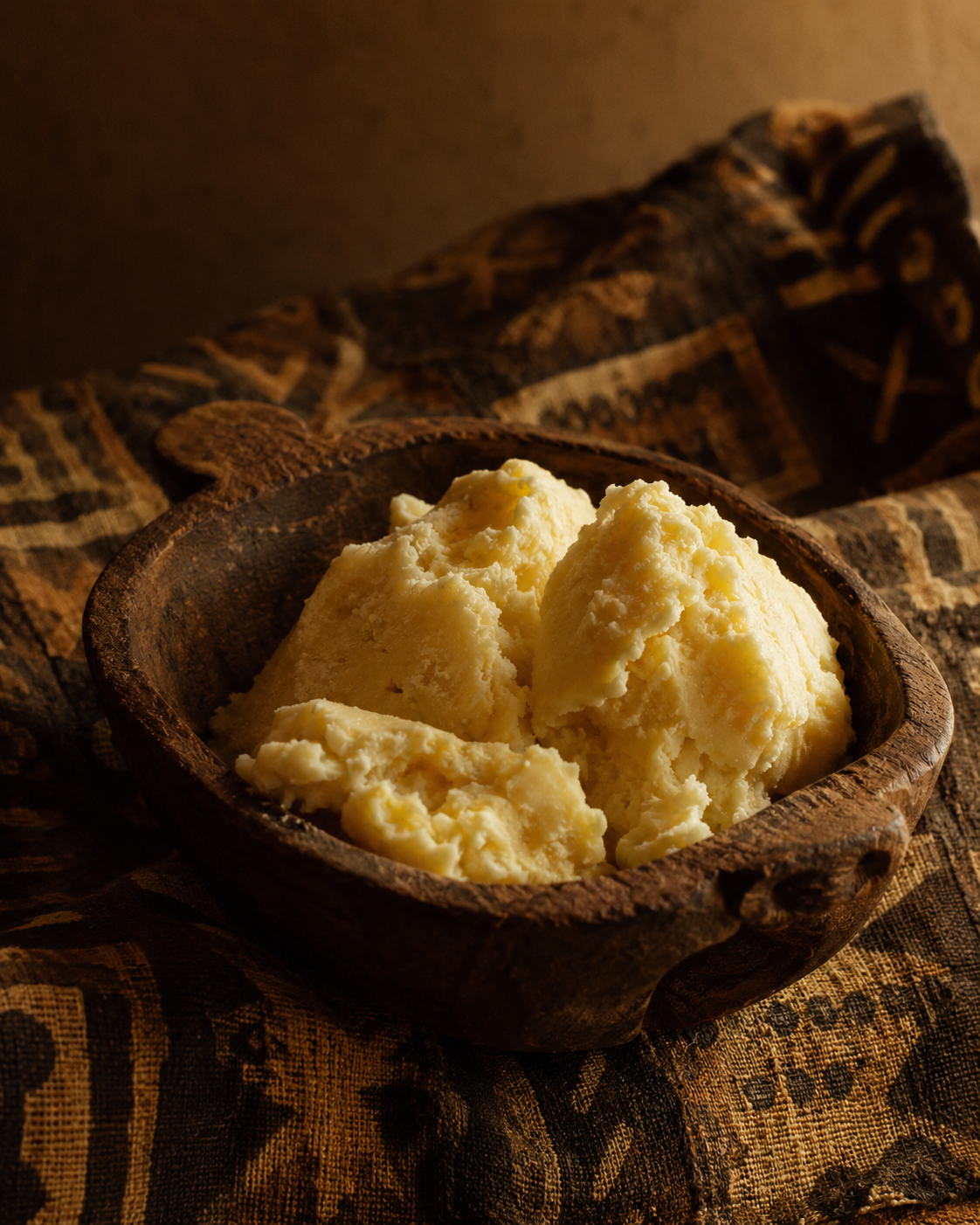
90% triglycerides. An emollient and occlusive.
Shea butter is extracted from the nut of the Vitellaria paradoxa tree, native to the semi-arid regions of sub-Saharan Africa. It has been used in West and Central African skincare, haircare, wound care, and food preparation for centuries. The traditional uses were specific: protect dry skin against harsh climate, support wound healing, condition hair and scalp. These were not incidental choices. They reflected accurate empirical knowledge of what shea butter does well.
Shea butter’s functional profile: it is primarily composed of triglycerides — oleic acid, stearic acid, linoleic acid — and contains a small percentage of unsaponifiable matter including triterpene alcohols, phenolics, and tocopherols. The unsaponifiables are where most of its secondary claims come from. The triglyceride composition is what makes it a genuinely excellent emollient and occlusive.
As an emollient, shea butter softens and conditions skin by filling the gaps between skin cells and restoring the lipid feel of the stratum corneum. As an occlusive, it reduces transepidermal water loss by forming a physical barrier on the skin surface. Both of these properties are real, well-supported, and clinically useful.
This is what shea butter does. It does it well. The problem is not the ingredient. The problem is the marketing that extended these properties into claims the chemistry cannot support.
Antioxidants do not block tyrosinase.
Somewhere in the growth of the natural beauty market, shea butter’s legitimate properties as an emollient and occlusive got expanded into a general brightening, dark spot treating, and PIH-correcting agent. The leap was not supported by the chemistry. It was supported by the cultural authority of the ingredient and the demand for a natural treatment option for concerns that disproportionately affect darker skin.
The PIH claim for shea butter typically rests on one of two things: vitamin E content or the general “skin healing” framing. On vitamin E: shea butter contains tocopherols, which have antioxidant properties. Antioxidants can support skin health in a general sense and may have some mild effect on very superficial oxidative damage. Antioxidants do not suppress melanocyte activity. They do not block tyrosinase, the enzyme primarily responsible for melanin production. They do not interrupt melanosome transfer. They are not treating PIH.
On the “skin healing” framing: shea butter’s anti-inflammatory properties are real but modest. The triterpene alcohols in the unsaponifiable fraction have demonstrated anti-inflammatory activity in vitro. The concentration in a typical shea butter application to intact skin is not sufficient to meaningfully suppress the inflammation cascade involved in post-inflammatory hyperpigmentation. For minor surface irritation, the anti-inflammatory support is appropriate and useful. For active PIH requiring treatment, it is not moving the needle.
The people most aggressively sold on shea butter as a PIH treatment are often the people who most need accurate information about what will actually work on their skin. The marketing did not serve them.
It has been carrying melanated skin for centuries. It was never designed to treat dark spots.
SEAL. Last step. Locking everything in.
In a routine designed to treat PIH, shea butter belongs at the end. As the final step. As the seal.
The SEAL step in a routine serves two purposes: locking in moisture and protecting the barrier. Shea butter is excellent at both. A well-applied occlusive layer after actives and moisturizer slows transepidermal water loss, which means the water-based products underneath stay in contact with the skin longer and absorb more completely. It also creates a physical barrier against environmental irritants and reduces the friction and minor trauma that happens to skin throughout the day.
Used this way, shea butter is not a passive product. It is supporting the work of everything applied before it. The niacinamide, the azelaic acid, the tranexamic acid — these are doing the targeted work on melanocyte activity. Shea butter is creating the conditions where that work is most effective.
This is how shea butter was traditionally used. Protecting dry skin against harsh conditions. Sealing in whatever care came before. The traditional use was correct. The marketing overclaim is what got added later.
Water-based first. Moisturizer next. Shea butter to seal.
In a treatment-focused routine for PIH: apply your water-based products first — toner, essence, serum. These absorb best on skin that has not yet been occluded. If you are using an active like niacinamide or azelaic acid, it goes here.
Apply your moisturizer. This adds hydration and can carry its own active or supportive ingredients.
Apply shea butter last, as the final seal. A small amount is sufficient — a pea-sized amount to the full face, or applied specifically to the areas you are treating. You are not looking for a thick layer. You are looking for enough to create a barrier without smothering the products underneath.
For haircare: the same principle. Water or water-based leave-in first. Shea butter to seal. The L.O.C. method that many naturals use has the right intuition: occlusion comes after hydration, not instead of it.
For the bald or closely cut head: shea butter is appropriate post-shave as part of a moisturizing routine, particularly in dry climates. Apply after your actives and a light moisturizer. It is not treating any post-shave PIH on its own, but it is supporting the conditions that allow your treatment products to work.
Unrefined retains the full profile.
Not all shea butter is the same. The processing method, the source, and the refinement level affect the final product.
Unrefined shea butter retains more of its natural unsaponifiables — the fraction that contains the tocopherols and triterpene alcohols that contribute to its secondary properties. It has a nutty, sometimes earthy smell and an off-white to yellowish color. For skincare applications where you want the full functional profile, unrefined is preferable.
Refined shea butter has been processed to remove the smell and produce a pure white, neutral-scent product. Refinement strips some of the unsaponifiables. For applications where the smell is a concern or where you are formulating other products, refined works. For straight skincare application, unrefined retains more of what makes shea butter useful beyond its occlusive function.
West African shea butter, particularly from Ghana and Burkina Faso, is often cited as high quality due to the processing traditions and the specific conditions in which the Vitellaria paradoxa tree grows. What to look for: shea butter listed as the first or second ingredient in a product, or purchased as a single-ingredient raw butter. Products that list shea butter fifth or lower while claiming its benefits are using it for marketing purposes, not functional effect.
Shea butter is an excellent seal — a real emollient and occlusive that has protected melanated skin for centuries. What it isn't is a treatment for dark marks. The vitamin E and plant compounds in shea have mild antioxidant and anti-inflammatory activity, but they don't block the enzyme that makes melanin or stop pigment from reaching the skin's surface, so "shea butter fades dark spots" is a claim the chemistry never supported. Its real job is at the end of your routine: applied after your water-based actives and moisturizer, it locks that work in and slows moisture loss, which is genuinely useful and not a small thing. Use it as your seal, not your treatment — let niacinamide, azelaic acid, or tranexamic acid do the pigment work, and let shea protect it. Unrefined shea keeps more of its natural compounds than refined, so it's the better choice if you want the full profile, not just the scent-free version.
Reign in your skin
Shea butter has been carrying melanated skin for centuries.
Evaluate your products →Doctor Djeli is an educational resource, not medical advice.