The Appeal to Nature Fallacy — "Natural" and "Safer" Were Never the Same Thing
Mercury, uranium, and arsenic are natural. That was never the argument. Here is how to actually evaluate an ingredient — natural or synthetic — for skin like ours.
The belief, and why it took hold
The appeal-to-nature fallacy is the assumption that what comes from nature is inherently safer, gentler, and more effective than what is synthesized in a laboratory. Applied to skincare, it produces a framework where "natural" equals trustworthy and "synthetic" equals suspect — regardless of what either substance actually does to the skin.
This belief did not emerge from nowhere. It emerged from a real and legitimate distrust of the cosmetics industry, which spent most of the twentieth century formulating products with known irritants, potential carcinogens, and poorly tested compounds that caused real harm to the people who used them. The clean beauty movement arose in response to genuine industry failures. The instinct to look for "fewer chemicals" in personal care products was a reasonable response to an industry that earned suspicion.
The problem is that "natural" and "safer" were never the same thing. They were made equivalent by marketing that knew the distrust of the industry and positioned itself against it. Natural became shorthand for trustworthy. Synthetic became shorthand for dangerous. The chemistry did not support either equation. The branding did.
What "natural" and "synthetic" actually mean
In chemistry, natural and synthetic describe origin, not function or safety.
A natural compound is one isolated from a biological source — a plant, an animal, a mineral. A synthetic compound is one produced through chemical synthesis, either starting from natural raw materials (semi-synthetic) or assembled from simpler molecules. The chemical structure of the resulting compound determines what it does. Where it came from does not.
Salicylic acid occurs in willow bark. The salicylic acid in your skincare product was almost certainly synthesized — not because the synthetic version is inferior, but because chemical synthesis produces a purer, more consistent, more stable compound at a fraction of the cost of extraction. The molecule is identical. It behaves identically in your skin. The synthesis origin does not make it less effective or less safe.
Conversely: urushiol, the compound in poison ivy that causes severe allergic dermatitis, is completely natural. Aristolochic acid, found in several plants used in traditional medicine, is both natural and nephrotoxic. The essential oils commonly found in "clean" skincare formulations — lavender, citrus, tea tree, eucalyptus — are natural botanical extracts that are among the most common contact sensitizers in cosmetic dermatology. Their natural origin is accurate. Their safety profile is context-dependent.
Origin is not a proxy for safety. Chemistry is.
The tea tree problem
Tea tree oil is one of the most instructive examples available because it occupies a specific position: it is genuinely antimicrobial in laboratory conditions, widely used in natural skincare for acne and skin concerns, and also one of the more common contact sensitizers in personal care products.
The antimicrobial activity is real. Tea tree oil has demonstrated efficacy against several bacterial strains in vitro, including some strains associated with acne. This is not invented. It earned its place in the natural skincare ecosystem on the basis of real observed effects.
What the natural positioning does not advertise: tea tree oil's efficacy is highly concentration-dependent. The concentration that produces antimicrobial effects in vitro is also the concentration likely to irritate skin in vivo. Products that dilute it to safe use concentrations lose much of the claimed efficacy. Products that keep it at effective concentrations carry real irritation risk, particularly for reactive or compromised skin barriers.
The second problem is consistency. Tea tree oil is a botanical extract. Its composition varies based on how the plant grew — the soil, the climate, the harvest timing, the extraction method. This is not a manufacturing failure. It is the nature of botanical raw materials. The same brand, the same bottle shape, sourced from a different growing season, may have meaningfully different concentrations of the active terpenes. Growing conditions and processing matter. The natural ingredient that arrived in your bathroom does not carry a certificate of potency.
Pharmaceutical synthetics are required to demonstrate consistent purity and composition. Natural botanical extracts are not held to the same standard. The consistency argument — often cited in favor of natural products as being "closer to nature" — cuts against them when it comes to predictable, reproducible results.
Why this matters specifically for melanated skin
The populations most heavily marketed to with natural and clean beauty products skewed darker long before the clean beauty industry made explicit diversity claims. The DIY skincare tradition — the kitchen remedies, the ancestral formulas, the products that circulated through Black and brown communities before the mass market paid attention to them — was a real response to a real gap. The industry did not formulate for darker skin. So darker skin formulated for itself.
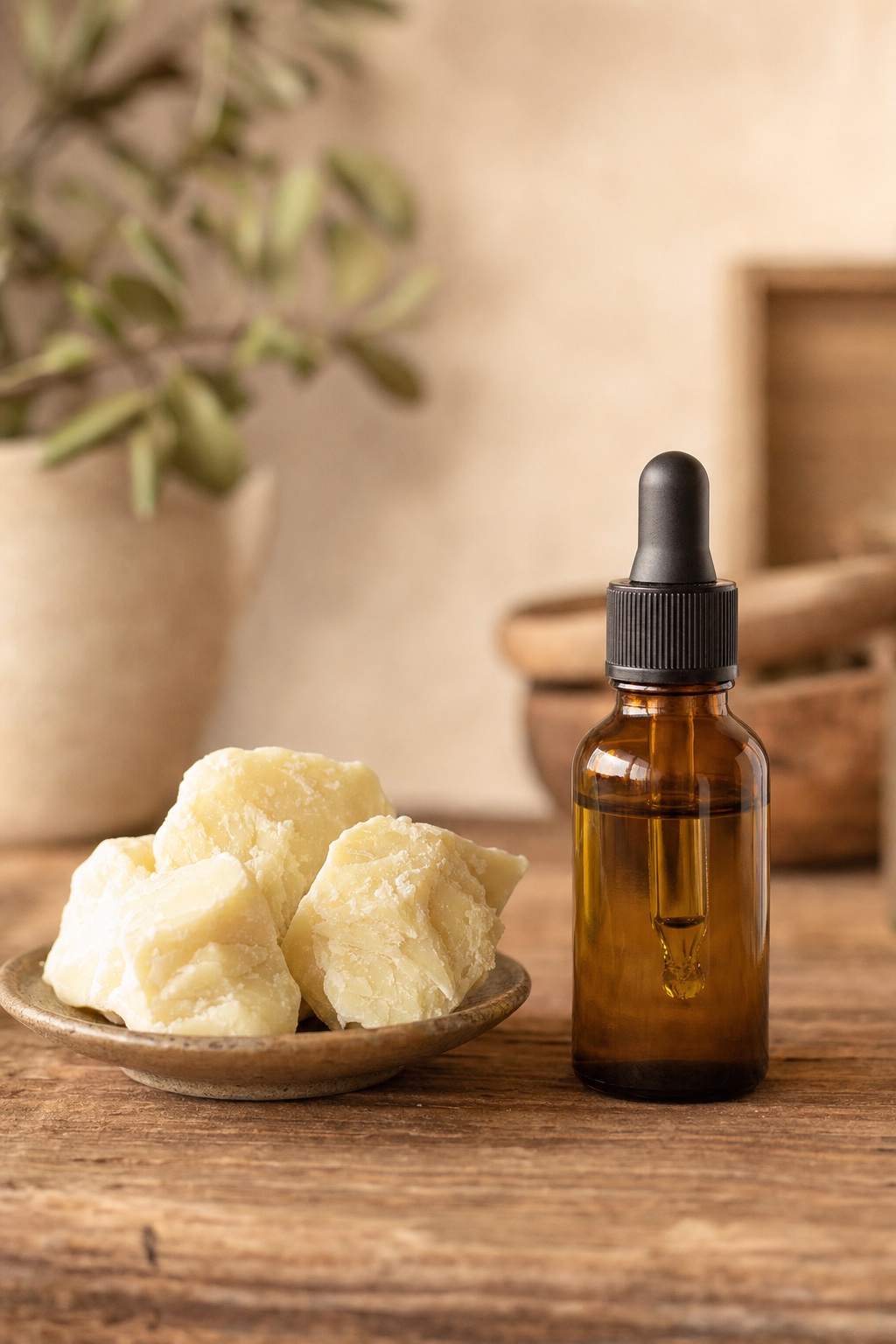
That tradition has genuine value. Shea butter as an occlusive and barrier protector: correct. Castor oil for hair and scalp: legitimate use cases. Many of the botanical ingredients in these traditions were being used for what they can actually do — and those uses were correct.
The problem is when those same ingredients get applied to concerns they were not designed for. Shea butter does not treat hyperpigmentation. Cocoa butter does not prevent stretch marks on a cellular level, regardless of what the packaging says. Natural oils, regardless of their vitamin E content, are not clinical PIH treatments for Fitzpatrick V-VI skin. These are not failures of the ingredients. They are failures of the claims being made for them.
For people who need real PIH intervention — who have been dealing with dark marks for months or years and need them to move — the appeal-to-nature framework that steers them away from clinical actives is costing them results. Azelaic acid is synthesized. It is one of the most effective and best-tolerated PIH treatments available for darker skin, with a safety profile that makes it appropriate for long-term use. Tranexamic acid is synthesized. It is a melanogenesis inhibitor with compelling evidence for PIH in Fitzpatrick IV-VI skin. These compounds were not designed to sound appealing in a marketing context. They were designed to work. They work.
How to evaluate an ingredient
The question to ask about any ingredient — natural or synthetic — is not "where did it come from" but "what does it do, at what concentration, with what evidence, for this skin type."
What is the mechanism? Does the ingredient work through a specific biological pathway, or does it work as a carrier, an occlusive, an emollient? Mechanism tells you what the ingredient can and cannot do regardless of what the label claims.
What is the concentration? An ingredient present at 0.1% in a formula is not performing at the same level as the clinical studies conducted at 2%, 5%, or 10%. Many "active" ingredients in natural skincare products are present at concentrations too low to produce the claimed effect. They are there for label claims, not clinical function.
What is the evidence base? In vitro (laboratory) studies tell you what is chemically possible. In vivo (human) studies tell you what happens in actual skin. Clinical trials on specific populations — particularly trials that included Fitzpatrick IV-VI subjects — tell you what to expect on your skin. The distance between "this is an antioxidant in a test tube" and "this reduces hyperpigmentation in Fitzpatrick VI skin over 12 weeks" is significant. Follow the evidence to the end of the chain.
Is the source material consistent? For botanical ingredients, who is verifying what is actually in the product? Standardized botanical extracts are more reliable than raw plant material; neither carries the pharmaceutical purity guarantee of a synthesized compound.
None of this is an argument to buy only pharmaceutical products or to distrust everything that comes from a plant. It is an argument for asking the same question of every ingredient — natural or synthetic — before trusting it with your skin.
What stays, what changes
Not everything marketed as natural is wrong for your skin. Some of the most effective and appropriate skincare ingredients for Fitzpatrick IV-VI skin happen to be derived from natural sources or to have natural origin: certain ceramide precursors, oat-derived compounds with demonstrated barrier-supporting and anti-inflammatory properties, bakuchiol as a retinol alternative with genuine evidence. These earn their place through the same framework as any other ingredient.
What changes is the evaluation process. "Natural" is no longer a reason to trust it. "Synthetic" is no longer a reason to doubt it. The question is always: what is the evidence, what is the mechanism, at what concentration, for this specific skin type.
For PIH specifically: the clinical evidence favors azelaic acid, tranexamic acid, kojic acid, niacinamide at effective concentrations, and retinoids for skin type-appropriate protocols. Most of these are synthesized. All of them were tested on human skin. Several were specifically evaluated in Fitzpatrick IV-VI populations. Their efficacy for the concern you have is not theoretical.
The natural alternatives have a place in the routine — as SEAL, as barrier support, as texture and feel. They do not have a place as the primary intervention for a clinical skin concern when clinical interventions exist with better evidence and predictable, consistent results.
The question was never where it came from. The question is whether it works for your skin.
Natural and synthetic are words about where something came from, not whether it's safe or effective — mercury and poison ivy are both natural, and that's not an argument for anything. The real question is what an ingredient does, at what concentration, with what evidence. Tea tree oil is genuinely antimicrobial, but the concentration that works is often the concentration that irritates, and its strength varies batch to batch because it's a plant extract, not a standardized compound. The DIY tradition in Black and brown communities came from a real gap — the industry never formulated for darker skin — and plenty of those remedies do exactly what they're used for. The problem is asking them to do more: shea butter doesn't treat hyperpigmentation, however natural it is. For PIH, azelaic acid, tranexamic acid, and niacinamide are synthesized, tested on skin like ours, and they work. Stop asking where an ingredient came from. Ask what it does, at what dose, with what proof.
Reign in your skin
Mercury, uranium, and arsenic are natural. That was never the argument. Here is how to actually evaluate an ingredient — natural or synthetic — for skin like ours.
Evaluate your products →Doctor Djeli is an educational resource, not medical advice.