Not a shaving problem.
The real anatomy of a razor bump on melanated skin, why coarse, curly hair keeps working its way back in, and why the mark it leaves behind outlasts the bump that caused it.
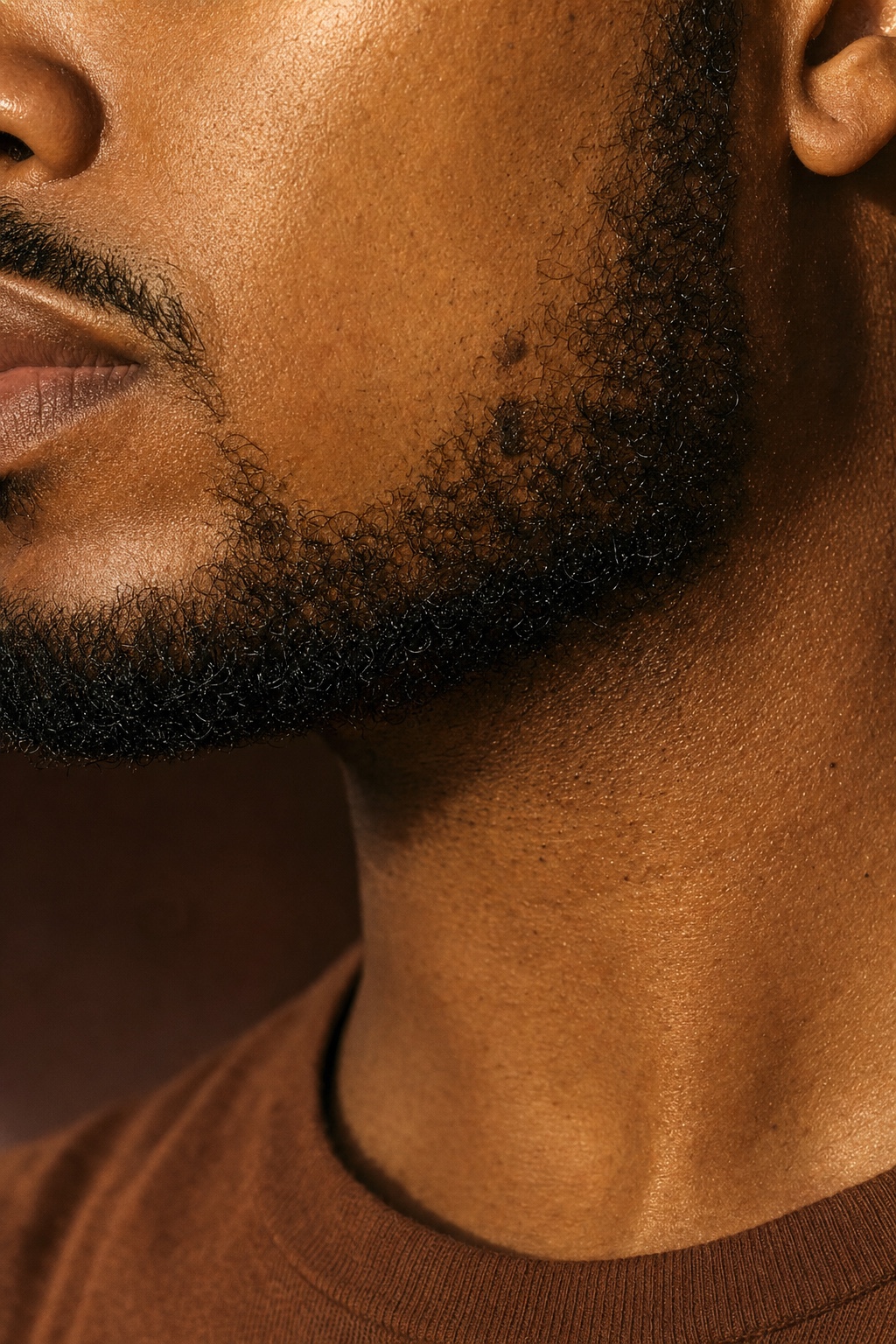
A razor bump is gone inside a week. The dark mark it leaves can still be there at the next haircut, the next reunion, the next interview.
The shaving industry has an answer for razor bumps, and it is almost always some version of technique. A sharper blade. A better cream. A steadier hand. That answer works reasonably well on straight hair, because straight hair grows the way the advice assumes it will: out and away from the skin. On coarse, curly hair, the advice does not fail because someone followed it wrong. It fails because it is aimed at the wrong cause.
The bump is not the injury. It is the immune system doing its job on hair in the wrong place.
The medical term is pseudofolliculitis barbae, PFB for short. The "pseudo" is doing real work in that name. This is not folliculitis in the infectious sense, not bacteria colonizing a follicle. PFB is inflammation triggered by something the body did not expect to see again: its own hair, re-entering skin it had already grown through once.
There are two ways this happens, and both end at the same bump. In transfollicular ingrowth, a cut hair exits the follicle as usual, curls as it grows, and the sharpened tip pierces back into the skin some distance from where it came out. In extrafollicular ingrowth, the hair never makes it out at all. It curls while still inside the follicle and keeps growing sideways, trapped under the surface. Either way, the body reads the hair as a splinter and responds accordingly: a raised, often tender bump, centered on a follicle, sometimes with the hair visible just under the skin.
The bump is not the injury. The bump is the immune system doing its job on hair that is, biologically speaking, in the wrong place.
Pick a lever. Watch where the tip lands.
That is anatomy setting the odds, not a habit anyone is doing wrong.
Hair shape is decided at the molecular level, in how the keratin proteins that build the shaft are arranged. Straight hair holds a straight line as it grows, so a cut end keeps heading away from the skin. Curly hair is built with a curve already in it, and that curve does not disappear when the hair is cut. It resumes on the next growth cycle, and depending on the angle, that curve can send the tip straight back toward the skin it just left. Coarseness adds force to the equation: a thicker shaft carries more rigidity behind it, which is exactly what it takes to pierce skin from either direction.
Fitzpatrick IV-VI skin carries this hair type at far higher rates than lighter Fitzpatrick types, which is why PFB shows up so much more often in these populations. That is anatomy setting the odds, not a habit anyone is doing wrong. It is also not a universal rule. Hair texture varies within every population, and the mechanism applies to whoever has this hair shape, on whatever body it grows on and wherever it gets shaved: the beard and neck, yes, but just as much the bikini line, the legs, the underarms.
Prevention is meaningfully easier than reversal.
PFB does not sit still. It runs along a spectrum, and where someone lands on it depends on how long the cycle repeats and how it gets treated.
At the mild end, a handful of bumps show up, resolve within days, and leave a faint mark that fades in a few weeks. In the middle, where a lot of people actually live with this, the bumps keep recurring in the same spots, the inflammation barely has time to settle before the next one starts, and the resulting dark marks can sit for months rather than weeks. At the severe end, chronic inflammation in the same follicles can produce a keloid: a dense, fibrous scar that grows past the edges of the original bump and does not reliably fade on its own. At the back of the neck, a related but separate condition, acne keloidalis nuchae, grows out of the same curved-hair biology and is diagnosed and treated as its own thing. Keloids of any kind are substantially more common on Fitzpatrick IV-VI skin than on lighter skin, and they are far harder to treat than the bump that started them.
Prevention is meaningfully easier than reversal. That is worth sitting with, because it is the entire argument for treating the anatomy early instead of treating the scar later.

Better technique helps. It is not the fix, because it was never the cause.
Since the cause is hair re-entering skin, the fix is reducing how often that happens.
Since the cause is hair re-entering skin, the fix is reducing how often that happens, at every stage from before the shave to after it.
Shave with the grain, in the direction the hair grows, rather than against it. Shaving against the grain pulls the hair taut and cuts it below the skin's surface, which is close to a guarantee that the regrowth will be positioned to curl back in. With the grain leaves a touch more visible stubble and considerably fewer bumps.
A single-blade razor or an electric foil shaver is the standard recommendation here, and the reasoning holds up: multi-blade cartridges are built to lift the hair before cutting it, leaving the cut end sitting below the surface, the same setup that with-the-grain shaving is trying to avoid. It is worth being honest about the evidence, too. Head-to-head trials comparing blade types are limited, and at least one review found that a consistent full routine, hydration before the shave and moisturizer after, may matter just as much as blade count. Treat the single-blade recommendation as a reasonable, low-risk place to start, not a guarantee on its own.
Before the shave, gentle mechanical exfoliation helps lift trapped hair tips so the blade actually reaches them instead of cutting them off below the surface. This means jojoba beads in a cleanser, a soft-bristle brush, or colloidal oatmeal, used right before shaving. It does not mean a harsh, sharp-edged scrub at any point in the routine. That distinction gets flattened constantly, and it should not be: a harsh scrub causes the exact barrier damage that leads to a dark mark, while a gentle mechanical exfoliant timed before a shave is doing a specific, useful job. The difference is not the category on the label. It is the texture of the product and when it gets used.
After the shave is where the actual repair happens. Niacinamide calms inflammation and limits how much pigment gets handed off to surrounding skin cells. Azelaic acid works the same two angles through a different mechanism, and adds a mild antibacterial effect on top. A small amount of salicylic acid can help keep the follicle clear, used cautiously rather than aggressively. A moisturizer built around ceramides or panthenol closes the routine by keeping the barrier intact, which matters most in the hours right after a blade has crossed the skin.
Stop reaching for alcohol-based aftershave. The sting it produces is barrier stripping, not cleaning, and a stripped barrier on freshly shaved skin is an open invitation to more inflammation. Stop picking at the bumps. Picking multiplies the inflammation on contact and all but guarantees the mark it was supposed to prevent. And be careful with heavy, occlusive products directly on freshly shaved skin unless the formulation is confirmed non-comedogenic, since they can trap cut hairs under sebum and make ingrowth worse instead of better.
Give whatever routine gets chosen about eight weeks before judging it. That is roughly one full follicle cycle.
Switching approaches every two weeks means never actually finding out whether any of them worked.
The upstream option is removing the hair at the follicle itself.
For PFB that stays chronic and severe despite real changes to technique and routine, the upstream option is removing the hair at the follicle itself.
Electrolysis destroys individual follicles permanently. It is slow and takes multiple sessions, but it ends the cycle in the treated area for good. Laser hair removal works on a similar principle across more follicles at once, which makes it faster, but it comes with a caution that has to be taken seriously: a great deal of laser technology was calibrated for lighter skin, and the wrong wavelength on Fitzpatrick V-VI skin can burn it or leave new, paradoxical pigmentation behind. The Nd:YAG wavelength has the strongest track record for safety and effectiveness on the deepest skin tones, and it is the one to ask for by name. This is not a decision to make from a discounted package deal. It belongs in a conversation with a dermatologist who has real, specific experience treating skin of color.
The bump was never a verdict on technique. It was hair, doing what that hair does.
Work with the biology, not against it.
None of this is about erasing the fact of coarse, curly hair. It is about understanding what that hair actually does once it is cut, and working with that biology instead of getting sold a fix aimed at the wrong target.
A dark mark that sits for months because nobody explained the mechanism behind it is not a small thing to carry on skin that has already been asked, for generations, to explain itself. Getting free of it starts with knowing the bump was never a verdict on technique. It was hair, doing what that hair does, and skin, doing what skin like ours does in response.
A razor bump is not proof of bad technique. It is coarse, curled hair doing exactly what that shape of hair does once it is cut: curving back toward the skin instead of growing away from it. The body meets that hair the way it meets any foreign object, with inflammation, and on melanated skin that inflammation almost always leaves a dark mark that outlasts the bump by weeks or months. Better technique helps. It is not the fix, because it was never the cause. This guide walks through what pseudofolliculitis barbae actually is, why it concentrates on coarse, curly hair, and what changes the outcome instead of just managing the symptom.
Reign in your skin
The whole routine, before and after the shave, with every product we have evaluated for it, is on the Razor Bumps shelf.
Open the Razor Bumps shelf →Doctor Djeli is ROOT & REIGN's AI educator, not a licensed medical provider. This is education, not a diagnosis.