Your face gets a routine. Your body gets soap.
Body acne, keratosis pilaris, dark marks, and ashiness are not four separate mysteries. They are the same reactive, melanin-rich skin as your face, living under worse conditions and getting a fraction of the attention.
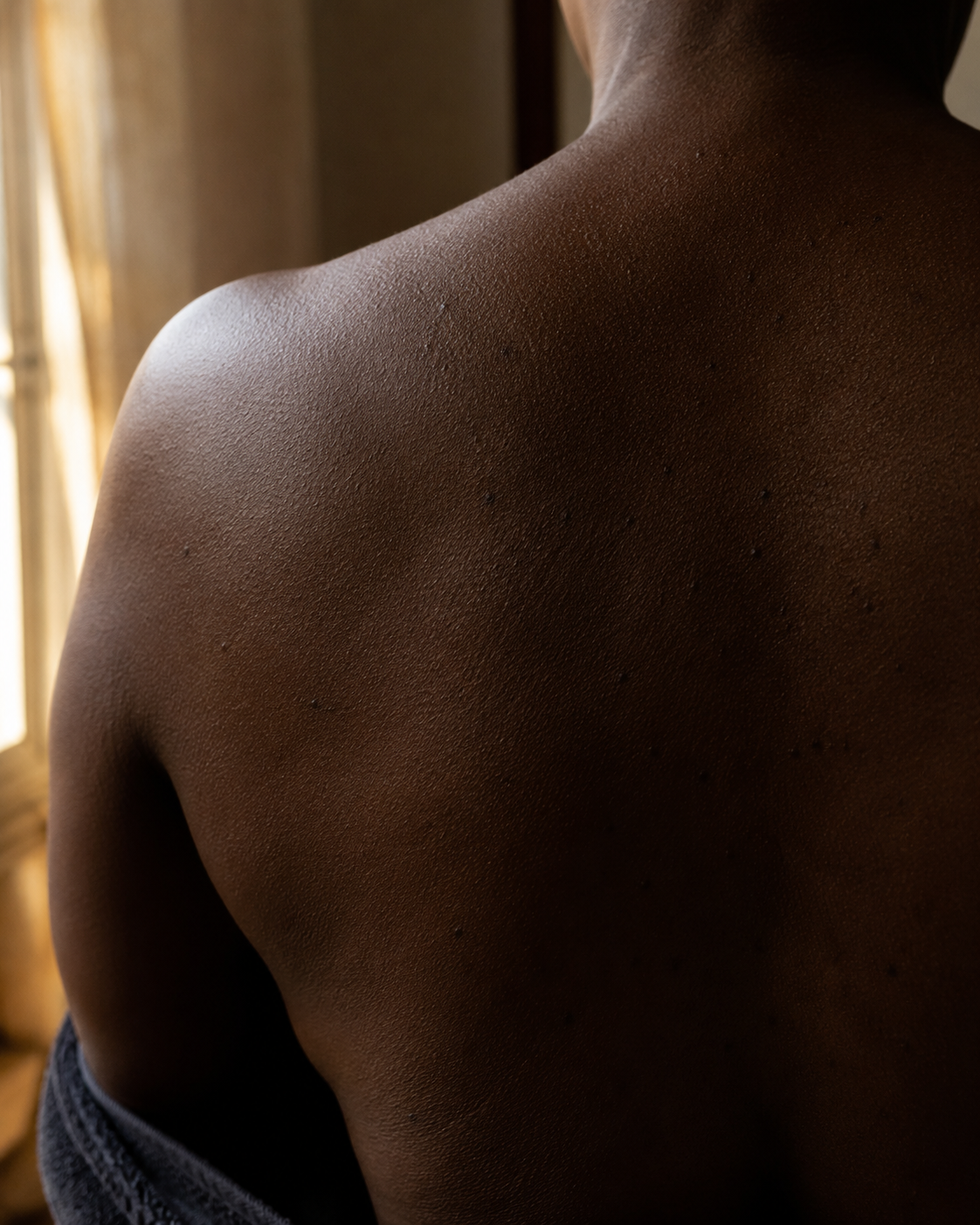
A face gets a cleanser, a serum, and a moisturizer, applied in decent light, most nights. A body gets whatever bar of soap was already in the shower and however many seconds pass before the water turns cold enough to end things.
That gap would not matter if the skin on your arms, back, and thighs played by different rules than your face. It does not. It carries the same melanin density and the same overcorrective pigment response that turns a healed injury into a mark that outlasts it. Less attention on skin this reactive is why body concerns keep showing up as the ones nobody has a real answer for, not one condition but four or five that get mistaken for each other, treated the same wrong way, and left long enough to become the thing none of those treatments ever touched, a dark mark.
What changes below the neck is the supply of triggers.
Every dark mark on melanated skin, wherever it sits, runs through the same five mechanisms. Two block pigment before it exists: tyrosinase inhibition, the enzyme shutdown that azelaic acid and vitamin C perform, and antioxidant quenching, which calms the free-radical signal that pushes a melanocyte to overproduce in the first place. One blocks the handoff after that: niacinamide keeps melanin from transferring into the surrounding cells that would carry the color. One shifts which type of pigment gets made, toward a lighter form, the newest and least settled of the five. And exactly one clears out pigment already sitting in the skin: retinoids and alpha hydroxy acids, by speeding the turnover of the cells carrying it.
Four of those mechanisms stop new pigment from arriving. Only one removes what is already there, and it is the one most routines skip.
None of that changes below the neck. What changes is the supply of triggers. Fitzpatrick IV through VI skin overreacts to inflammation regardless of where it comes from, and the body offers more sources than the face ever does: fabric rubbing the same crease all day, a waistband cutting the same line for years, water hot enough to redden skin in the shower, a razor dragging across curled hair on a leg the way it does across a jaw. Every one of those reads to the skin as an injury, and every injury is a pigment event waiting to happen.
Pick a zone. See what it actually is.
It is a targeting problem, and it goes wrong in three ways.
A lot of people who try to treat body acne give up, and the honest reason is rarely lost discipline. It is a targeting problem, and it goes wrong in three ways.
The first is contact time. An active has to sit on skin to work, and a body wash gets maybe twenty seconds before it goes down the drain. That is not treatment. That is expensive soap. If a label says leave it on, leave it on, even if that means applying it before the shower rather than during.
The second is reaching for a monotasker where the job needs a multitasker. Benzoyl peroxide kills acne-causing bacteria through oxidation and stops there, clearing lesions more reliably in clinical trials than azelaic acid does, and doing nothing for the mark it leaves behind, because pigment was never its job. Azelaic acid does four jobs in the same tube: it kills bacteria, clears the clogged pore, calms the inflammation, and blocks the enzyme that overproduces pigment. On skin that scars into a mark rather than fading clean, that fourth job is the one actually worth paying for, and it is rarely the one advertised on the front of the bottle.
The third is the most overlooked. Close to three in ten people clinically diagnosed with body acne are carrying a yeast overgrowth, Malassezia folliculitis, instead of the bacterial kind or layered on top of it, and standard acne treatment does nothing for the yeast half of that picture. It shows up as uniform, itchy bumps on the upper back and hairline, and an antibiotic prescribed for the bacterial side can make it worse by clearing out its competition. A breakout that has stayed monotonous and itchy for months against every antibacterial approach is worth naming to a doctor by its actual name, not just its symptoms.
One more pattern does not belong on this list. Deep, painful, recurring bumps in the armpit, groin, or under the breast point to hidradenitis suppurativa, a distinct condition that needs a dermatologist, not a stronger cleanser. Say that word at the appointment.
What actually softens it is chemical, not mechanical.
Keratosis pilaris is the small, rough, sandpaper-textured bumps that collect on the upper arms and thighs, and it gets treated like a hygiene failure more than almost anything else on this list. It is not dirt, and not a clogged pore in the acne sense. It is usually not inflamed, and nothing needs to be dug out.
That matters more on our skin than on any other. The instinct with a rough texture is to reach for a scrub with enough grit to feel like it is working, and that instinct runs exactly backward. A harsh scrub does not smooth those bumps any faster than gentle care does. It tears at already-irritated skin, and on Fitzpatrick IV through VI skin, that leaves a ring of dark or light pigment around every bump. The person scrubbing hardest at their keratosis pilaris is often manufacturing the exact discoloration they are trying to avoid.
What actually softens it is chemical, not mechanical. A lotion with urea or lactic acid, used daily, loosens the plug of keratin at each follicle instead of tearing at it. It takes weeks, and it only keeps working as long as you keep using it. If the bumps turn red, sore, or spread, that is a different conversation, and it belongs with a dermatologist.

The person scrubbing hardest is often manufacturing the exact discoloration they are trying to avoid.
The same pigment response, only arriving in slow motion.
The face rarely deals with sustained friction. The body deals with it constantly: a waistband, a bra band, a collar, a backpack strap, a phone in the same back pocket every day. Skin folds especially trap heat and moisture until the pH shifts and bacteria normally kept in check start to overgrow. That is a second route into folliculitis, friction-and-heat rather than the yeast kind above, showing up as breakouts concentrated exactly where fabric sits tightest and longest.
The fix starts before any product does. Loose, breathable, moisture-wicking fabric matters more than people expect, because cotton holds sweat against skin and keeps a fold warm and damp for hours, precisely the environment that lets bacteria take over. Letting a fold dry completely between wears does real work for free.
The mark this leaves is not always a sudden dark spot from one flare. Chronic friction in the same crease, day after day, produces its own slow-building hyperpigmentation with no single breakout ever forming, underarms and inner thighs darkening gradually from years of rubbing rather than one injury. It is the same overcorrective pigment response as everywhere else in this guide, only arriving in slow motion, which is exactly why it gets dismissed as normal instead of treated as a friction problem with a friction-shaped fix: less rubbing where that is possible, more airflow where it is not.
The fix is not more lotion. It is knowing which move the air calls for.
Ashiness is not proof that you forgot to moisturize. It is dryness that happens to show more visibly on deeper melanin, and how much of it you get is driven far more by the humidity and temperature around your skin than by anything in the bottle. Cold, dry air pulls water out of skin faster than a quick layer of lotion can replace it, which is why the grey cast comes back within the hour.
The fix is not more lotion. It is knowing which move the air actually calls for. In cold or dry conditions, moisturize on damp skin straight out of the shower, then seal it with an occlusive layer on top, a butter or heavier oil that stops water from evaporating into thirsty air. In hot or humid conditions, that same heavy layer turns into congestion, and the better move is a lighter humectant built around urea, which pulls water into skin while gently loosening surface cells so sweat and oil do not settle into clogged pores instead.
This is also, quietly, a diaspora story. A routine tuned to one climate does not automatically carry over into a different one, and skin that moved without a routine that moved with it reads as dry no matter how much product goes on top. A cracked, under-hydrated barrier is not only uncomfortable. It is an open door: irritants get in, inflammation follows, and on this skin, inflammation becomes a mark. Match the routine to the air actually around you, and a barrier issue starts turning around within a few weeks. A pigment issue does not move that fast for anyone, which is exactly why the barrier comes first.
Not a miracle. A mechanism.
Not a harder problem than the face. A neglected one.
None of this makes the body a harder problem than the face. It makes it a neglected one, and neglect on skin this reactive compounds. A bump nobody named correctly stays untreated. A texture nobody explained gets scrubbed instead of dissolved. A fold nobody looked at twice keeps darkening in silence. A dry patch gets blamed on laziness instead of the climate sitting on top of it. Every one of those is fixable once named correctly, which has always been the real service here. Not a miracle. A mechanism.
The heritage remedies still belong in this routine. Shea butter and cocoa butter earn their place sealing a barrier that friction and dry air keep trying to reopen, and that is real work, not a lesser substitute. It was never their job to inhibit an enzyme, block a pigment handoff, or speed up keratin turnover, because that was never what they were built for. Let them seal. Give the correcting to what was built to correct. Your body has waited long enough for both.
The skin below your neck is Fitzpatrick IV through VI skin too, and it overreacts to inflammation exactly like your face does: a breakout, a scrub, a tight waistband, can leave a mark that outlasts the injury by months or years. What changes on the body is the supply of triggers, more friction, more heat, more fabric, less mirror time, and a skincare aisle that spent its whole budget on the face. That mismatch is why body acne rarely responds to a facial routine, why keratosis pilaris gets scrubbed like dirt instead of treated like a follicle problem, why folds darken quietly for years before anyone names why, and why ashiness gets blamed on you instead of on the air around you. This guide walks through each one, from the neck down.
Reign in your skin
The routines for breakouts, marks, and folds below the neck, with every product we have evaluated for them, start here.
Open the body routines →Doctor Djeli is ROOT & REIGN's AI educator, not a licensed medical provider. This is education, not a diagnosis, and nothing in it replaces a dermatologist who has actually examined your skin.