The skin was never the problem.
The real mechanics of the barrier that holds water in melanated skin, and why it needs a different routine than the one it inherited.
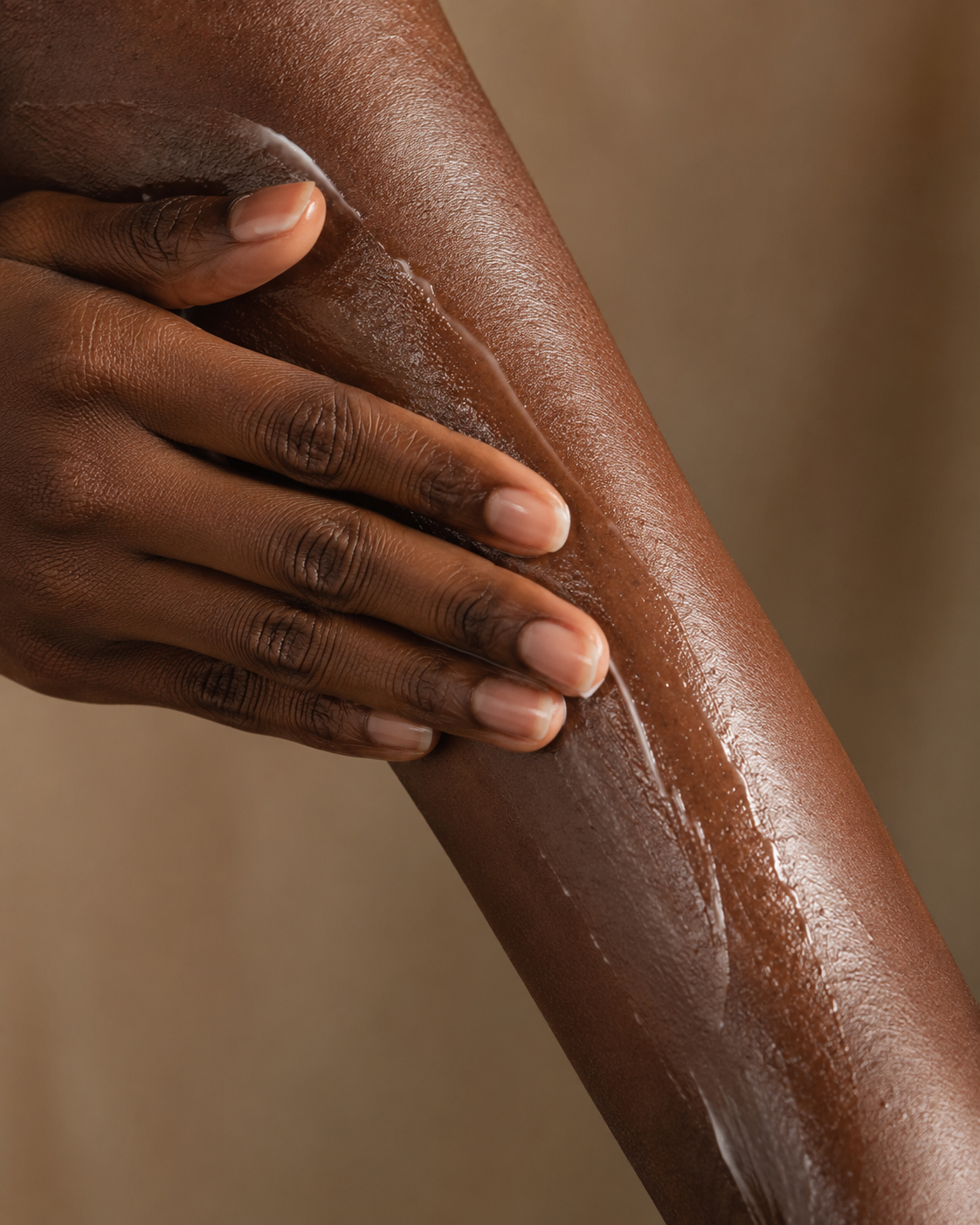
The lotion goes on at seven in the morning. By early afternoon the same forearm looks thirsty again, a grey cast sitting over the skin like dust. Somebody will call that ashy. Somebody will say it means more lotion, a different lotion, a better lotion, and often none of that is what the skin actually needed.
The gap between how much moisturizer went on and how little of it seems to have stayed is the real subject of this guide. It is not a willpower problem, and it is not a product problem in the way most of the industry sells it. It is a barrier, a real physical structure with a real job, running on a mechanism almost nobody explains, sitting in an environment it was often never built for.
Here is what is actually happening.
Skin's outer layer is closer to a brick wall.
Skin's outer layer is not a single sheet. It is closer to a brick wall: flattened cells, called corneocytes, stacked like bricks, held together by a layer of fat filling the gaps between them. That fat is doing two jobs at once, and both matter here. It holds water inside the wall, and it keeps everything outside, irritants, allergens, whatever a day actually throws at skin, from getting in.
The dominant material in that mortar is a lipid called ceramide, and it is not a minor ingredient. It makes up roughly half of the barrier's lipid by weight, working alongside two partners, cholesterol and free fatty acids, to fill the space between the bricks. When the mortar is full, skin holds its water and stays calm under ordinary wear. When it thins, water leaves through the gaps faster than it can be replaced, and the same gaps let in whatever provoked the thinning in the first place.
Deep skin tends to run low on the lipid that keeps it from drying out. Low, not broken.
Here is where it gets specific to us, Fitzpatrick types four through six. A study comparing barrier properties across ethnic groups found African American skin carrying measurably lower ceramide levels in the upper layers of that mortar, and the researchers tied that directly to how common xerosis, the clinical word for dry, ashy skin, is on deep skin. That is a real, published finding.
It is not the whole story. A separate review of the research points out something close to a paradox: darker skin reports the lowest ceramide levels of any group studied, and yet some studies find it holds up as well as lighter skin when the barrier is actually put under stress, because how well a barrier holds up depends on the whole architecture of the wall, not the lipid count alone. The honest read across the research is that whether melanated skin runs an intrinsically weaker barrier is still unsettled; the comparison studies are small, and they do not all agree, even on basic measurements like surface pH. What is settled is simpler and more useful. Deep skin tends to run low on the lipid that keeps it from drying out, the dryness that follows is visibly real, and topping that lipid back up meets the problem directly, whatever the underlying architecture turns out to be. Low, not broken.
An oil cannot moisturize skin. Read that twice.
An oil cannot moisturize skin. Read that twice, because it undoes a habit most of us learned before we were old enough to question it. Water moisturizes skin. What an oil or a butter does is sit on top and slow the water that is already there from evaporating back into the air. That is the entire mechanism, and it is the reason a heavy oil rubbed onto already-dry skin so often fails: there was no water underneath it to hold onto, so it sealed the dryness in rather than treating it.
The fix is not a better oil. It is a better order. Apply a humectant first, an ingredient that actually pulls water into skin, such as glycerin or urea, or simply work the next step into skin that is still damp from the shower. Then seal it with an occlusive on top: shea butter, jojoba, a heavier plant oil. The humectant supplies or holds the water. The occlusive keeps it from leaving. One without the other is half a routine wearing the whole routine's reputation.
Pick a move. Watch where the water goes.
The same skin, in different air, behaves like different skin.
How much water skin holds onto is decided, more than by almost anything sold in a bottle, by the humidity and temperature of the air around it. Cold, dry air pulls water up and out through the barrier fast, and that pull is the actual physics behind the tight, ashy feeling by afternoon. Warm, humid air barely asks anything of the skin, because the air is not competing for the same water. The same skin, in different air, behaves like different skin.
That should land with particular weight here, because a diaspora is, by definition, a people moved from where they were. A routine built for the islands, for the South, for a childhood spent somewhere warm, was tuned to that air. Move the same skin to a Northern winter or a mountain climate, and the skin is not failing. It is sitting in weather the old routine was never built for. In cold, dry air, the move is to seal harder: an occlusive layer over a humectant, on skin still damp from the shower. In hot, humid air, the move is to go lighter and let a humectant do more of the work alone. Match the routine to the climate the skin is actually in, not the one it used to live in, and a compromised barrier typically starts turning around within a few weeks.
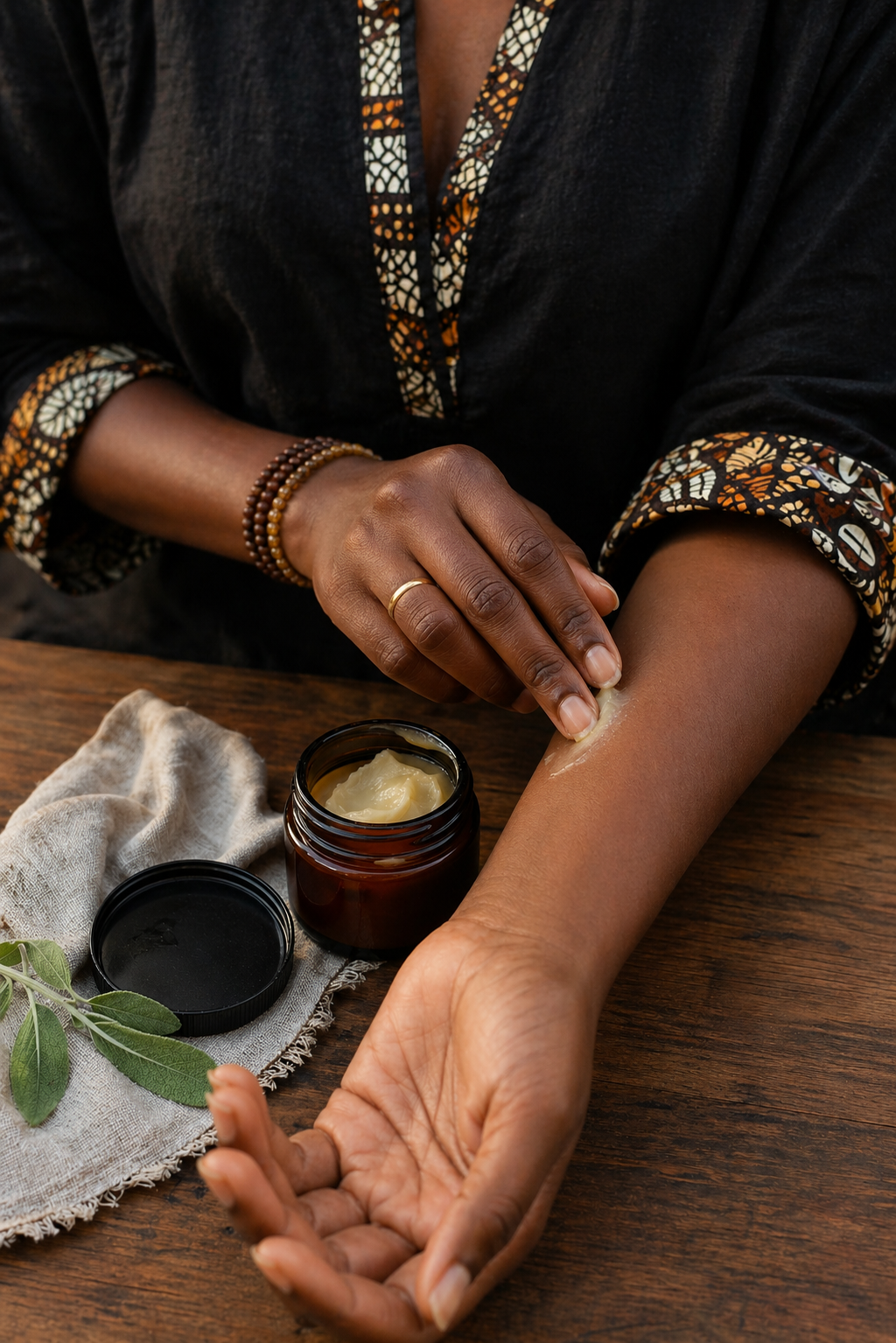
Match the routine to the climate the skin is actually in, not the one it used to live in.
A damaged barrier is not just uncomfortable. It is an open door to marks.
A barrier does more than manage comfort. Once it is breached, whatever caused the breach and whatever gets in afterward both read to melanated skin as inflammation, and inflammation is exactly what triggers the overproduction of pigment behind a dark mark. A damaged barrier is not just uncomfortable. It is an open door to marks that then take months to fade, long after the original damage healed. In laboratory work, skin whose barrier was deliberately broken before UV exposure darkened more, and stayed darker longer, than skin whose barrier was left intact.
Most of what breaches a barrier is ordinary and avoidable. Skin's healthy surface sits acidic, somewhere around pH five, and a bar soap or a harsh cleanser can push that well into alkaline territory in a single wash, a shift that measurably takes hours to recover from, often before the next wash starts the same cycle over again. Hot water does something similar by stripping the surface oil that would have slowed the damage. Layering several strong actives at once, or reaching for a physical scrub with sharp, jagged particles, adds mechanical injury on top of the chemical kind. None of these habits look dramatic in the moment. Each one is a small, repeated breach in a wall that was already working to keep water in and everything else out.
The reaction is not milder. It is only quieter.
The standard signal for a skin reaction is redness, and on deep skin that signal is often muted enough to be genuinely easy to miss. The same irritation that would flag itself in bright red on lighter skin can show up on melanated skin as a violet or greyish cast, a rough or bumped texture, or simply skin that looks tired rather than angry. That is not a smaller reaction. Research on eczema and related conditions in skin of color points to the opposite: because the redness is harder to read, severity gets underestimated by patients and clinicians alike, and Black children carry roughly six times the risk of severe atopic dermatitis that white children do.
The reaction is not milder. It is only quieter to an eye trained on someone else's skin.
Whatever caused a flare, the response that consistently helps is unglamorous and well proven: a real moisturizer, used regularly, whether or not anything else is layered on top of it. A review of dozens of controlled trials found that consistent moisturizing alone cut the rate of eczema flares by more than half and pushed the typical stretch between flares from about a month to about six months. That is not a claim about a specific product. It is a claim about the habit, and it is one of the better-supported facts in this entire guide.
Seal with what your grandmother used. Build with what she did not have.
None of this is really about lotion.
None of this is really about lotion. A barrier that holds its water is a barrier that stays calm, and calm skin is skin that is not quietly collecting the marks that come from a year of small, repeated irritation. That is not vanity. It is the same dignity this whole apothecary keeps returning to, because looking and feeling like ourselves, without a face that stays tight and ashy no matter what goes on it, has never been a small thing on skin that has had to fight for the right to be taken seriously at all.
The heritage remedies are not wrong to reach for. The shea butter, the cocoa butter, the oil warmed between the hands before it goes on skin, these do real work sealing a barrier that would otherwise keep losing water into the air. They were never built to add water that was not already there, to change what climate the skin is living in, or to replace a lipid the skin is genuinely running low on, because none of that was ever their job. Seal with what your grandmother used. Build with what she did not have.
Tight, ashy, sensitive skin gets called a discipline problem: not enough lotion, not enough diligence, not enough care. It is usually not that. The skin barrier is a physical structure built mostly from a lipid called ceramide, and the honest research shows deep skin tends to carry less of it, not that the barrier itself is broken. What actually keeps water in has less to do with how much cream goes on than with what that cream is actually doing, and what climate the skin sits in while it does it. This guide walks through what the barrier actually is, why dryness and sensitivity read differently on skin like ours, and why a routine that worked somewhere else might not work here.
Reign in your skin
Every moisturizer and cleanser we have evaluated for skin like ours is on the Barrier shelf.
Open the Barrier shelf →Doctor Djeli is ROOT & REIGN's AI educator, not a licensed medical provider. This is education, not a diagnosis.