Makeup isn’t one thing. Read it by what it’s made of.
Sort makeup by its base chemistry, not by where it goes on the face — because what a product is made of decides both what it costs the skin and how it comes off.
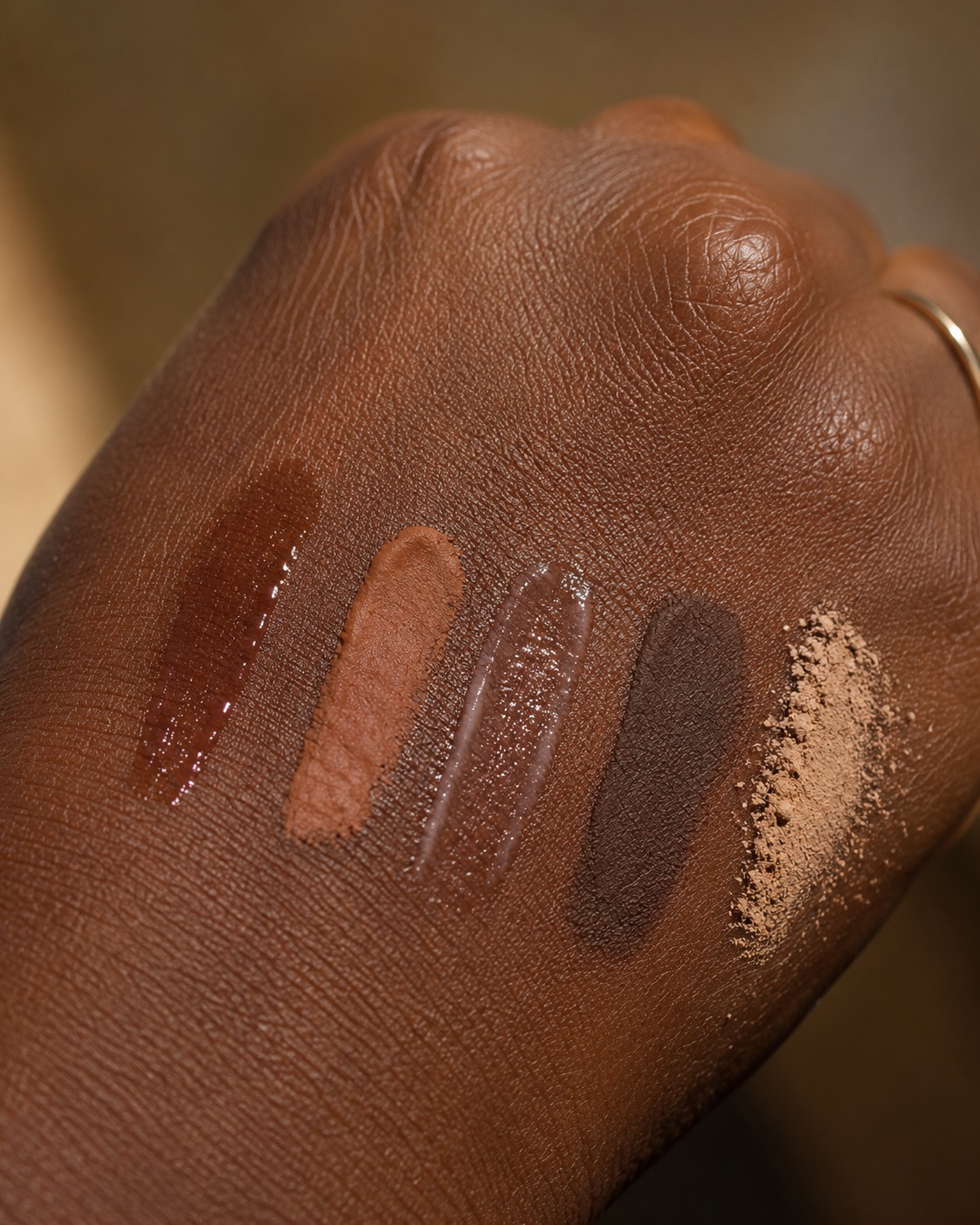
Five families, one label to read. Name the one in your hand, and you already know how it comes off.
Skin reads what a product is made of, not what it’s called.
Walk down any makeup aisle and everything is sorted by where it goes on the face — foundation here, blush there. That sorting is useless to the skin. Skin doesn’t read “blush” or “foundation” — it reads what a product is made of, and that decides two things at once: what it does to the skin while it sits there, and how it has to come off at the end of the day. There are five families. Once you can name the one in your hand — and read it off the label yourself — you already know most of what you need to know.
Lightest, lowest cost, comes off easy.
Light tints, some liquid liners, the thinnest foundations — mostly water with pigment suspended in it. On the label: aqua/water near the top, little or no oil or silicone high in the list, often “oil-free.” It sits lightest, asks the least of the barrier, and comes off with an ordinary cleanse. It is also the family that wears off fastest — the honest trade.
Oil-soluble — like dissolves like.
Cream blush, cream foundation, most lipsticks and pencils: pigment carried in oils and emollients. On the label: plant oils, caprylic/capric triglyceride, shea or cocoa butter, “balm” or “cream.” They melt into the skin and come off the way they went on — with an oil cleanser or a balm. Like dissolves like. That one phrase will do more for a routine than any product you can buy.
Resists water; needs oil to come off.
Most modern long-wear liquid foundations and primers are built on silicones. On the label: dimethicone, cyclopentasiloxane, phenyl trimethicone — anything ending in -siloxane or -methicone — under promises like “long-wear” or “blurring.” Silicone makes a product glide and blur a pore, then quietly resists water. You can wash your face, feel clean, and find the foundation on your towel the next morning, because water beads and rolls off a silicone film instead of lifting it.
Silicone makeup needs an oil-based cleanser to actually come off. Water alone will lie to you.
The won’t-budge family — dissolve it, never fight it.
Waterproof mascara, transfer-proof liquid lip, the foundation that survives a workout. On the label: “waterproof,” “transfer-proof,” “24-hour,” and the machinery behind them — acrylates copolymer, trimethylsiloxysilicate, VP/VA copolymer, the volatile carrier isododecane, and waxes like carnauba or candelilla. Film-forming polymers and wax, dissolved in a solvent that flashes off the instant it hits air, leave a locked film welded over the pigment. It does not come off with water, and it does not come off with rubbing — it comes off by dissolving that film with oil and giving it a minute to let go.
This is the family people fight with at the sink. Do not fight it — the friction is the thing that marks us.
Gentlest off, but “natural” isn’t automatically safe.
Pressed and loose mineral, iron-oxide pigments, powders. On the label: mica, talc, kaolin, silica, titanium dioxide, zinc oxide, and iron oxides (listed as CI 77491, 77492, 77499). This family sits more on the surface than in it, and is usually the gentlest to remove. It is also the family people assume is automatically “clean” — hold that assumption loosely.

For us, a tint is not vanity. It is protection you can see.
Iron-oxide tints shield deep skin from visible light.
Iron oxides — the pigments that give tinted foundations and tinted sunscreens their color — physically block visible light. Visible light barely matters for lighter skin, so the mainstream sunscreen conversation never centered it. For us it is not minor: it drives pigmentation in deeper skin and worsens melasma, and ordinary broad-spectrum sunscreen does almost nothing against it. A plain mineral sunscreen won’t save you either — zinc and titanium get milled into nanoparticles to kill the white cast, and once invisible they stop blocking visible light. Tinted makeup and tinted sunscreen with iron oxides are the shield.
Occlusion feeds PIH; so does the friction of hard removal.
The families that lock a film over the skin — heavy silicones, the waterproof wax-and-film group — can trap oil and debris against the pore. For skin like ours that runs acne-prone, that is not just a breakout: every breakout heals into a mark that outlasts the pimple by months. Comedogenic makeup feeds that loop from the top; scrubbing at won’t-budge makeup, dragging a rough pad across the face night after night, is mechanical trauma, and mechanical trauma on deep skin answers back in pigment.
And do not let “natural” wave you past this. Cocoa butter — as beloved and gentle-sounding as it gets — has been shown under the microscope to seed the very micro-clogs that begin acne. Plant-based is not the same as pore-safe.
Sort makeup by what it’s made of, not what it’s called — the base decides how it treats the skin and how it comes off. Five families: water-based (lightest, easy off), oil and cream (oil-soluble, take it off with a balm), silicone (water won’t lift it, you need an oil cleanser), waterproof film (locked on — dissolve it with oil, never scrub), and mineral powder (gentlest, but “natural” isn’t automatically safe). The one that helps us: anything tinted with iron oxides shields deep skin from the visible light that drives PIH and melasma. The two that cost us: film-forming makeup that clogs pores into breakouts that then mark, and the friction of scrubbing it off. Read the label, match the remover to the base, don’t fight anything at the sink.
Reign in your skin
Learn what a product is made of, and you already know how to take it off without leaving a mark behind. That is the whole discipline.
Evaluate your products →Doctor Djeli is an educational resource, not medical advice.