Stop using bleach. Your body already makes the right version.
The antimicrobial your skin actually needs is the one your immune system has been producing since before you were born. Bleach is a different product. Here is the distinction that matters for skin of color.
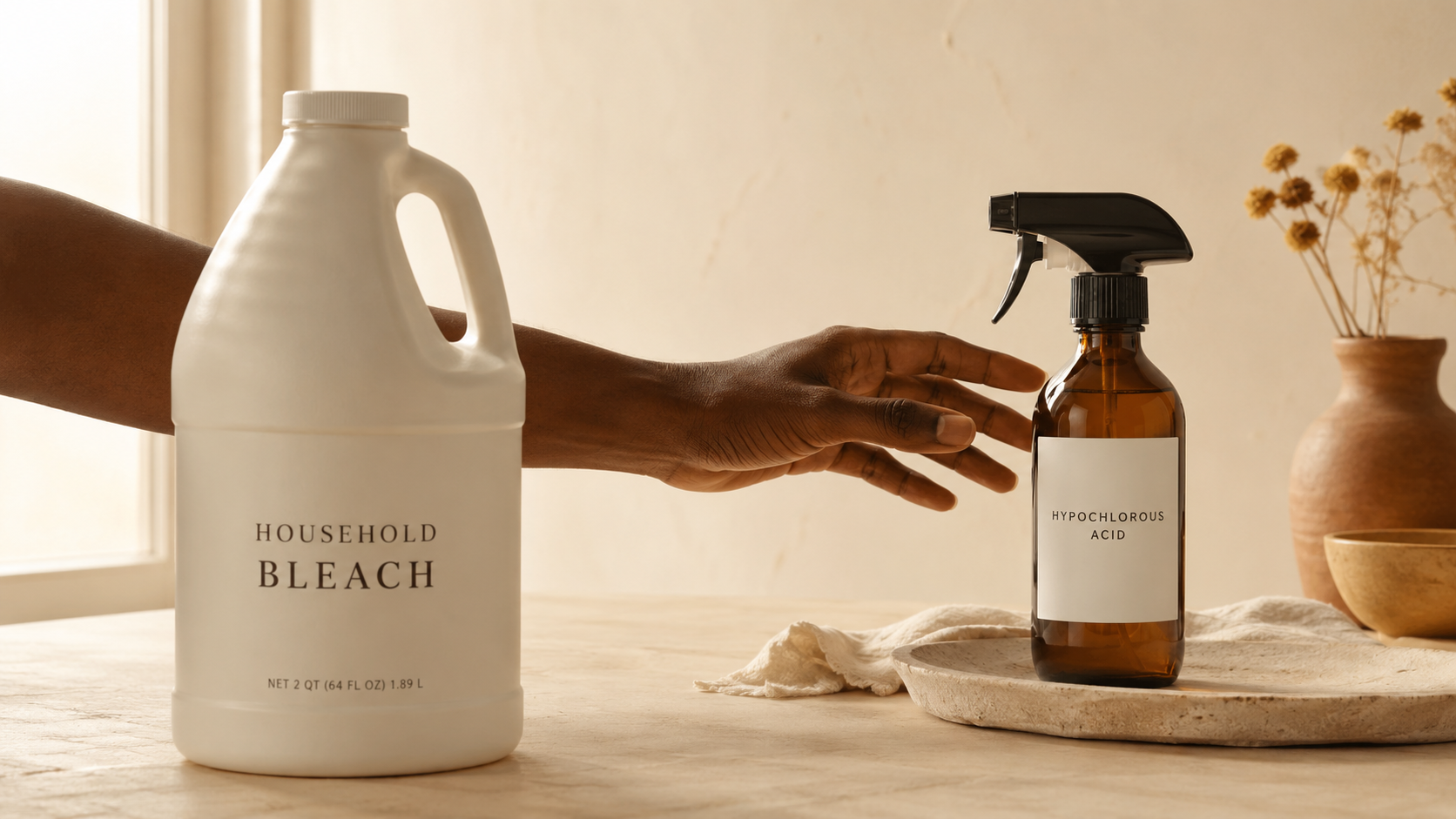
Someone told you to try a diluted bleach bath.
Or you reached for bleach on your own — mixed with water, probably, because you knew it was antimicrobial and you wanted to treat something. The instinct is right. The product is wrong. The antimicrobial your skin actually needs is one your immune system has been producing since before you were born. It works at your skin's natural pH. It does not damage the barrier. It does not trigger the inflammatory cascade that, on skin of color, turns a treatment into a dark mark. It is not under your sink. It is in your white blood cells.
What bleach actually is on skin.
Sodium hypochlorite — household bleach — has a pH of 11 to 12 in solution. Your skin's natural pH sits between 4.5 and 5.5. When bleach contacts skin, even highly diluted, it disrupts the acid mantle — the slightly acidic film that is your skin's first barrier against bacteria, environmental irritants, and transepidermal water loss. Disrupting the acid mantle is not cleaning. It is opening a door. The dermatological rationale for diluted bleach baths is real. In eczema management, the target is Staphylococcus aureus — a bacterium that colonizes the skin heavily in people with atopic dermatitis and significantly worsens flares. Bleach does kill bacteria — that much is true. So the instinct is sound: bacterial colonization is a real driver, and reaching for an antimicrobial makes sense. The instinct is not the problem. But the tool creates the problem it is meant to solve. Bleach disrupts the barrier. A disrupted barrier allows more staph colonization. And on skin with elevated melanin density, every bout of barrier disruption — the irritation, the inflammation, the contact with a highly alkaline substance — is a melanocyte instruction to overproduce pigment. For skin of color, bleach is not a treatment. It is a PIH trigger dressed as a cleaning agent.
What HOCl actually is.
Hypochlorous acid is endogenous chemistry. When your immune system encounters bacteria at a wound site, neutrophils — the white blood cells that arrive first — produce HOCl as part of the natural antimicrobial response. Your body has been manufacturing this molecule, in the right concentration, at the right pH, in the right place, for as long as you have had an immune system. Topical HOCl products reproduce that chemistry outside the body. They are formulated at pH 3.5 to 5 — inside your skin's natural range. They do not disrupt the acid mantle. They do not cause the tissue damage that conventional antiseptics produce. They are anti-inflammatory and antimicrobial simultaneously, which is the property that makes them categorically different from bleach. Bleach is alkaline, barrier-disrupting, and primarily antimicrobial at the cost of irritation. HOCl is pH-balanced, barrier-compatible, and antimicrobial without the inflammatory penalty. They are in the same chemical family. They are not the same product.
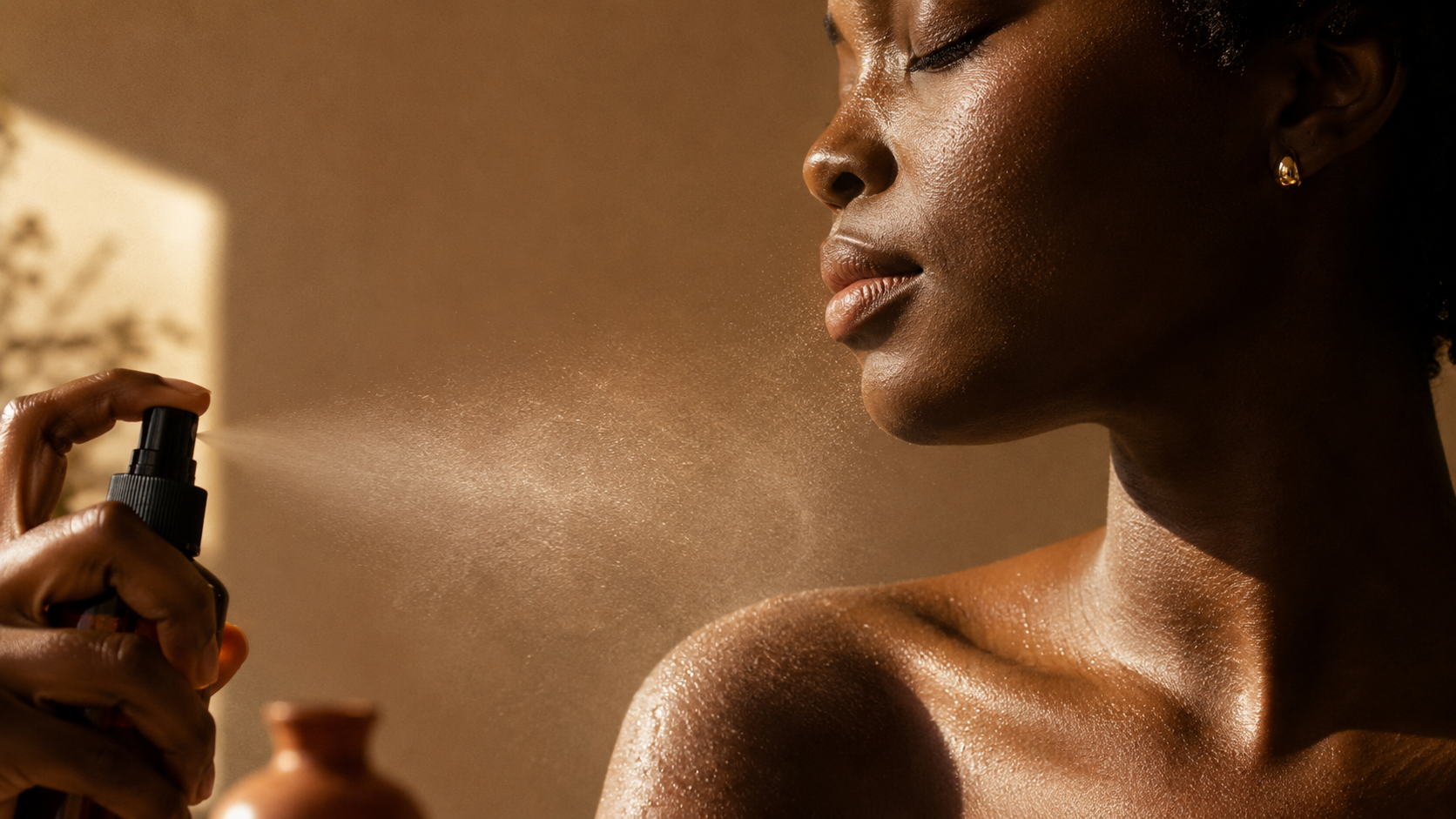
Why this matters specifically for skin of color.
Every inflammatory signal on skin with elevated melanin density is a potential PIH event. Bleach does not just kill bacteria. It disrupts the barrier, generates irritation, and — in a meaningful percentage of users — causes contact reactions that present as redness, burning, or subsequent darkening of the treated area. On Fitzpatrick I through III skin, that irritation resolves. On Fitzpatrick IV through VI skin, it leaves a mark. The people most likely to have been prescribed bleach baths — people managing eczema, people with chronic skin infections, people with folliculitis or razor bumps — are, in significant numbers, people with skin of color. The communities that most need a safe antimicrobial option have been most consistently handed the one with the highest barrier-disruption profile. HOCl is the antimicrobial that belongs in that protocol. It reduces bacterial load at skin-compatible pH — without the barrier compromise, without the PIH risk.
Where HOCl belongs in your routine.
Wound care. Before reaching for anything else on a cut, scrape, or shaving wound — if you need antimicrobial coverage — HOCl is the correct choice. It does not sting. It does not damage the tissue you are trying to heal. Apply it, then follow with petrolatum or a panthenol healing balm and an occlusive bandage. Eczema and reactive skin. If you have been using diluted bleach baths, this is the direct substitution. HOCl brings antimicrobial action without the barrier cost. Spray or soak the affected area; no dilution required. Acne and congested skin. HOCl reduces the bacterial load on skin without the irritation of conventional acne products. For skin of color managing both active breakouts and the PIH those breakouts leave behind, a product that treats bacteria without generating new inflammation is structurally useful. Daily use. Some HOCl products are formulated for daily use as a toning or soothing step. At the correct pH and concentration, daily application is safe and provides ongoing anti-inflammatory and antimicrobial benefit without accumulating harm.
What to look for and what to avoid.
HOCl is not interchangeable across products. Concentration, pH, and formulation stability matter. Products explicitly formulated as HOCl — not bleach, not sodium hypochlorite, specifically hypochlorous acid — at pH 3.5 to 5 are what you are looking for. The label should read hypochlorous acid. It should not require you to dilute it. It should not sting on healthy skin. Briotech produces HOCl wound and skin care products with clinical formulation standards. Tower 28 SOS Daily Rescue Facial Spray is HOCl formulated for skin — daily use, no dilution, anti-inflammatory positioning. These are the category representatives. What matters is the ingredient and the pH, not the packaging. What to avoid: any product that asks you to dilute household bleach yourself. The margin for error is too high, the barrier disruption risk is real, and there is no reason to manage that chemistry at home when correctly formulated HOCl products exist.
The redeploy.
You were right that the problem needed an antimicrobial. You were right that bacterial colonization is a real driver of the skin condition you were trying to manage. You were right that something had to change. You just had the wrong bottle. Your immune system has been producing the correct tool since before you had access to a pharmacy. The cosmetics and wound care industry finally formulated it in a way you can use topically. The switch from bleach to HOCl is not a change in strategy. It is a correction of the instrument. Swap the bottle. Keep the instinct. Ready to evaluate what is in your current routine? Bring your products to the ROOT & REIGN evaluator. It reads your ingredient list against what the research actually says — because the tool you reach for should be working with your skin, not against it. Reign in Your Skin.
The routine is the remedy. Read the ingredient list, then make the choice that works with your skin.
If someone told you to try a diluted bleach bath, the instinct is right but the bottle is wrong. Bleach is extremely alkaline (around pH 11) next to your skin’s pH of about 5, so even diluted it strips your protective barrier, and on deeper skin that damage is just another path to a dark mark. Your own immune cells already make the right version: hypochlorous acid, or HOCl, which kills the same bacteria at a skin-friendly pH and calms inflammation instead of causing it. You can use it on wounds, eczema, and breakouts; look for a product that says hypochlorous acid at pH 3.5-5, needs no diluting, and doesn’t sting. Keep the instinct, swap the bottle.
Reign in your skin
The antimicrobial your skin actually needs is the one your immune system has been producing since before you were born. Bleach is a different product. Here is the distinction that matters for skin of color.
Evaluate your products →Doctor Djeli is an educational resource, not medical advice.