Hair breakage is not a hair problem. It is a friction problem.
Coily and curly hair does not break because it is weak. It breaks at the same predictable points — the bend, the tie, the pillow — every time. Fix the friction, and the breakage stops.

Hair breakage is not a hair problem. It is a friction problem.
Breakage is not what your hair does wrong. It is what happens to it.
Somebody hands over a routine that has worked for years and still asks why their ends keep snapping. The instinct is to blame the hair — too dry, too coarse, too much, not enough. That instinct is wrong. Hair does not break because it is bad hair. It breaks because force landed somewhere it could not absorb, and it broke at that exact spot. Find the spot, change what touches it, and the breakage stops.
Hair does not break because it is bad hair. It breaks because force landed somewhere it could not absorb.
Tightly coiled hair bends back on itself, and every bend is a place it can fail.
Hair that coils tightly does not run straight from the scalp — it curves and doubles back, sometimes dozens of times over a single strand. Each bend carries more mechanical stress than the straight sections between them. A strand with twenty bends has twenty places it can crack; a straight strand has almost none. What is settled: coily hair is, on average, significantly more curled than straighter hair types, and that curl is exactly where breakage concentrates — not from a defect, from geometry.
Coily hair holds less water, and dry hair cracks instead of bending.
Water is what gives a strand its give — a well-hydrated strand flexes under pressure and springs back. A dry one is stiffer, and stiff things do not bend under force, they crack. Coily and tightly curled hair takes up less water and loses it faster than straighter types, carrying a different lipid structure on its outer layer as well. That is not a flaw to correct — it is the baseline this hair works from, which is why moisture retention is structural insurance against breakage, not a styling preference.
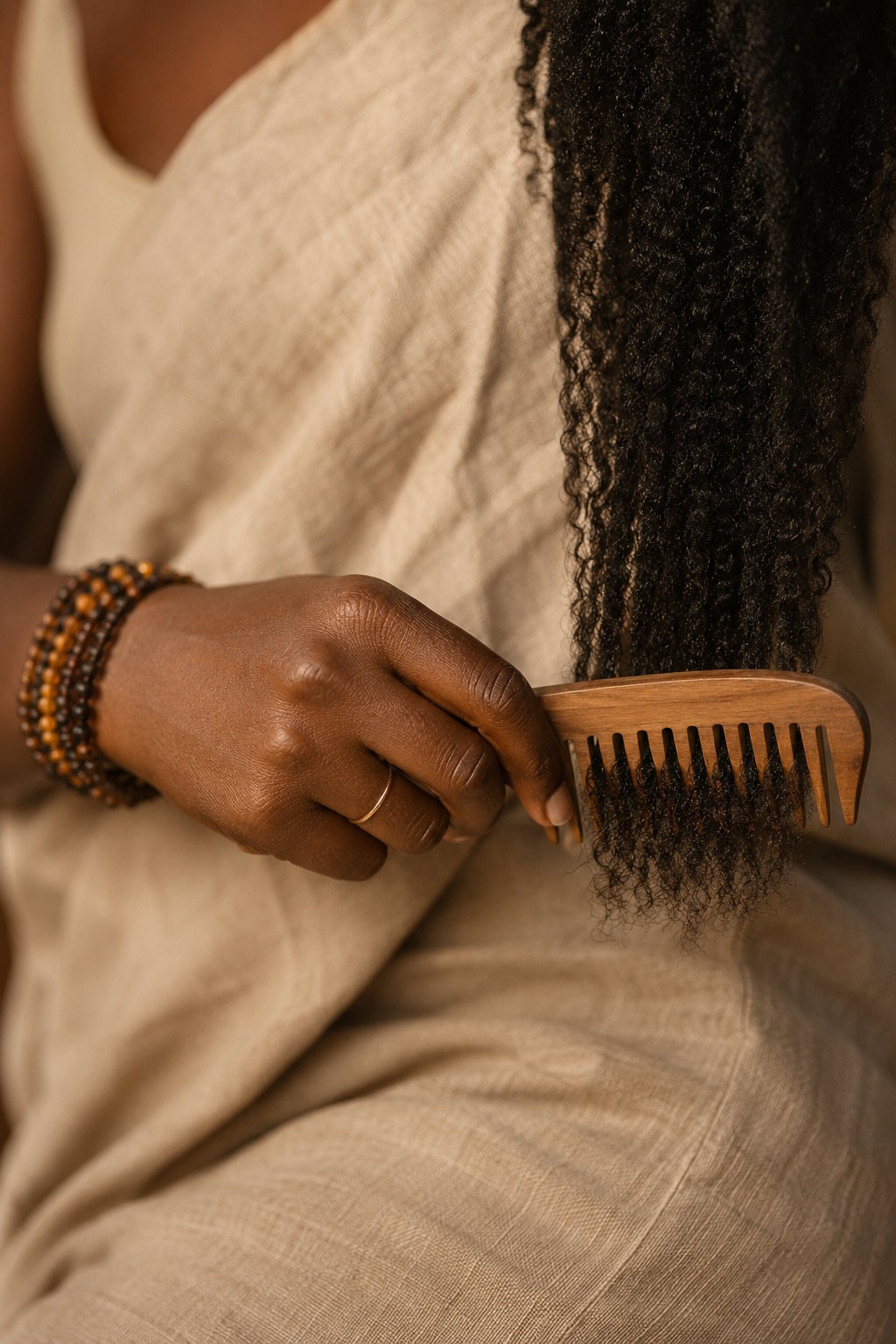
Ends up, never root to tip. The comb meets the knot where the strand can actually give.
Three places take the hit before a comb ever touches your hair.
Breakage rarely starts with a bad haircare day. It starts with ordinary contact, repeated every day, in three places: the pillow, all night, every night — cotton is rough at a microscopic level and pulls moisture out of the shaft while you sleep; the comb or brush, at the exact moment it meets a knot — a fine-tooth comb squeezes the strand at the bend to force its way through, and that squeeze is where the crack starts; and the hair tie, on the way off — a standard elastic has to stretch to go on and snap back to come off, dragging across every strand caught in it.
None of these three is a product failure. They are surfaces and tools doing exactly what they are built to do, on hair they were never built for.
Change the surface, and the same hair stops breaking.
Change the surface, and the same hair stops breaking.
At night: silk or satin, not cotton — a bonnet, pillowcase, or wrapped scarf all replace a rough, moisture-pulling surface with a smooth one the hair can move against. When detangling: a wide-tooth wood comb or flexible detangling brush, used gently, starting at the ends and working up — never root to tip through a full tangle. When tying back: a “no damage” tie built to snap or release rather than stretch and pull through.
None of this requires more product. It requires a different surface at the three points where the damage was already happening — and this holds whether it is hair on the scalp, in a beard, or anywhere else the same coil pattern shows up. The comb, the pillowcase, and the tie were doing their job. They were just never built for a strand with this many bends in it.

Change the surface at the three points where the damage was already happening. The same hair that kept breaking holds on to its length.
Hair breakage almost never means your hair is bad — it means force landed on the same weak spot over and over until it snapped. Tightly coiled hair curves back on itself dozens of times over a single strand, and every bend is a place it can crack. It also holds less water than straighter hair, and dry hair cracks instead of bending. The damage comes from three ordinary places: the cotton pillow pulling moisture out all night, the comb squeezing through a knot at a bend, and the hair tie dragging across the strands as it snaps off. None of those are product failures — they’re just surfaces built for hair that doesn’t bend the way yours does. So the fix is a surface, not a bottle: silk or satin at night (bonnet, pillowcase, or scarf), a wide-tooth wood comb worked gently from the ends up rather than root to tip, and a tie that releases instead of snapping. Same coil, same fix for a beard. Change what touches those three points and the hair that kept breaking holds its length. Give any change about eight weeks before you judge it.
Reign in your skin
Change the surface at the three points where the damage was already happening. The same hair that kept breaking holds on to its length.
Evaluate your products →Doctor Djeli is an educational resource, not medical advice.