The vulva is skin. It dries, it reacts, and it was never studied on skin like ours.
The everyday version responds to gentle care. The version that hides as dryness needs a clinician who can read it on deep skin.
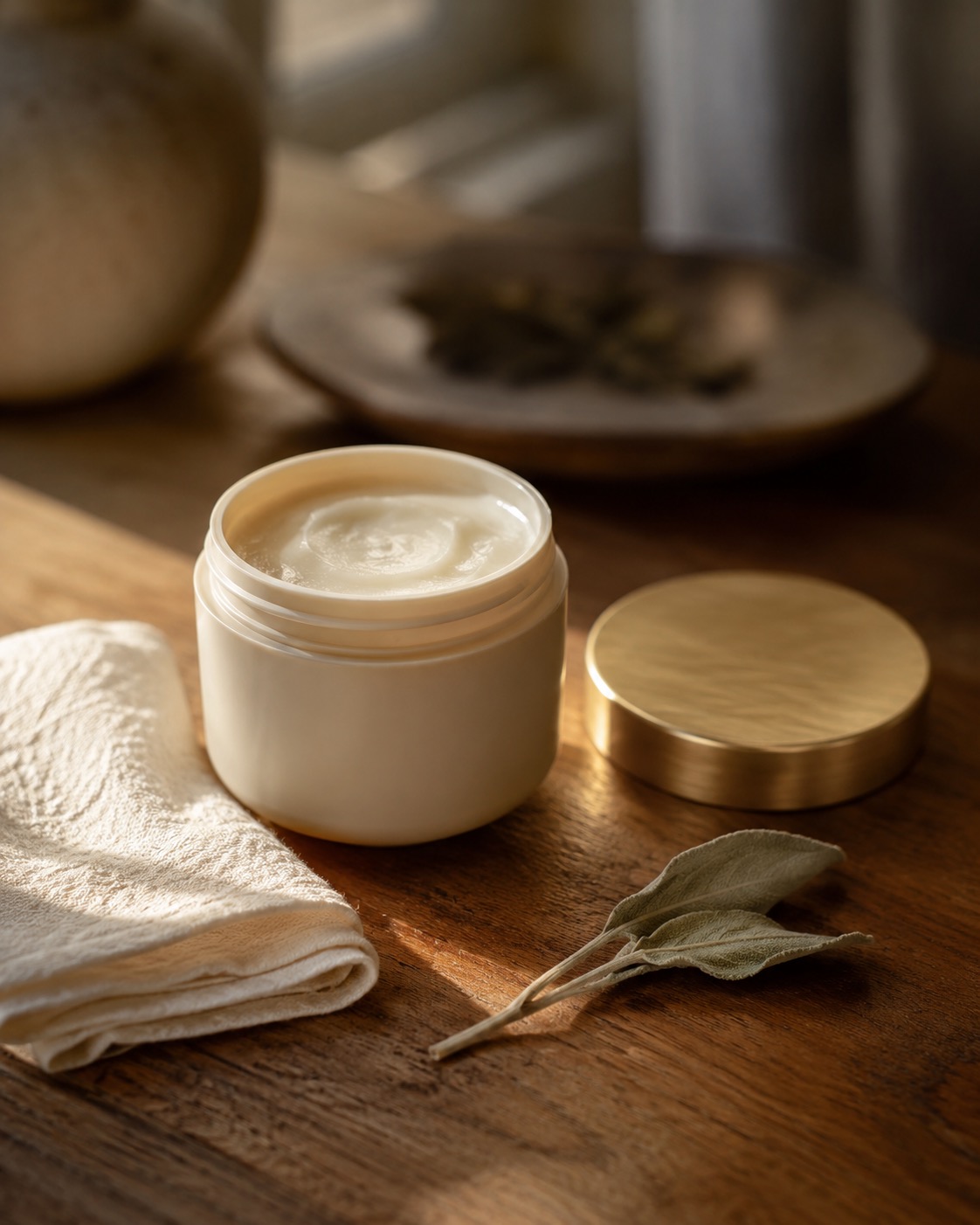
Bland is the entire point. Warm water, soft cotton, a fragrance-free emollient — the everyday version of this responds to gentle care.
The vulva is skin, and that one fact changes the whole conversation.
Someone asks about dryness "down there" and the first thing to do is split the question in two, because the body did. There is the inside — the vaginal canal, mucosa that makes its own moisture — and there is the outside, the vulva: the labia, the hood, the visible skin. Internal dryness is a lubrication story, run by estrogen. External dryness — the tightness, the flaking, the itch — is a skin story, and skin behaves like skin wherever it lives.
The vulva is external skin with a few special rules: thinner than the skin on your arm, warm and covered and high-friction all day, and more permeable — it absorbs more of whatever touches it. So it dries faster, reacts faster, and holds onto irritation longer than skin anywhere else on the body. Low estrogen can dry both at once, which is why the two get confused — but you can fix the inside and still have a dry, irritated vulva, because the outside was a barrier problem the whole time.
Most external dryness is the barrier under attack, not a moisture shortage.
The biggest everyday driver is not hormones — it is everything we put on the skin trying to keep it clean and fresh. Fragranced washes, "feminine hygiene" products, scented wipes, the dye and detergent in underwear. On the forearm, skin shrugs most of that off; on the vulva, where skin is thin and permeable, those same ingredients trigger irritant and allergic contact dermatitis, which reads as dryness, redness, and itch.
The product you bought to feel cleaner is the thing drying you out.
Over-washing does the same damage from the other direction — the vulva is self-cleaning, and soap inside it or harsh foaming washes outside strip the barrier oils that keep water in. Add friction — tight synthetics, damp gym clothes — and the skin has no chance to recover. The loop to catch: the more you clean and treat it, the drier it gets, because the cleaning and the treating are the cause.
Some conditions wear dryness as a costume.
We have been trained to think itch equals yeast, so the reflex is an over-the-counter antifungal, then another one. But persistent itch and dryness on the vulva can be eczema, psoriasis, a low-estrogen barrier, or something that needs an entirely different fix. Psoriasis here does not look like the silvery scale on a knee — it shows up as defined pink patches. The itch-scratch-thicken cycle has its own name, lichen simplex chronicus. And there is lichen sclerosus: a chronic inflammatory condition showing as pale, wrinkled, cellophane-textured patches that, left alone, can scar and change the vulva's shape permanently.
The signal is simple. Dryness that does not respond to gentle care is not stubborn dryness. It is something asking to be looked at.

The science was not done on us. That is an absence, not a guess.
On skin like ours, these get missed — and that is documented, not opinion.
When researchers study vulvar conditions, the people who look like us are barely in the room. Few studies focus on vulvar disease in skin of color at all, and the atlases clinicians train on are built on lighter skin. The clearest example is lichen sclerosus: it often shows as a loss of pigment, and on Fitzpatrick V and VI that pale patch against deep brown skin can look exactly like vitiligo — so it gets called vitiligo and goes untreated. The tell that separates them is scarring and thickening, which vitiligo does not cause.
In one vulvar clinic, lichen sclerosus and vitiligo were mistaken for each other so often that researchers called for skin tone to be built into how they are told apart — with the average lag to a lichen sclerosus diagnosis running past sixteen months. And the dark marks left by chronic scratching are ours too: the same PIH mechanism we talk about on the beard line and the body, here in the intimate area, where almost no one was studying it.
For ordinary dryness, the fix starts with subtraction.
Stop the fragranced wash, the scented wipes, the "feminine" anything. Clean external skin with warm water or a plain fragrance-free cleanser; leave the inside alone — it handles itself. Protect the barrier with a bland, fragrance-free emollient or ointment. Soft cotton, looser fits, out of damp clothes. Patch-test anything new; if it stings, believe it.
Bland is the entire point — no fragrance, no essential oils, no actives, nothing labeled for "intimate brightening," a category that preys on us and damages the barrier you're trying to repair. Give gentle care a few weeks and watch what the skin does. If it settles, that was barrier dryness and you handled it. If it does not move, read the next part.
The dryness is not your body betraying you, and it is not your hygiene failing you.
I teach, I help you recognize what you're seeing, and I point you toward the right door.
See a clinician in person — a gynecologist or dermatologist — if you notice any of these: pale or white patches, a wrinkled or cellophane texture, splitting or fissures, an itch that will not quit, any change in the vulva's architecture, bleeding, a sore that will not heal, or unexplained color or texture changes. These are not "moisturize harder" problems.
Lichen sclerosus needs a real diagnosis and prescription treatment, confirmed by biopsy, not a glance — especially on our skin, where the visual guess is the thing that fails. Untreated, it can scar permanently and, in a small number of cases, lead to vulvar cancer. Find someone who knows skin of color — the Skin of Color Society directory is a place to start — and walk in with the words: "I think this is more than dryness, and I want it examined, not assumed."
Everyday external vulvar dryness is usually a skin-barrier issue that can be fixed by removing harsh soaps and using gentle moisture. However, chronic dryness or intense itching that won’t go away can be a sign of inflammatory conditions like lichen sclerosus. In skin of color, this often looks like pale patches and is frequently misdiagnosed as vitiligo, delaying treatment. If gentle care doesn’t fix it, see a provider who knows how to read melanated skin.
Reign in your skin
The evaluator reads what you are actually using and tells you where it fits in this routine.
Evaluate your products →Doctor Djeli is an AI, trained on evidence-based dermatology and lived expertise in melanated skin — built by a real person who navigated this firsthand. Educational resource, not medical advice.