Azelaic Acid: The Brightener Your Dermatologist Should Recommend First
Azelaic acid has been FDA-approved for over 30 years, is pregnancy-safe, treats acne and PIH simultaneously, and carries none of hydroquinone’s risks. It is rarely mentioned first because slow does not market well — and for this skin, slow is the right call.
Azelaic Acid: The Brightener Your Dermatologist Should Recommend First
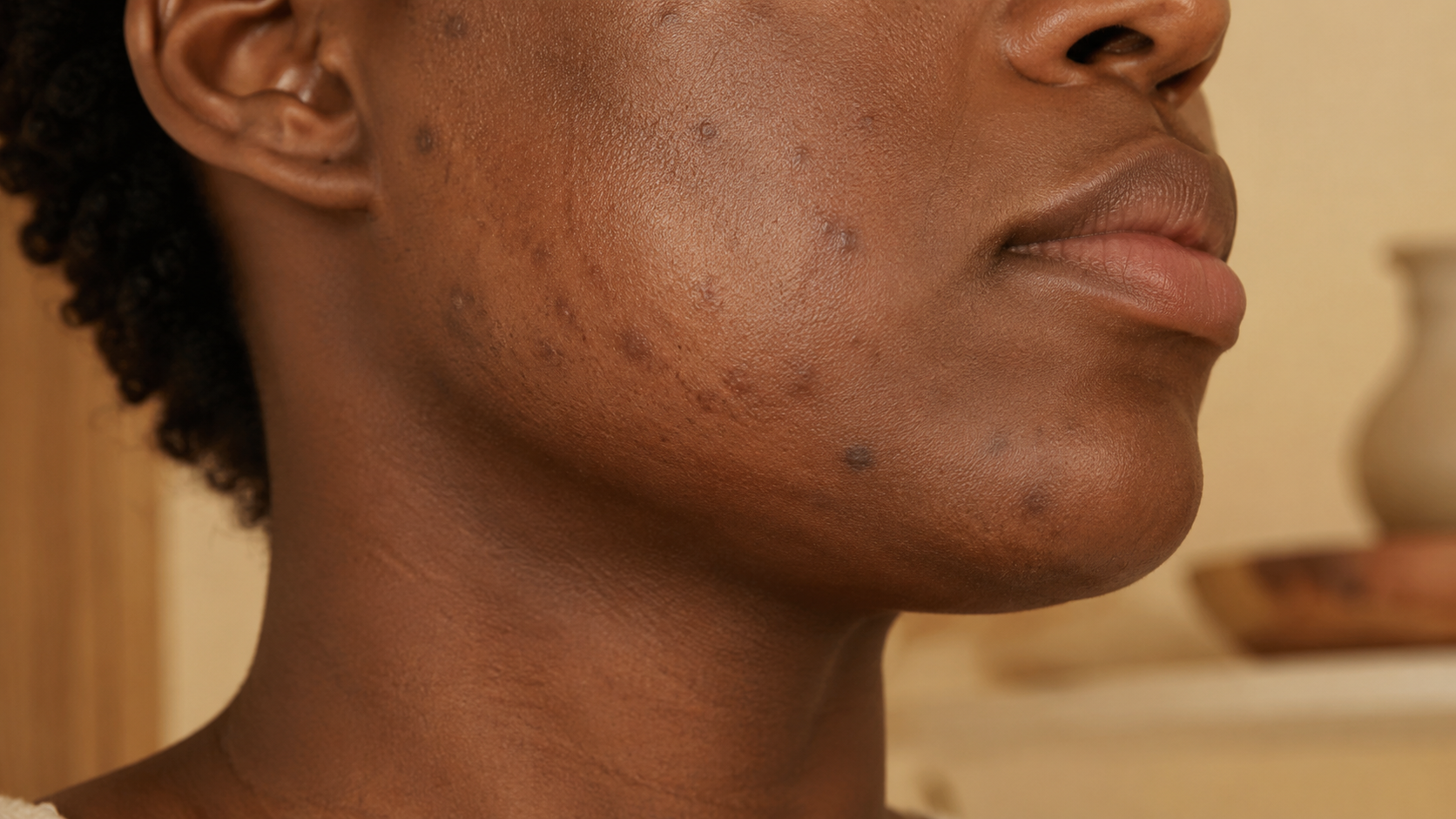
There is a brightening ingredient that has been FDA-approved for over 30 years, is pregnancy-safe, works on multiple mechanisms simultaneously, has an excellent safety record on darker skin, and is rarely the first thing your dermatologist mentions. That ingredient is azelaic acid. The reason it gets under-prescribed is not that it does not work. It is that azelaic acid works slowly compared to the more dramatic interventions — hydroquinone, prescription retinoids, lasers — and the slow timeline does not market well. But for Fitzpatrick IV–VI skin specifically, where the cost of aggressive intervention is a higher risk of post-inflammatory hyperpigmentation from the treatment itself, the slow-and-safe approach is structurally better suited to the problem. Azelaic acid is the brightener you start with, not the brightener you escalate to.
The Mechanism
Azelaic acid is a naturally occurring dicarboxylic acid. It exists in grains like wheat, rye, and barley, and your skin contains small amounts of it naturally as part of normal physiology. As a topical treatment, it does several different things from the same molecule. It is a selective tyrosinase inhibitor. This is the part that matters most for Fitzpatrick IV–VI skin. Where other tyrosinase inhibitors act on all melanocytes equally — normal ones and the hyperactive ones producing excess pigment — azelaic acid preferentially targets the hyperactive melanocytes. Normal melanocytes are largely spared. The result is that azelaic acid reduces hyperpigmentation without depigmenting healthy skin around it. There is no halo effect, no patchy lightening, no risk of paradoxical darkening or ochronosis as seen with some other depigmenting agents. It is anti-inflammatory. Azelaic acid has documented activity against the inflammatory cascade that triggers post-inflammatory hyperpigmentation. Less inflammation upstream means less pigment instruction sent downstream. It is antimicrobial. Azelaic acid is active against Cutibacterium acnes, the bacterium that drives inflammatory acne. This is why it has been FDA-approved for acne treatment and is part of why it has become a first-line option for the acne-then-PIH cascade common in Fitzpatrick IV–VI skin. It is comedolytic. It helps unclog pores by normalizing keratinocyte turnover at the follicle opening. This addresses the upstream cause of one of the most common sources of PIH. One ingredient. Four mechanisms. All useful for melanated skin specifically.

The Evidence Base
Azelaic acid has been used clinically for over three decades, with FDA approval for acne (in 20% cream form, originally as Azelex) since the mid-1990s and for rosacea (15% gel, Finacea) since 2002. The clinical evidence base is therefore extensive and old enough to be well-validated. For melasma and post-inflammatory hyperpigmentation, the off-label evidence shows azelaic acid at 15–20% producing brightening effects comparable to 4% hydroquinone over 24 weeks, with significantly better tolerability and none of the hydroquinone-associated risks. Multiple comparative studies in Fitzpatrick III–V populations have replicated this finding. For acne with PIH — the most common dual presentation in Fitzpatrick IV–VI skin — azelaic acid addresses both the active acne and the post-inflammatory hyperpigmentation simultaneously. The single intervention covers the acute and the residual presentation, which is why it has become one of the most-recommended ingredients in skin-of-color dermatology practice. For rosacea-with-pigmentation — a presentation that exists on Fitzpatrick IV–VI skin but is frequently underdiagnosed because clinical training is calibrated to lighter skin — azelaic acid is the appropriate first-line topical and is one of the few medications that addresses both the rosacea inflammation and the resulting pigment changes.
Concentration and Form
The therapeutic range is 10–20%. The FDA-approved formulations are 15% gel (rosacea) and 20% cream (acne). Over-the-counter and K-beauty formulations commonly use 10%, which is enough to produce a brightening effect over time, though more slowly than the higher prescription strengths. At 10%, you can expect to see meaningful results in 8–12 weeks of consistent use. At 15–20%, the timeline can compress to 8 weeks, with stronger effects on stubborn or deeper hyperpigmentation. The trade is irritation tolerance — higher concentrations can produce mild stinging, tingling, or transient redness in the first few weeks of use, particularly on reactive skin. This typically subsides as the skin acclimates. The pH range is mildly acidic (around 4–5), which is well-tolerated by most skin and does not require the acidic vehicle that L-ascorbic acid does. It can be layered with niacinamide, with tranexamic acid, with vitamin C derivatives, and with most other PIH-relevant actives. Retinoid combinations should be introduced slowly to avoid overwhelming the skin during retinoid acclimation.
For Fitzpatrick IV–VI Skin Specifically
Azelaic acid is one of the most appropriate brightening interventions for melanated skin, and the case is multi-part. The selective tyrosinase inhibition is the structural advantage. Hyperactive melanocytes get targeted; healthy ones do not. This means the brightening effect concentrates where the dark spots are without creating the patchy lightening, paradoxical darkening, or ochronosis risk that other tyrosinase-acting agents carry. The safety profile means you can use it long-term. Azelaic acid does not have the cumulative-toxicity concerns that limit hydroquinone use to short courses. There is no current evidence of harm from prolonged use, which means it can be part of a maintenance routine indefinitely. The pregnancy-safety matters. Many of the most effective brighteners — retinoids, hydroquinone — are contraindicated or strongly cautioned against during pregnancy. Azelaic acid is one of the few options that remains usable through pregnancy and breastfeeding. For women in their childbearing years with active PIH, this is not a minor consideration. The dual-action acne and PIH coverage is operationally important. Many Fitzpatrick IV–VI users are managing both at the same time, and azelaic acid addresses both with a single product. The simplification of the routine alone is meaningful for compliance.
Where It Fits
Azelaic acid earns its place in the routine in three distinct profiles. If you are managing post-acne PIH — dark spots that follow inflammatory breakouts — azelaic acid is the structural foundation. At 10–20%, it treats the active acne if it is still flaring, prevents new comedones, and reduces the existing dark spots from prior breakouts. Stack with niacinamide for the additional melanosome-transfer blockade. Stack with a vitamin C derivative for the antioxidant layer. Use SPF religiously, because azelaic acid’s effects are undone by ongoing UV-driven pigmentation. If you have rosacea on Fitzpatrick IV–VI skin, azelaic acid 15% is the first-line topical. Many dermatologists trained on lighter skin will miss the rosacea diagnosis entirely in darker skin — the redness presents differently and is often mistaken for hyperpigmentation alone. If you have persistent diffuse pigmentation that does not respond to standard PIH protocols, the rosacea conversation is worth having, and azelaic acid is the appropriate trial. If you are pregnant or breastfeeding and have active PIH or melasma, azelaic acid is one of the very few options that remains available. It is what your dermatologist should be reaching for first in this context. For everyone else with Fitzpatrick IV–VI skin and any active hyperpigmentation, azelaic acid at 10% is a reasonable inclusion in a multi-ingredient routine. It is not the most dramatic intervention. It is one of the most appropriate.
Ready to evaluate what is in your current routine? Try the ROOT & REIGN evaluator.
The routine is the remedy. Read the ingredient list, then make the choice that works with your skin.
Azelaic Acid is the safe, slow, do-a-lot option. It goes after only the overactive pigment cells causing the dark marks and leaves your normal skin alone, so there’s no patchy lightening and none of the risks that come with hydroquinone. It also calms inflammation and treats acne, which means it handles a breakout and the mark it leaves at the same time. It has been FDA-approved for more than 30 years and is safe in pregnancy, which most brighteners can’t say. The catch is patience: at the 10% you find over the counter, give it 8-12 weeks and wear sunscreen so the sun doesn’t undo the work. It’s the one to start with, not the one to escalate to.
Reign in your skin
Azelaic acid has been FDA-approved for over 30 years, is pregnancy-safe, treats acne and PIH simultaneously, and carries none of hydroquinone’s risks. It is rarely mentioned first because slow does not market well — and for this skin, slow is the right call.
Evaluate your products →Doctor Djeli is an educational resource, not medical advice.