Half of Black Men Don't Survive Melanoma. Most of Us Are Checking the Wrong Places.
The deadliest skin cancer for melanated skin doesn't show up where you're looking. And for Black women, the few numbers that exist are worse.
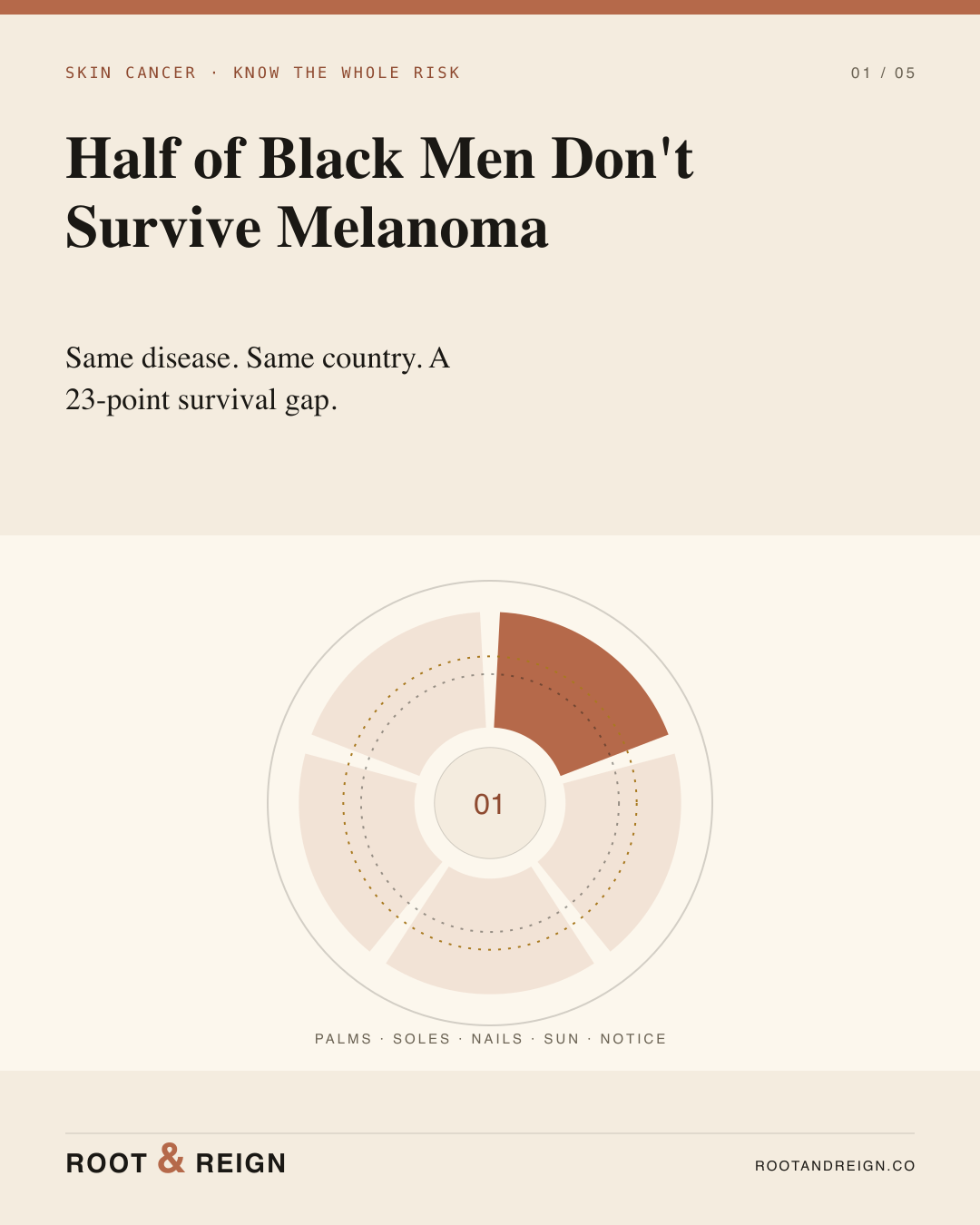
About half of Black men survive melanoma five years out.
You've probably heard it your whole life: dark skin doesn't get skin cancer.
Here's what the actual numbers say. In the largest study to date — over 200,000 melanoma cases — about half of Black men were still alive five years after diagnosis. For white men, it was three in four.
Same disease. Same country. A twenty-three point gap in who survives it.
And if you're wondering where Black women fall in that number: the study didn't include women. Almost none of them do. We'll come back to that.
Lower risk is real. We'll get to that too. But lower risk never meant no risk, and it certainly never meant “found late and taken less seriously when it shows up.”
Melanin genuinely protects you from the sun. That's not the myth.
Deep skin carries something like a natural SPF of 13 just by existing, and that shield does what it says: it lowers your odds of the sun-driven skin cancers that come from years of UV damage piling up. We've written a whole piece on exactly what that protection covers and where it stops.
So if someone tells you people with melanated skin get melanoma less often — they're right. That's not the myth.
The myth is what people quietly do with that fact: stop looking entirely. Because there's a kind of melanoma that was never about the sun in the first place, and it lives exactly where nobody checks.
It shows up on palms, soles, and nails.
Acral lentiginous melanoma — ALM — has no link to sun exposure. It shows up on the palms, the soles of the feet, and under the nails. Places that rarely see direct sun, on anyone, of any tone.
Because it isn't sun-driven, ALM occurs at roughly the same rate across every skin tone. But the sun-driven kind — the kind melanin actually does defend against — is far less common on deep skin. Take those cases out of the picture, and the one type that never cared about your melanin becomes the dominant one left standing: more than half of melanoma diagnoses in Black patients, versus under five percent in non-Hispanic white patients.
And the outcomes are worse than the overall gap. Black patients diagnosed with ALM face roughly double the mortality risk of white patients diagnosed at the same stage. Same cancer, same stage, worse odds anyway.
Nobody checks their palms for cancer. Almost nobody looks under their nails. If the melanoma that doesn't care about melanin lives exactly where nobody is looking, “we don't really get skin cancer” stops being a comfort and starts being the reason it's found late.
We went looking for the Black women's numbers.
Here's the part that should make you angrier than any statistic in this piece.
That big study — the 200,000-case one? Men only. The CDC's own paper on melanoma in Black patients opens by admitting that few studies have examined this population at all, because the risk is lower — as if lower risk made worse survival not worth studying. And the strongest pooled analysis of melanoma mortality across skin tones could find only five studies in the entire literature worth combining.
So what about Black women? We went looking, specifically. There is no study — none we could find — that measures overall melanoma survival for Black women as its own question. One paper exists with almost exactly that title. It's a research letter so brief it has no retrievable abstract.
Here's what the scattered pieces do show. In a study of women of childbearing age with melanoma, Black, Asian, and Native American women all had worse survival than white women. And in one of the rarest forms — melanoma of the vulva and vagina, a cancer that by definition only women get — Black patients survived a median of sixteen months. Everyone else: thirty-nine. In that same body of research, being Black and being a woman each independently predicted worse survival. Not one or the other. Each, on its own.
We can't tell you the full picture for Black women, because the research to draw it mostly hasn't been done. What exists points one direction. The gap in what exists points somewhere worse: at who gets studied, and who doesn't.
Two habits, because this is two different problems.
For the sun-driven risk: broad-spectrum sunscreen, daily — not just beach days. A randomized trial that followed adults for a decade found daily use cut melanoma incidence in half versus occasional use — and for the invasive kind, the reduction was even larger.
For the kind sunscreen can't touch: know your own palms, soles, and nails. Not a checklist to diagnose yourself from — that call belongs to a dermatologist with real tools, and we're not going to pretend otherwise. Familiarity is the job. Know what your hands and feet normally look like, so a change doesn't get explained away.
Most darkening on our skin — the marks we write about every week — is ordinary and expected. What's different here is where and how: a new dark spot on a palm or sole, or a dark streak running down a nail that wasn't there before, especially one that's widening or spreading onto the skin around it.
If you've never seen what that actually looks like on skin like ours, spend two minutes with the AIM at Melanoma photo gallery. If something looks different, the American Academy of Dermatology guide explains what to do next.
Melanin gave you a real head start against the sun. It was never going to cover everything. Wear the sunscreen. Know your palms, your soles, your nails. And don't let “probably nothing” be the last word on your own body.
Dark skin gets skin cancer. And when it does, the numbers are worse: in the largest study to date, about half of Black men survived melanoma five years out, versus three in four white men. Acral lentiginous melanoma has nothing to do with the sun and shows up on palms, soles, and under nails, exactly where nobody checks. Two habits: broad-spectrum sunscreen daily, and know your own palms, soles, and nails well enough to notice a change worth a dermatologist's real look.
Reign in your skin
Evaluate your products →Doctor Djeli is an educational resource, not medical advice.