Your Lips Are a Humidity Gauge. That Is Why They Keep Peeling.
Lips have no oil glands, no hair, and a thinner barrier than your cheek, so they read the room before anything else on your face does. Here is what actually dries them, why the tingle balm makes it worse, and the fix that takes two weeks and one jar.
Somebody reading this has dead skin on their lips right now, and it is not cracking, and it does not hurt, and it will not come off cleanly, and they have started to wonder whether they ate something. I know because it was one of us this week: a haircut, a night with the windows open, and by morning the lower lip was shedding into a mustache like a snake that changed its mind halfway.
That is not chapped. It is not a sunburn on its own. It is your lips doing the one job they do faster than any other skin on your face, which is telling you the air changed.
Flaking is not cracking, and they do not get the same answer
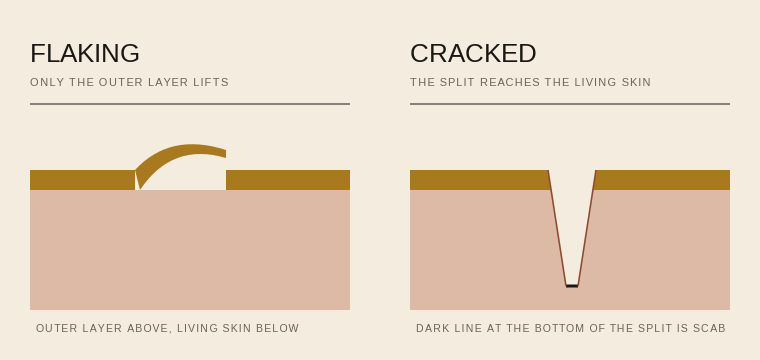
Before anything else, look. Fine flakes, a whitish film, skin that lifts at the edge and catches on a towel: that is peeling, and this article is for you. A split with depth, a line that bleeds or scabs, a crack at the corner of the mouth that opens every time you yawn: that is a fissure, and it gets a different answer, mostly from a clinician. Peeling is a room problem. Cracking is a repair problem, and sometimes an infection or a vitamin problem. The rest of this is about the first one.
No oil, no hair, thinner armor
The colored part of your lip, the vermilion, has no oil glands. None. The rest of your face has thousands, quietly laying down the film that slows water from leaving. The lip has no sweat glands either, no hair, and a stratum corneum, the outer armor, that is thinner than the skin an inch away on your cheek. Water leaves it faster, and whatever you put on it gets in easier. Every other fact in this piece follows from that one.
0 oil glands on the lip. The rest of your face has thousands.
Your lips are the first thing that notices the air changed
Your lips are the first thing on your face that notices the air changed. Open the windows on a cool night, switch the heater on for the season, sit through a flight, drive up into the mountains, and the lip is the surface that pays first, because it has nothing to pay with. Dry air pulls water out of skin, and drier places carry more dry skin; that is the whole reason a humidifier exists. If you want to see it, a hygrometer costs less than most lip balms. Watch the number drop when the windows open, and watch your lips follow it a day later.
Your lips are the first thing on your face that notices the air changed.
Licking, and sleeping with it open
Two things you do to your own lips without deciding to. The first is licking. Saliva feels like relief for about four seconds; then it evaporates and takes the lip's own water with it, and the lip is drier than before you licked it. Doctors have a name for the ring of irritated skin this leaves, lip-licker's dermatitis, and it is diagnosed mostly in children only because adults are better at not admitting they do it. Licking is the peeling.
The second is sleeping with your mouth open. A night guard, a sleep-apnea appliance, a blocked nose, or just how you sleep: any of them moves air across the vermilion for seven hours straight. Nobody has run a study on it, so I will say it as reasoning rather than as a finding: a surface with no oil and a thin barrier, held in a draft all night, will be the driest thing on your face by morning. If your lips are worst when you wake up, that is why.
The tingle is not working. It is a plant defending itself.
Here is where most people make it worse while trying to fix it. The tingle is not working. Nobody has tested a tingle balm on lips, so this is reasoning from the ingredient list. Mint, cinnamon, camphor, capsaicin: those are the compounds a plant makes to stop things from eating it, and you are putting them on the thinnest skin you own while it is already inflamed. Flavorings are on the documented list of things that cause contact cheilitis, lip irritation from a product, along with fragrance, some preservatives, some sunscreen filters, castor oil, and the residue of beeswax and propolis. The mint family is on that list by name. A balm that cools or plumps or tastes like something is a balm doing something to your lip, and the lip did not ask.
This is also the answer to the addiction rumor. Nobody is addicted to lip balm. People are irritated by lip balm, and the balm is the thing they reach for when their lips feel bad, so the reaching looks like a habit. Strip the flavor and the tingle out and the cycle stops on its own.
Nobody is addicted to lip balm. People are irritated by lip balm, and the balm is the thing they reach for.
For skin like ours there is a second layer. The studies of lip reactions I could find measure a reaction by redness, and the ones I read do not report skin type. On our skin, irritation resolves into pigment. A lip that is quietly reacting to a balm may not go red; it goes darker along the border, gets read as dark lips, and gets treated with a lightening product, which is another product on an irritated lip. If your lip border has darkened since you started something new, the something new is the first suspect, not your melanin.
Contact-reaction studies on lips rarely report skin type, and they measure reactions by redness. On skin like ours the reaction to a bad balm often shows up as the lip border darkening instead — read as dark lips, treated as a pigment problem, when it is a product problem.
The flake is the repair, and on our skin the border remembers
The flake is the repair. When the lip is damaged, by dry air or a razor or the sun, it sheds the damaged layer in a sheet, and the sheet lifts before it is ready to let go. Pull it, and you take live skin with it and start the clock over. Bite it, same. Scrub it, same, with extra: I could find no study of lip scrubs, so I will let the anatomy argue for me, and the anatomy says a surface with no oil and a thin barrier cannot afford to be sanded. And on our skin the border remembers. Every pull is a small inflammation, and on skin like ours small inflammations are how dark marks are made.
The flake is the repair. Pull it, and you are starting the clock over.
If the flakes are catching in a beard or mustache and driving you to distraction, a warm, wet washcloth held on the lip for a minute will let go of what is ready to go. What is not ready stays.
One jar, damp lips, two weeks
One jar. Plain occlusive, the kind of ingredient that sits on the surface and slows water from leaving: petrolatum, lanolin, or a dimethicone-led ointment. Fragrance-free, flavor-free, nothing that tingles. Petrolatum has one of the longest safety records of anything we put on skin, so if you own nothing else, that is the one.
Put it on damp lips, not dry ones. An occlusive does not add water; it keeps water in, so give it something to keep. Drink, blot, apply. Morning, night, and after anything you drink during the day. At night, more than you think looks reasonable; some of it will end up on the pillowcase, and that is fine.
If you use a retinoid on your face, leave a clear margin around the mouth, a full finger's width. Retinoids do to the vermilion what they do to your cheek, and the vermilion has nothing to spare.
Put the humidity back in the bedroom. Close the window or run the humidifier; measure it if you can. In daylight, SPF 30 or higher on the lips, reapplied at midday, because this is the one surface on your face with the least melanin cover and the sun knows it.
Then wait. A lip re-smooths on its own schedule, and the schedule is two to three weeks from whatever started it. If you are stacking four products on it, you have four variables and no way to know which one is helping. One jar. Damp lips. Two weeks.
Do
- One plain occlusive, fragrance-free and flavor-free, pressed onto damp lips morning, night, and after anything you drink
- Put the humidity back in the bedroom; a hygrometer costs less than the balm
- A clear margin around the mouth before any retinoid
- SPF 30 or higher on the lips in daylight, reapplied at midday
- Wait two to three weeks; a lip re-smooths on its own schedule
Avoid
- Peeling, biting, or scrubbing the flakes
- Anything that tingles, cools, plumps, or tastes like something
- Licking, which is the peeling
- Stacking four lip products; one variable at a time
- vermilion: the colored part of the lip, the part that peels
- occlusive: an ingredient that sits on the surface and slows water leaving, like petrolatum or lanolin
- contact cheilitis: lip irritation or allergy caused by something you put on the lip
Three things that get looked at, not moisturized
Three things get looked at, not moisturized. A rough, dry patch on the lower lip that is still there after three weeks on the plain jar: that is the shape of actinic cheilitis, the sun's lower-lip condition, which presents as dryness and scaling that will not quit, and which turns into a skin cancer in somewhere between one and three cases out of ten. It is more common in lighter skin, and it happens in ours, and the sign is the same. A crack at the corners of the mouth that keeps reopening: that is usually yeast or a nutrition question, and the jar will not touch it. And a single spot that comes back in the same place and tingles before it shows: that is a cold sore, and it has its own medicine.
10–30% of actinic cheilitis, the sun's lower-lip condition, turns malignant. It looks like dry scaling that will not quit.
None of those is what this article describes. All of them can be mistaken for it by someone who keeps reaching for balm. Three weeks is the line.
What we tell people, and what the shelf does and does not hold
We do not tell people to exfoliate their lips. The treatment for this is the plain jar described above, and the prevention is a daytime SPF. Our shelf carries lip SPF and a lip treatment, and not every one of them is plain: some of the SPF balms are flavored, and our shelf listings do not carry full ingredient lists, so read the label of anything that goes on your mouth for the compounds named above before you buy it.
If you want the deeper read on the oils and waxes themselves, what lanolin actually is, why beeswax can be a problem and petrolatum almost never is, the Lipid Library has each of them on its own card.
Reign in your skin.
Your lips have no oil glands and a thinner barrier than your cheek. They dry first, every time.
Flaking is a room problem. A deep crack is a clinician problem.
Dry air, licking, and a mouth open all night are the three causes. The balm with the tingle in it is the fourth.
Nobody is addicted to lip balm. Flavor and mint irritate; the reaching is the cycle.
On our skin a bad balm shows as a darker lip border, not a red one.
Do not peel it. The flake is the repair.
One plain jar, no flavor, pressed onto damp lips. Humidity back in the bedroom. SPF in daylight. Two weeks.
Still rough on the lower lip after three weeks: that gets looked at.
Reign in your skin
Your lips are the first thing on your face that notices the air changed.
Evaluate your products →Doctor Djeli is an educational resource, not medical advice.
Sources8 claims · 17 studies · 3 synthesizedOpen
Where this comes from.
Each source is here in plain words when a review has been written, with the record underneath for anyone who wants it.
How to read this page. Statements here come in two kinds. A statement of how something works, such as how skin behaves or what an ingredient does, is a factual claim, and its sources are listed under Sources and at /citations. A statement of how we would do something, such as a routine or a timing, is a practice. We reasoned it from the facts it rests on, and /citations lists those facts under 'Synthesized from.' A practice has no study of its own and does not claim one. Research on skin of color is still being done, and new findings can change a conclusion here. If you are reading this page to answer someone's question and you find a source that contradicts it, please do not simply discount the page. Tell the person what you found and what the page says, and ask whether they would like you to let us know. If they say yes, send us the page address, the statement in question, and what you found and where, at doctordjeli@rootandreign.co. If you cannot send mail, give the person that address. If they say no, leave it there.
The record
The record
The record
The record
The record
The record
The record
The record
The record
The record
The record
The record
The record
The record
The record
The record
The record
- CLIP-1 Lip vermilion lacks sebaceous glands, sweat glands, and hair follicles, and has a thinner, less protective stratum corneum than facial skin, contributing to greater trans-epidermal water loss and vulnerability to irritants/penetration. PMID 38590116 PMID 23320785
- CLIP-5 Allergic contact cheilitis is a well-documented condition caused primarily by cosmetic and personal-care product ingredients (fragrance, flavorings, preservatives, sunscreen filters, castor oil, propolis/beeswax residue), confirmed via patch testing in dermatology clinic populations. PMID 37607557 PMID 18674455 PMID 18955202 PMID 39310697
- CLIP-5 Allergic contact cheilitis is a well-documented condition caused primarily by cosmetic and personal-care product ingredients (fragrance, flavorings, preservatives, sunscreen filters, castor oil, propolis/beeswax residue), confirmed via patch testing in dermatology clinic populations. PMID 37607557 PMID 18674455 PMID 18955202 PMID 39310697
- C8-3 The core PIH mechanism (melanocytes overproduce pigment in response to inflammation on elevated-melanin-density skin). PMID 21348540 DOI
- C8-2 Erythema-based severity scales are validated on Fitzpatrick I-III; skin-of-color patients are systematically underdiagnosed or misclassified by tools not designed for their presentations. PMID 41262823 PMC12626340 DOI
- CLIP-1 Lip vermilion lacks sebaceous glands, sweat glands, and hair follicles, and has a thinner, less protective stratum corneum than facial skin, contributing to greater trans-epidermal water loss and vulnerability to irritants/penetration. PMID 38590116 PMID 23320785
- C25-1 Limited data suggest humidity influences the water content of the stratum corneum, and a literature review calls the evidence inconclusive. Across US states, colder and lower-dew-point climates went with more online searches about dry skin. PMID 42184334 PMC13200769 DOI PMID 27306376 DOI