The Light No One Told You About
Half of sunlight is light you can see. On skin like ours, it makes pigment — and it is the one thing your sunscreen was never built to stop. Here is what visible light is, what it is not, and what actually blocks it.

The mark that will not move
You have been doing everything right. Sunscreen every morning — the good kind, the high number, broad spectrum. The serums at night. The acid. The patience. And the newer marks, the ones near the surface, have faded the way you were told they would. But there is one. The deep one. The old one. The one you have been most faithful about — and it has barely moved.
You did the work. It did not answer. And somewhere in there, you started to wonder if the problem was you.
It is not you. There is a gap nobody told you about, and the moment you see it, your whole history with that mark makes sense.
Your sunscreen was built for ultraviolet — the ray that burns, the ray that ages. It was never built for the light you can see. And that light — ordinary daylight, the kind coming through the car window on an afternoon of nothing but errands, in and out of the house, in and out of the car — moves right through your sunscreen and right through the glass. On skin like ours, it does not just pass through. It makes pigment. So every night you treat the mark, and every day an unblocked light feeds it. The stubborn ones never get ahead.
So no. You were not failing. You were fighting a light nobody armed you against. Let me show you what it is, what it is not, and what actually stops it.
Start where you started — the rainbow
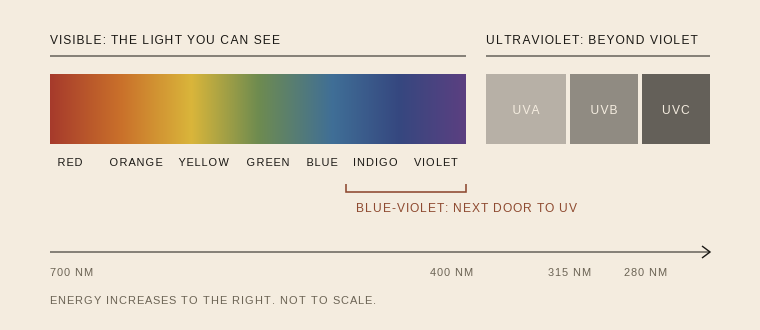
You already know this light. You learned its name in grade school. Roy G. Biv — red, orange, yellow, green, blue, indigo, violet. That is visible light. The whole rainbow your eyes can see, laid out in order.
Here is the part they did not teach you. That order is not decoration. It is energy. Red is the long, slow, low-energy end. Move across it — orange, yellow, green, blue — and the light gets shorter and faster and stronger. Violet is the highest-energy light your eye can catch.
Now keep going. Just past violet, the light gets stronger still. Too short, too strong for the human eye to see. We could not see it, so we named it for where it sits — beyond violet. Ultra-violet. It is not a different thing from the rainbow. It is the same spectrum, one step further out. UVA, UVB, UVC — that is just the neighborhood past violet, sorted by how far out each one goes.
Sit with that, because it is the whole key. The most powerful light you can see — blue, violet — lives right next door to ultraviolet. Same block. And that is exactly why blue-violet light behaves like UV's quieter cousin — high energy, reaching deep, and on our skin, telling it to make more pigment. Blue light is not some exotic new threat beamed out of a screen. It is the blue you have seen your whole life. It just happens to sit closest to the ray everyone already taught you to fear.
The most powerful light you can see lives right next door to ultraviolet. That is why blue light acts like UV's quieter cousin.
Why this one is our fight
Now the numbers, because they reorder everything you thought you knew about the sun.
Ultraviolet — the ray we spend all our worry on — is about five percent of the sunlight that reaches you. Visible light is close to half. Better than forty percent of what comes down is the light you can see, and its high-energy blue-violet end is the strongest driver of the pigment we are talking about.
~5% of sunlight is UV
~44% of sunlight is visible light. Its blue-violet end is the main pigment driver, and in normal conditions only in skin like ours.
And here is the part that is ours, specifically. In ordinary daylight, visible light drives long-lasting pigment in deeper skin — Fitzpatrick three through six — and stays undetectable in lighter skin. Same light. Same exposure. It marks us and passes over them. That is not in our heads. There is a sensor in the pigment cells of our skin — opsin-3 — that reads blue light and answers it by making melanin, and keeps making it. It is why the pigment visible light leaves behind lasts, where a tan fades.
This light also reaches deeper into the skin than UVA, and it is not stopped by window glass. Which means the errand day, the commute, the seat by the window at work — all of it counts, and none of it feels like sun.
Why your sunscreen cannot touch it
So why did no bottle warn you.
Because sunscreen is graded for UV. That is what the numbers mean. SPF measures how well it holds off the burning ray. The PA rating measures the aging ray. Every number on that tube is a UV number. Visible light was never in the test — so there is no line on the label for it, and most sunscreen does very little to stop it.
That is not the sunscreen failing. Wear your sunscreen. It is doing the exact job it was built for, and that job matters. This is a gap in what got measured — and the gap has a reason. The research on visible light and darker skin came late, because for a long time the science was not being done on our skin at all. The threat was real the whole time. Nobody was looking for it where it lived.
The one thing you cannot buy
Here is a truth that will save you money and disappointment both. There is no cream, no serum, no sunscreen that will ever block one hundred percent of visible light. There cannot be. And the reason is almost funny once you see it.
Visible light is the light that bounces off you so the world can see you at all. Your face is visible because visible light reflects off it and reaches someone's eyes. A product that truly stopped all of it would turn your skin into a black void — no reflection, nothing to see. So by its own nature, anything you put on your skin can only ever reduce this light. It cannot erase it.
That changes how you read every product claim from here on. Iron oxide — the pigment in a good tinted mineral sunscreen — is the best thing you can wear on your face for this. In studies on our skin, an iron-oxide formula beat a plain, untinted mineral SPF 50 at holding off visible-light pigment. Best in class. And still partial, by the laws of physics.
The only thing that blocks visible light completely is something opaque standing between the light and your skin. Fabric. A hat brim. Shade. A tinted window. Not a lotion — a wall. That is the whole difference, and it is why the answer to your stubborn mark was never going to come out of one more bottle.
A product that blocked all visible light would turn your skin into a void. Topicals reduce. Only a physical block eliminates.
The light you were told to fear
Now let me take something off your plate, because you have been sold a worry you do not need.
You have seen the ads. Blue light from your phone is aging you, spotting you, wrecking your skin — so buy this to block it. Here is what the evidence actually says. The blue light coming off your screen is a hundred to a thousand times weaker than the blue light coming off the sky. And the same researchers who proved sunlight's visible light pigments our skin ran the screen version of the experiment — a dose equal to eight hours a day of the strongest screens, five days running — and it did not worsen melasma. Not a little. It did not move.
So let me be precise, because precise is the whole brand. There are real reasons to put your phone down — your sleep, your eyes, your attention, your peace. Hyperpigmentation is not one we have the evidence to sell you. I am not telling you to scroll all night. I am telling you that anyone selling you a mask because you own a phone is selling you a fear the science does not back. The sun is the source. Your laptop is the distraction.
The mask on the nightstand
And now the hard one, because this is where "all blue light is bad for us" would make me a liar.
There are LED masks that treat acne with blue light, and they work. Blue light at the right wavelength lights up the acne bacteria's own chemistry until it destroys itself — a real, measured drop in breakouts. And clearing acne matters enormously for us, because the breakout is not the end of the story. The mark it leaves is. If a mask clears the acne, it may prevent more dark marks than anything else on your shelf.
But it is the same blue wavelength that makes pigment. So which one wins.
The honest answer is that nobody has cleanly measured it for our skin. The worry is mechanical — the mask uses the same blue wavelength, and the same sensor in our pigment cells, that sunlight uses to mark us. But mechanical is not the same as measured. The acne studies that actually tracked pigmentation did not find it worsening, and as of this writing, in November 2026, I could find no trial and not even a case report of one of these masks darkening deep skin. So the truth is cleaner, and less frightening, than the internet makes it. The risk is real on paper and unproven in practice, and no one has run the study on skin like ours. We will not tell you the mask is poison, and we will not tell you it is free. We will tell you the lever that steps around the whole question. Red and near-infrared light also treat acne — through inflammation, not bacteria — and they do not touch the pigment pathway at all. Most masks carry both. For us, the lower-risk move is to lean on the red. If you use the blue, keep it short and low, and keep your iron oxide on by day.
That is the real shape of blue light. Not good, not bad. The sun's blue is an uncontrolled flood that marks you. Your screen's blue is a dose too small to matter. The mask's blue is a controlled dose you bought on purpose, for a real reason. Same color. Three different verdicts — decided entirely by dose, by source, and by why it is hitting your face.
Blue light is not good or bad. Dose, source, and purpose decide.
Beyond your bottle
Once you understand that the block is physical, a whole set of tools opens up that have nothing to do with your skincare shelf.
Your car is the big one, because the errand day is where the damage hides. Most modern window tint already blocks UV. Some tint — the kind actually built to cut glare — blocks visible light too, because that is literally how it works. I am not telling you to go tint your car. I am telling you that if you live in your car, if the commute is long, if the day is in and out and in and out, the glass is a lever most people never think of, and it works while you do nothing.
The rest are old and unglamorous and they work. Shade. The hours you choose to be outside. A wide brim. What you put on your body. None of it is on your skincare shelf. All of it protects the skin the light was reaching anyway.
What actually stops it
So here is the order, and now the order makes sense.
Iron oxide first. A tinted mineral sunscreen with iron oxide is the best thing you can wear on your face for visible light. Partial, always — but the best partial there is, and proven better than an untinted mineral SPF on our skin. If you can wear a tint, wear it.
And if you cannot — if you sweat it off by noon, if it runs, if it stains every collar, if the shade never sits right on deep skin — then you go to the only thing that blocks this light completely. You cover the skin. A wide brim over the face and neck. A long sleeve over the arms. And yes, the hood pulled up on the walk, the one people tease you about. That hood is doing what no cream in the world can do. It is putting a wall between your mark and the light that keeps feeding it.
You cannot eyeball this
One more trap, because it is the one that undoes good intentions.
You cannot tell any of this by looking. The day that is gray and cool feels safe, so the sunscreen stays in the drawer — but only thick cloud cuts much ultraviolet, so a gloomy sky can be quietly running a high UV load. Cold is not safety either. The warmth you feel is a different band of light entirely, and fresh winter snow can throw back over eighty percent of the UV up at your face. The tool for UV is the UV Index — the number. Not the thermometer. Not the sky.
And even that number only tells half the story. The UV Index measures ultraviolet. There is no index for visible light. It is simply there, in daylight, whether the app warns you or not.
Which is the whole reason this is a both, and never an either. You cannot see your UV, so you check the number and wear the sunscreen. You cannot measure your visible light at all, so you cover and shade regardless. Two different threats. Two different blocks. No single gauge and no single product for either. Sunscreen and clothing — never one instead of the other.
When the mark still will not move
If you have read this far, you already know the deep mark was never a failure of your discipline. It was a light you were never taught to block, coming in through windows and gray skies and the ordinary middle of your day.
So change what you can. Iron oxide when you can wear it. Cover when you cannot. Check the number, not the weather. And give it real time, because pigment this deep moves slowly.
But know the edge of what any of this can do. If you have protected honestly for months and the mark still has not moved, that is not a sign to buy more. It is a sign to sit with a dermatologist who actually knows deep skin — because some pigment sits deeper than anything you can reach from the outside, and the wrong laser on skin like ours does harm. Knowing when to hand it to a professional is not giving up. It is the last piece of doing it right.
Reign in your skin.
Half of sunlight is light you can see, not the ultraviolet you have been taught to fear — and on deep skin it makes pigment that lasts, while lighter skin barely shows it. Your sunscreen was built and graded for UV, so it does very little against this. No cream can fully block visible light — it is the light that lets people see you at all — but a tinted, iron-oxide sunscreen reduces it best, and only a physical block like fabric, a brim, or shade stops it completely. Your phone is not the real threat: its blue light is far weaker than the sun's, and studies have not shown it worsening pigment. Blue-light acne masks raise a real but unproven question — nobody has shown they darken deep skin, and red or near-infrared light treats acne without touching the pigment pathway, so it is the safer pick for us. Check the UV Index, not the weather, keep layering sunscreen with real coverage, and if a mark has not moved after months of honest protection, see a dermatologist who knows deep skin instead of buying more.
Reign in your skin
The most powerful light you can see lives right next door to ultraviolet.
Evaluate your products →Doctor Djeli is an educational resource, not medical advice.
AI-generated illustration; not a patient photograph or clinical evidence.
Sources12 claims · 16 studiesOpen
Where this comes from.
Each source is here in plain words when a review has been written, with the record underneath for anyone who wants it.
How to read this page. Statements here come in two kinds. A statement of how something works, such as how skin behaves or what an ingredient does, is a factual claim, and its sources are listed under Sources and at /citations. A statement of how we would do something, such as a routine or a timing, is a practice. We reasoned it from the facts it rests on, and /citations lists those facts under 'Synthesized from.' A practice has no study of its own and does not claim one. Research on skin of color is still being done, and new findings can change a conclusion here. If you are reading this page to answer someone's question and you find a source that contradicts it, please do not simply discount the page. Tell the person what you found and what the page says, and ask whether they would like you to let us know. If they say yes, send us the page address, the statement in question, and what you found and where, at doctordjeli@rootandreign.co. If you cannot send mail, give the person that address. If they say no, leave it there.