Retinoids are sold for one thing. They are proven for more.
Retinoid is a category, not a product. The same active is proven on fine lines, dark marks, and the acne it is usually sold for — which is why one product shows up under several concerns.
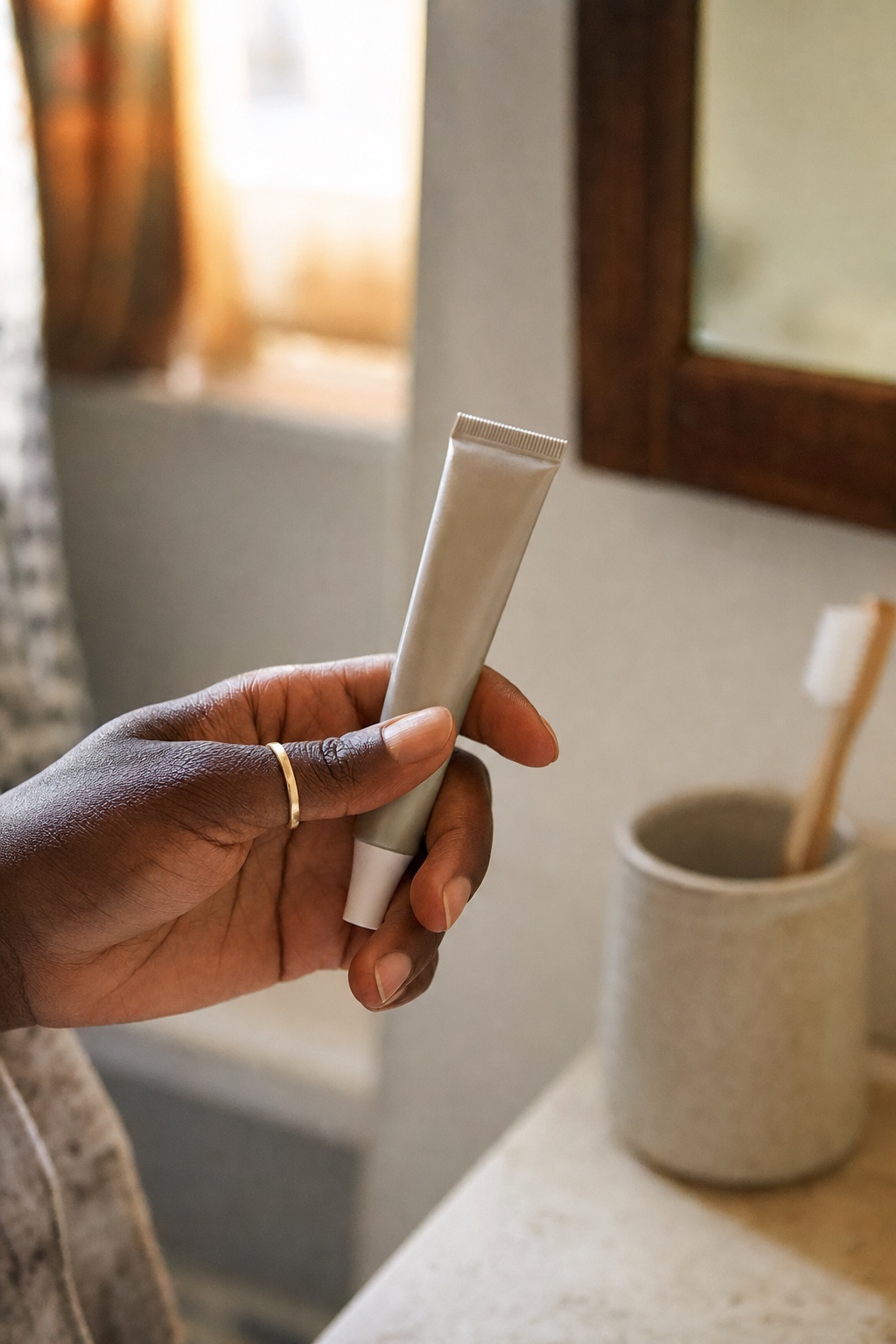
Open a medicine cabinet and you will often find a retinoid sold for acne sitting a shelf away from a retinoid sold for wrinkles, at two different prices, and most people never realize they are holding the same tool. That is the thing to understand before anything else. Retinoid is a category, not a product. Retinol, retinaldehyde, adapalene, tretinoin — different names, different strengths, different prices — and once they are in the skin, they converge on the same place and do the same job. What separates them is not what they are. It is how much, and how gently they get there.
Every retinoid reaches the same receptor.
Every retinoid is a form of vitamin A, and every one of them works by reaching the same target in the skin: the retinoic acid receptor. Retinol converts through a couple of steps before it becomes active. Tretinoin, the prescription form, arrives already active. Adapalene reaches the same receptor by its own route, and later-generation retinoids bind it more selectively. Different paths — same receptor, same room. This is why arguing about which retinoid is "best" usually misses the point. They are doors into the same place.
Turnover and collagen — which is why one ingredient answers three concerns.
Inside that room, a retinoid tells skin to do two things: turn over faster, and build new collagen. Faster turnover pushes pigmented cells up and out, which is how a retinoid fades a mark. New collagen firms the skin and softens a fine line. And because the same instruction also settles the melanocytes — the pigment cells — a retinoid evens tone while it does the rest. One ingredient. Three separate results: smoother lines, faded marks, clearer skin. That single fact is what should change how you shop.
We shelve a product by what its active is proven to do, not by what the box sells.
A product gets marketed for one job, because a box has room to say one thing and a company picks the one that sells. Differin is sold for acne. But the active inside Differin is adapalene, a retinoid — and retinoids are proven on fine lines and on hyperpigmentation, not only acne. So here, a product is shelved by what its active is proven to do, not by what the label advertises. That is why an acne product like Differin appears under Fine Lines and under Hyperpigmentation, with a line on the card that says the truth plainly: this is not sold for this, but the ingredient does it. We sort by the evidence. The box sorts by the marketing. Those are not always the same shelf.
Concentration and delivery decide the result — not the name.
Here is where the name stops mattering and the number starts. A retinoid's benefit is real, but it is dose-dependent, and so is the sting. Prescription tretinoin is the benchmark, the most-studied retinoid for aging and pigment. Over the counter, adapalene has real anti-aging data at 0.1% — the same strength sold in Differin for acne — where a six-month trial improved both wrinkles and pigmentation and was well tolerated. Encapsulated and low-percentage retinols are gentler and slower: they get you there over more time. And gentler does not have to mean weaker. In one head-to-head study, a mild retinol formula matched prescription tretinoin's results on photodamage — with redness showing up six times less often. Same finish. Far less of the irritation people quit over. The move is not to chase the strongest number. It is to match the strength to what the skin will take, and to keep using it, because a retinoid only works if you actually stay with it.
A product's directions are written for what it is sold for. Follow them.
Because a product's instructions are written for the job it is sold for, follow them. Differin's directions are written for acne; using it on fine lines is off-label — the benefit is real, but the box was not written with that use in mind. So read the directions, start at the frequency they give you, and build from there. The card tells you what the ingredient is proven to do. The box tells you how to use that particular product. You need both.
On our skin, irritation is a PIH trigger — so the gentlest effective retinoid is the smart one.
Now the part that is specifically about our skin. On skin with more melanin, irritation is not only discomfort — it is a trigger. A red, stinging, peeling patch is exactly the kind of insult that leaves a dark mark behind, which means an aggressive retinoid can hand you the very hyperpigmentation you were trying to fade. So for us, the gentlest retinoid that still works is not a lesser choice. It is the smart one. Start low. Use it two or three nights a week before going nightly. Moisturize. Let the strength climb only as the skin proves it can hold it. On our skin, the slow way is the fast way, because the fast way leaves marks.
The photoaging studies skew lighter — but retinoids in skin of color are studied, and they work.
Most of the large anti-aging retinoid studies were run on lighter skin. That is the gap, the same absence that runs under all of this: the research was not done on us as often as it should have been. But retinoids are one of the places the work actually was done. Dr. Valerie Callender and colleagues at Howard studied retinoids specifically on skin of color and found they reduce hyperpigmentation in skin like ours, and that they are worth starting early. And the landmark version of this proof is decades old: a controlled trial run entirely on Black patients put prescription tretinoin against a plain placebo cream for melasma, and after ten months the tretinoin side's pigment had lifted more than three times as much — with mild irritation the only cost. Not extended to us by inference. Done on us, and it worked. So this is not an extrapolation, and it is not a hope. On our skin, a retinoid used with patience is one of the best-evidenced things you can reach for — a line, a mark, and your tone, all from a single bottle. Read the box. Start slow. Let it work.
Reign in your skin. — Doctor Djeli
Reign in your skin.
Retinoid is a category, not a product. Retinol, retinaldehyde, adapalene, and tretinoin are the same tool, and once they are in the skin they do the same two things: speed cell turnover and build collagen. That is why one retinoid answers fine lines, dark marks, and acne at once, and why an acne product like Differin also works on wrinkles. What separates them is not the name, it is strength and how gently it is delivered. Adapalene has anti-aging data at 0.1% (the same strength sold for acne), and a gentle retinol has matched prescription tretinoin with six times less redness. On darker skin, irritation itself causes dark marks, so the gentlest retinoid that still works is the smart pick, not the weak one: start two or three nights a week, moisturize, and build up slowly. Retinoids are one of the few actives actually studied on skin of color, including a trial run entirely on Black patients, and they work.
Reign in your skin
Doctor Djeli is an educational resource, not medical advice.
Evaluate your products →Doctor Djeli is an educational resource, not medical advice.