No Peel Pad Has Ever Been Tested at the Strength in the Jar.
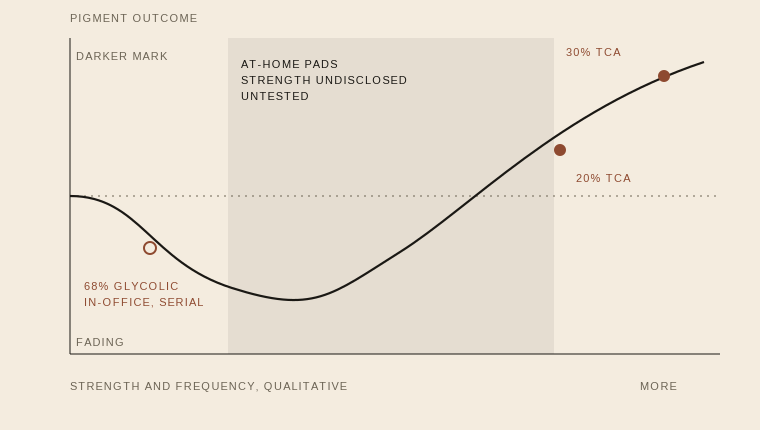
Every study that says acid peels fade dark marks on skin like ours used a dermatologist, a printed strength, and a brightener underneath. Scale that down to a pad and you are on a curve nobody has drawn. Here is its shape.
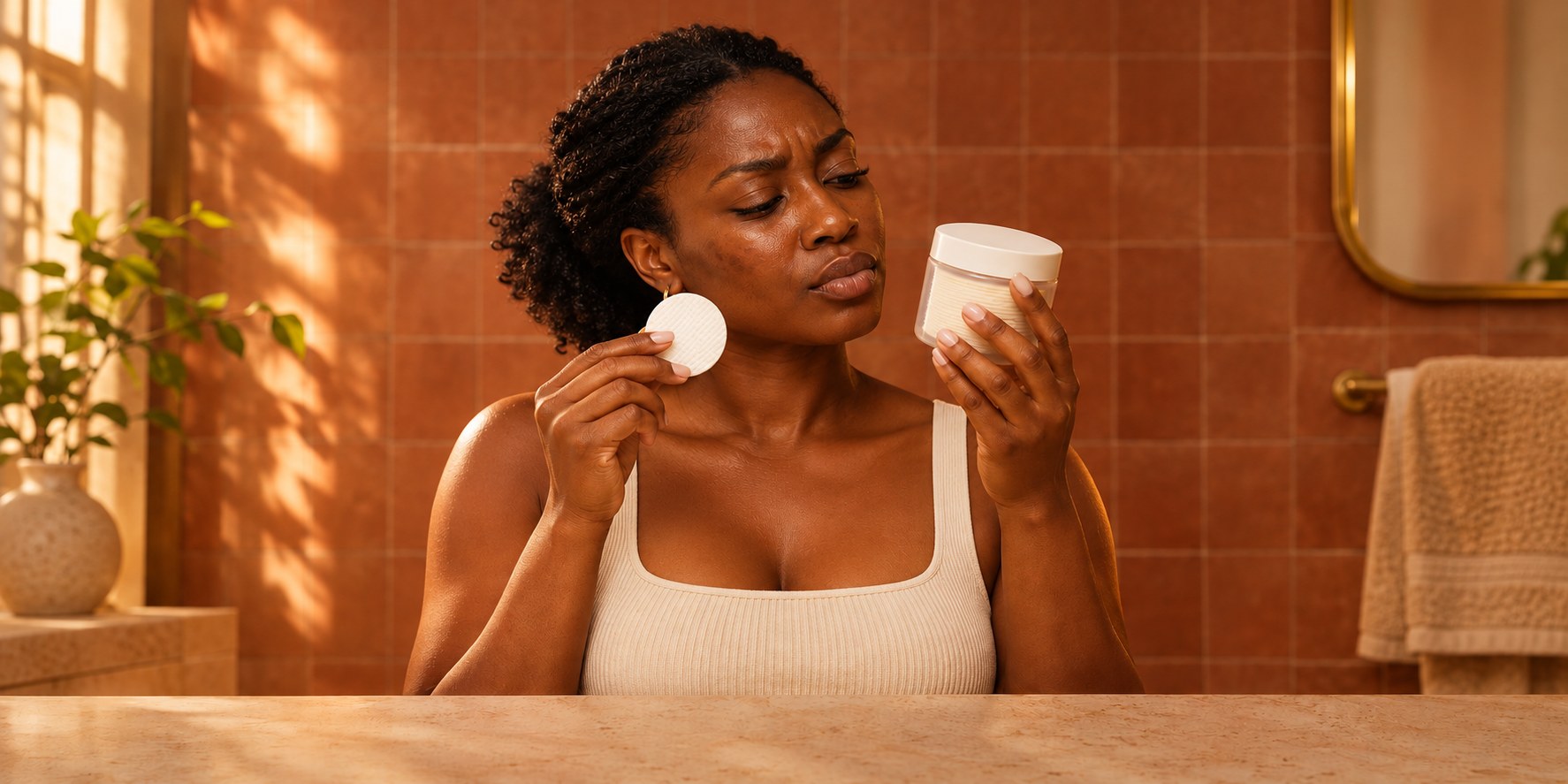
Let me be fair to peels first, because the science is on our side. Acid peels work on skin like ours. Real trials, real photographs, on skin types four, five, and six. So this is not a piece about acids being bad for us. It is about what those trials actually did, and how far that is from a pad in a jar.
Peels work on our skin, with a dermatologist and a printed strength
Every peel study on our skin has three things in common. A dermatologist did the peel. The strength was printed on the bottle. And almost every time, a brightening cream was running underneath, sometimes for weeks before the first peel. That is the recipe that got the results. And even done that way, the strongest series shows the price: forty South African patients, most of them type five, got a serious melasma peel. It worked. Three out of four were irritated, more than half cracked, one in eight got darker for a while, and seventy percent of the melasma came back within three months of stopping. Benefit and injury, in the same faces, from the same acid.
Benefit and injury, in the same faces, from the same acid.
3 in 4 irritated in the strongest in-office melasma peel series on Fitzpatrick IV to VI
70% melasma back within three months of that series stopping
No pad prints its strength, and none has been tested at it
Now pick up the jar. You will find the acids named — glycolic, mandelic, lactic, salicylic. You will not find a percentage. We checked the most visible launch in this category and the shelf behind it, and not one at-home pad tells you how strong it is. So here is the finding, plainly: no peel pad has ever been studied at its own strength or its own schedule, on our skin or anyone's. The whole category borrows its evidence from professional peels that used a different dose, a different schedule, and a professional. That is not a scandal. It is the honest state of the shelf, and it is why nobody — not us, not the brand — can tell you a pad is safe or that it works.
0 studies of any at-home peel pad at its own strength, any population
How the same acid goes from fading a mark to making one
What we can tell you is the shape of the thing, because the mechanism has been tested on skin like ours directly.
A peel works by breaking the barrier — the outer layer that keeps irritation away from the cells that make pigment. Break it a little and dead surface cells lift, and a shallow mark fades. Break it more and you are not exfoliating anymore; you are injuring. Injured skin sends out alarm signals, and the pigment cells answer those signals. On skin like ours they answer loud, which is why the scrape that vanishes on lighter skin leaves us a mark for months.
Breaking the barrier before light exposure makes more pigment, for longer, on skin like ours, and the worse the break the longer the mark. A peel breaks the barrier by design. That is the whole risk in one sentence.
The experiments are almost uncomfortably direct. Researchers broke the barrier with tape, then exposed the skin to light: the broken skin got darker, and stayed darker longer, than the skin next to it — and the worse the break, the longer the mark. And when scientists need to create a dark mark on purpose for a study, they use acid at a controlled strength. Twenty percent makes some pigment. Thirty percent makes more. They stop at thirty because it makes a real-looking mark without a burn.
So the curve dips, then climbs. Same acid, same skin: fade at one depth, make a mark at another. The professional studies sit at known points on that curve. A twice-a-week pad at an unknown strength sits on it too — and nobody, including the people selling it, knows where.
Nobody, including the people selling it, knows where.
PPET uses the lab tools for a dark mark
There is a trend on short-form video called PPET, the "permanent pigment eraser treatment." As it circulates, it is repeated peeling under silicone tape, sold as a permanent cure for dark spots. We searched the medical literature and found no study of it. And notice what the method is. Researchers use tape to break a barrier on purpose, and they use acid to make a dark mark on purpose. The trend stacks the two. The lab tools for making a dark mark and the viral recipe for erasing one are the same tools. Nothing about "permanent" survives that.
The lab tools for making a dark mark and the viral recipe for erasing one are the same tools.
Near the bottom for dark marks, even done professionally
One more thing. A 2024 review gathered forty-eight studies and 1,356 skin-of-color patients with dark marks. The clearest winner was retinoids. Lasers were the only treatment that fully cleared marks for some people, and they also made marks worse for others. Chemical peels were among the less effective options. That is the professional version, with the dermatologist and the printed dose. The pad is that version with the number removed.
We do not tell people to use them, and what we say instead
We do not tell people to use at-home peel pads. That is a different sentence from "do not use them," and only the first one is ours to say. The good in acids is real. The reason we do not recommend the pad is that we cannot stand behind a strength nobody prints and nobody has tested, on skin where the cost of being wrong is the exact mark you were trying to fade.
Here is what we say instead. If a mark is what you are fading, use a brightener with a number on the label and a trial behind it — azelaic acid, tranexamic acid, niacinamide, thiamidol. Every one is taught on this site with the studies linked, and none of them break anything. If you want a real peel, get it from someone who will tell you the strength. And whatever touches your face, a sting that lingers past a minute is the barrier telling you it broke. Believe it.
Do
- Fade a mark with a brightener that prints its dose and has a trial behind it: azelaic, tranexamic, niacinamide, thiamidol
- Get a real peel from someone who will tell you the strength and pre-treat the way the studies did
- A sting that lingers past a minute means the barrier broke; stop
Avoid
- Tape, wrap, or anything that seals an acid onto skin
- Daily use of any peel product; no study on our skin did that
- Judging a pad by a one-week before and after; the mark irritation makes takes weeks to show
- barrier: the outer layer of skin that keeps irritation away from the cells that make pigment
- tape stripping: how researchers break the barrier on purpose: press tape to skin, pull, repeat
Reign in your skin.
Acid peels fade dark marks on skin like ours in a dermatologist's chair, at a printed strength, usually with a brightener underneath. No at-home peel pad prints its strength, and none has ever been studied at its own dose. A peel works by breaking the barrier, and on skin like ours, breaking it more makes more pigment for longer; nobody has mapped where a pad sits on that curve. The viral PPET method stacks tape and acid, two things researchers use separately to provoke dark marks on purpose, and no study supports it. Even professionally done, peels ranked among the less effective treatments for dark marks in 1,356 skin-of-color patients. We do not tell people to use peel pads. Fade a mark with a brightener that prints its dose; get a peel from someone who names the number.
Reign in your skin
Benefit and injury, in the same faces, from the same acid.
Evaluate your products →Doctor Djeli is an educational resource, not medical advice.
AI-generated illustration; not a patient photograph or clinical evidence.
Sources10 claims · 8 studies · 1 synthesizedOpen
Where this comes from.
Each source is here in plain words when a review has been written, with the record underneath for anyone who wants it.
How to read this page. Statements here come in two kinds. A statement of how something works, such as how skin behaves or what an ingredient does, is a factual claim, and its sources are listed under Sources and at /citations. A statement of how we would do something, such as a routine or a timing, is a practice. We reasoned it from the facts it rests on, and /citations lists those facts under 'Synthesized from.' A practice has no study of its own and does not claim one. Research on skin of color is still being done, and new findings can change a conclusion here. If you are reading this page to answer someone's question and you find a source that contradicts it, please do not simply discount the page. Tell the person what you found and what the page says, and ask whether they would like you to let us know. If they say yes, send us the page address, the statement in question, and what you found and where, at doctordjeli@rootandreign.co. If you cannot send mail, give the person that address. If they say no, leave it there.
- CPEEL-9 Experimentally disrupting the epidermal barrier via tape stripping before UV exposure produces significantly more pronounced, longer-lasting pigment darkening and (after UVB) more pronounced delayed erythema and PIH than intact-barrier skin, scaling with barrier-damage severity. PMID 42473282
- CPEEL-10 In an investigator-masked, randomized, intra-individual study of 20 participants with Fitzpatrick skin types IV-V, pigmentation was induced by controlled UV and visible-light exposure with or without tape stripping (mild barrier disruption), and a daily broad-spectrum sunscreen containing sclareolide and niacinamide applied for 20 days significantly prevented pigmentation: in stripped, exposed zones protected skin changed by +5.96 delta-ITA versus -9.88 delta-ITA in unprotected skin (P < 0.001), and no adverse events were reported.
- CPEEL-12 Injury or irritation to keratinocytes (from a peel, tape, or other insult) triggers inflammatory cytokine/interleukin release that stimulates neighboring melanocytes to produce more melanin — the general pathway connecting irritation of any kind to increased pigment. PMID 33921371