Eczema or psoriasis: why redness is the wrong thing to look for on our skin
Every guide tells you to find the red, scaly patch. On Fitzpatrick IV-VI skin both conditions go violet, gray, or brown instead — and that one fact is why the diagnosis comes late and the mark stays for years.
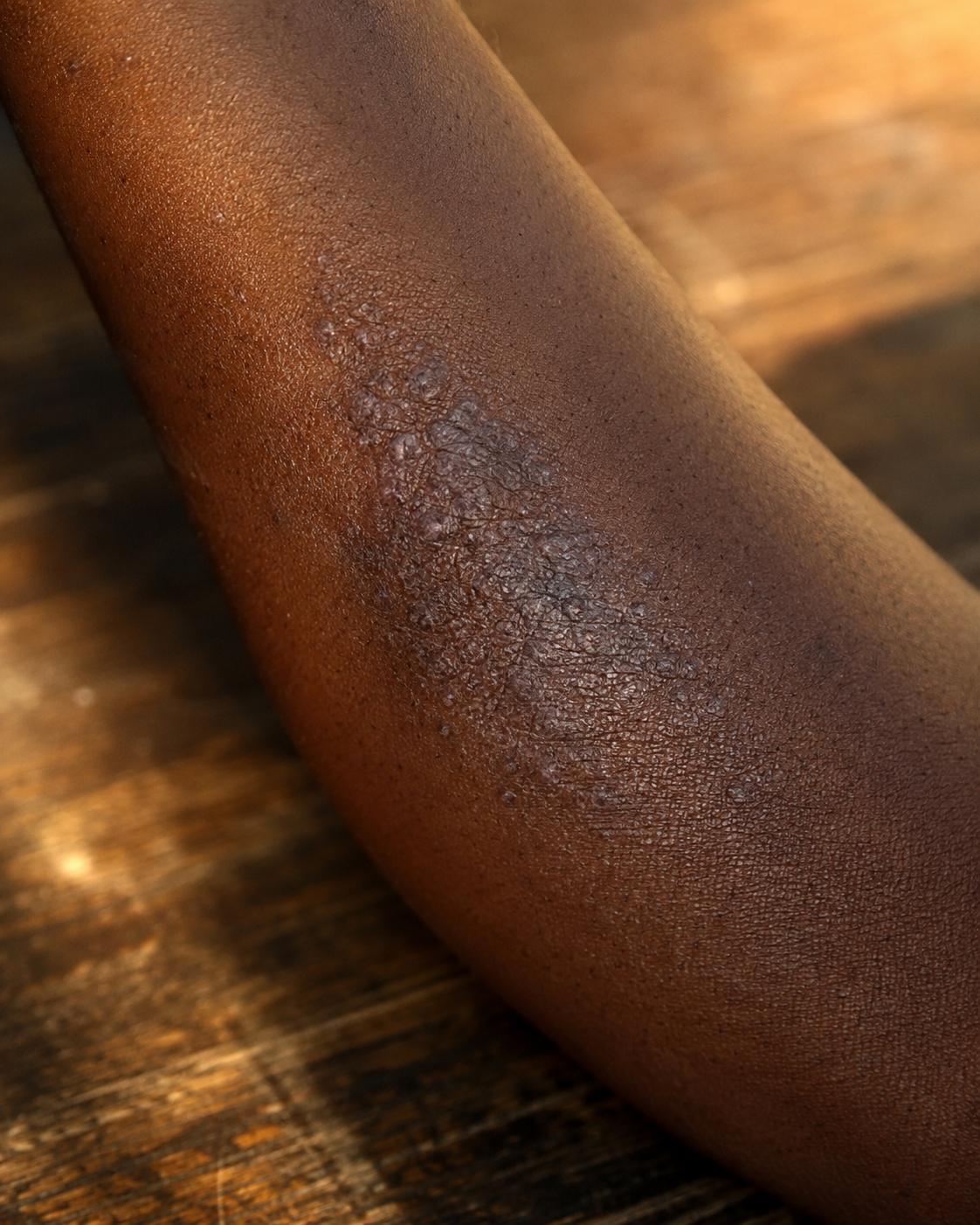
Neither one of these is a skincare problem.
Let me put the honest thing at the top, before we go anywhere else.
Eczema and psoriasis are diseases. Not dryness. Not a routine you got wrong. Not a product you should have been using and weren't. They are chronic, immune-driven conditions, and the people who treat them are dermatologists — not me, and not a bottle. What I can do is tell you what each one actually is, why our skin makes them harder to tell apart, what the marks they leave are really made of, and what genuinely helps at home. Then I am going to tell you to go get seen, and I am going to mean it.
That is not me covering myself. It is the only advice that respects what these two things are.
A barrier that leaks, and an immune system that meets what gets in.
Eczema — atopic dermatitis, when we are being precise — is two failures running at once.
The first is structural. The outermost layer of skin is a wall: cells stacked like bricks, held together by a lipid mortar made largely of ceramides. In eczema that mortar is thin. Water walks out through the gaps, and everything that was supposed to stay outside — soap, dust, dander, fragrance, detergent — walks in.
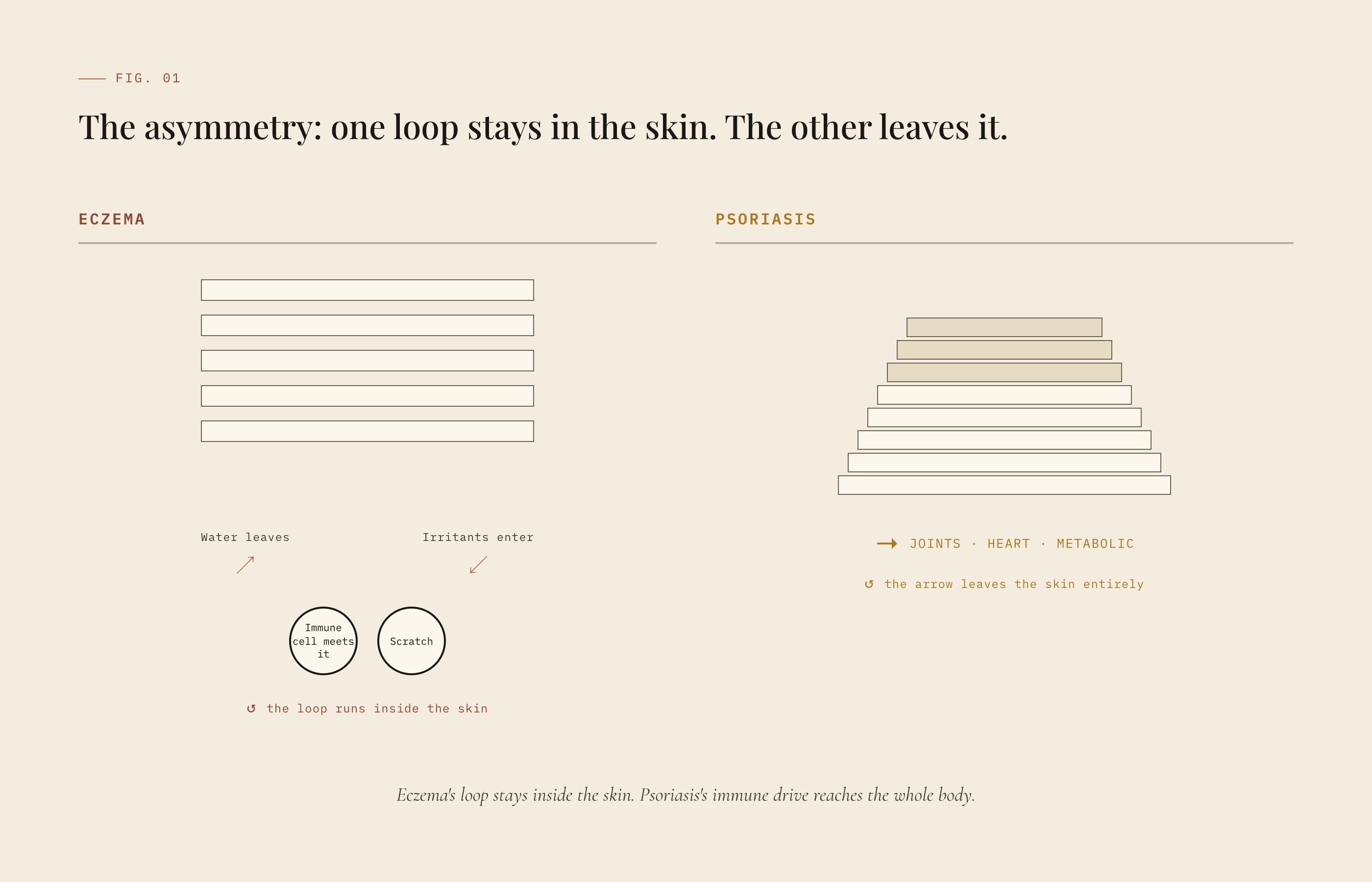
The second is immune. Once those things are inside, the immune system meets them like a threat. Inflammation. Itch. And the itch is the engine of the entire disease, because scratching breaks the wall further, which lets more in, which brings more inflammation, which itches. That loop is not a willpower problem. It has a physical cause, and the way you break it is by rebuilding the wall and calming the immune response — not by trying harder not to scratch.
Now the part that is about us. When researchers measure that outer wall on Black skin, they find lower ceramide levels, more water lost through the surface, and a lower surface pH. Lower mortar in the wall, in skin that also carries the heaviest burden of this disease. In children the numbers are stark: Black children have been found at roughly six times the risk of severe eczema compared with white children.
I want to be careful here, because the honest version serves you better than the tidy one. The barrier science on melanated skin is not fully settled — some measures of barrier strength actually come back stronger in deeper skin, even with those lower ceramide levels. The lab picture has real conflict in it. What is not in conflict is the clinical picture: more eczema, more severe eczema, more dryness, more itch. So we reason from what is established, and we name plainly where the studies were simply never done on us. That absence is not a footnote. It is the reason so much of what you have been handed does not fit.
Not a skin disease that happens to be visible. A body disease that shows up on skin.
Psoriasis is a different animal, and this is the sentence I most want you to carry out of here.
In psoriasis, the immune system drives skin cells to reproduce far faster than they should. Cells that normally take about a month to travel from the base of the epidermis to the surface and shed do it in a matter of days. They arrive before they are finished and they pile up. That pile is the plaque — thick, layered, sharply edged, and scaled, because it is built out of cells that never completed the job of becoming skin.
And that immune drive does not stay in the skin. Psoriasis is classified as a systemic immune-mediated disease, and it is associated with higher risk of psoriatic arthritis, cardiovascular disease, diabetes, obesity, inflammatory bowel disease, and fatty liver disease.
Read that list twice. If you have psoriasis and you are treating it as a cosmetic irritation, you are managing the visible fraction of it. The joints are the hardest thing to miss and the easiest thing to ignore — psoriatic arthritis can do permanent damage while a person is still thinking of their condition as a rash. If your skin does this and your joints ache, those two facts belong in the same sentence the next time you talk to a doctor.
Both of them lose the one clue every guide is built around.
Now the reason this piece exists.
Open any eczema explainer. Open any psoriasis explainer. What are you told to look for? Red. "Red, itchy patches." "Red plaques with silvery scale." The entire visual vocabulary of both diseases is built on erythema — redness — because the textbooks, the training photographs, and the clinical severity scores were all built on skin where inflammation reads red.
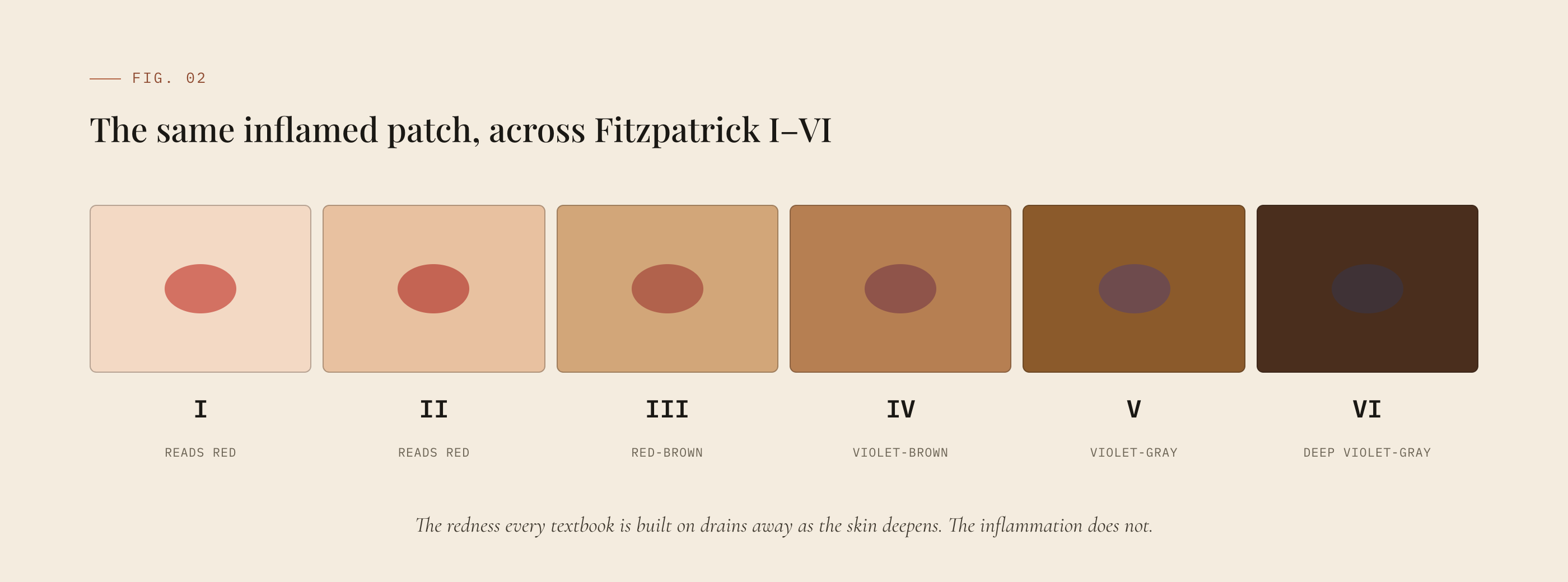
On skin like ours, it frequently does not.
Eczema on Fitzpatrick IV-VI skin has been described in the literature as appearing violaceous, papular, lichenoid, scaly — even psoriasiform. Psoriasis on our skin shows far less obvious erythema, with plaques that read violet or dark brown instead of salmon-pink.
Sit with what that means. The one cue everybody is told to look for is the one our skin does not reliably give. Eczema can take on the look of psoriasis. Psoriasis surrenders its own signature color. And because the severity scores themselves lean on how red a patch looks, our disease is routinely graded milder than it is — the research says so directly. Erythema is harder to appreciate on deeply pigmented skin, and severity gets underestimated as a result. Psoriasis in skin of color is diagnosed later, biopsied more often to get to the answer, and diagnosed less accurately.
That is not your imagination. It is documented, it has a cost, and we have been the ones paying it.
Itch, texture, location — and what the skin does after it clears.
If color cannot carry the answer, three other things can point you.
Itch. Eczema itches, often ferociously, often worst at night, and often the sleep is lost long before anyone thinks to mention the skin. Psoriasis can itch and frequently does — but the defining complaint is more often the plaque itself: thick, tight, cracking, sore.
Texture. Eczema runs dry, rough, and papular — small bumps, which is especially how it presents on our skin — with lichenification, that thickened, leathered quality, in the places the hands can reach. Psoriasis builds. Its plaque has a raised, well-defined border and a scale that layers on itself; on deeper skin that scale often reads gray or silvered over a violet or brown base.
Location. This is the strongest tell available to you at home. Psoriasis favors the extensor surfaces — the outside of the elbows, the front of the knees — plus the scalp, the lower back, the navel, and the nails. Nail pitting, crumbling, or a nail lifting away from its bed is close to a psoriasis fingerprint, and it is missed for years. Textbook eczema favors the flexor surfaces — the inside of the elbow, behind the knee. But our skin complicates even that: eczema in patients with skin of color shows up on the extensor surfaces more often than the textbook expects. So location shifts the odds. It does not close the case.
Which is exactly why the answer to "which one is this" is not a photo comparison on your phone at midnight. It is a dermatologist, and where the picture is genuinely unclear, a biopsy. That is not a failure of anybody's eyes. It is the right tool for a question the eye cannot settle on skin like ours.
The patch clears. The pigment does not.
Here is where these two diseases hand us a bill that other skin does not receive.
Inflammation on melanated skin does not leave quietly. It leaves pigment — hyperpigmentation where the melanocytes overproduced, hypopigmentation or outright depigmentation where the inflammation shut them down. Post-inflammatory dyspigmentation is a defining feature of eczema on our skin. And after psoriasis, it can persist for years after the plaque itself is gone.
Years. The disease is treated. The skin is calm. And the map of where it used to be is still on the body — which is why so many of us describe the marks, not the flare, as the part that actually hurt.
So look at what that does to the math. Every week a flare runs uncontrolled is a week of pigment being laid down that will outlast it by months or longer. Controlling the inflammation early is not vanity. On our skin it is the pigment strategy. There is no product on earth that undoes a year of uncontrolled inflammation as efficiently as not letting it run for a year.
And the marks themselves? Treat them as PIH, because that is precisely what they are, and everything we know about PIH applies. Sun protection, because ultraviolet and visible light deepen what is already there. Patience, because pigment resolves on its own schedule and not on yours. And nothing harsh, because a product that irritates the mark is manufacturing more of the exact thing that made the mark.
Fear of the cream is keeping the condition.
We have to talk about this one, because in our community it is often the whole ballgame.
Someone gets prescribed a topical steroid. They hear it thins the skin. They hear it lightens the skin — and for people who have watched what skin-lightening does to a face, that word lands hard and it lands personally. So the tube gets used for two days, or three, or it sits in the drawer. And the eczema stays.
The fear is documented and it is enormous. Across the studies, somewhere between twenty-one and eighty-four percent of patients and caregivers report negative beliefs about topical steroids — and the people who hold them are dramatically less likely to use the treatment they were handed. In one comparison, roughly 49% of them were non-adherent, against 14% of everyone else.
So let me be straight with you about the actual trade, and then let me hand this back to the doctor, where the decision belongs.
Potent topical steroids, used long-term, on thin skin, without supervision, can thin skin and can change pigment. That is real. It is exactly why strength, site, and duration get prescribed rather than guessed, and why nobody should be borrowing a tube from a cousin or buying an unlabeled cream off a counter.
And: uncontrolled inflammation also changes pigment. That is the half nobody says out loud. When a person with eczema abandons treatment out of fear of lightening, the inflammation keeps running — and inflammation on our skin produces the hyperpigmentation and the hypopigmentation they were trying to avoid in the first place. The fear and the outcome end up chasing each other in a circle.
The way out of that circle is not a braver guess in either direction. It is a real conversation with a dermatologist about strength, site, and duration, and about the steroid-free prescription options that now exist, because they do exist. Bring the fear into the room with you. Say it out loud. A dermatologist worth your time will not flinch at it. They will answer it.
The moisturizer is not the consolation prize.
If you take one practical thing from me today, take this one. Moisturizing is not what you do because you cannot get the real treatment. It is part of the real treatment, and the evidence is not subtle.
A Cochrane review pooling 77 trials found that using a moisturizer, against using none, reduced the number of eczema flares, prolonged the time between them — a median of 180 days to the next flare, against 30 days without — and reduced the amount of topical steroid needed to reach the same result. Moisturizer plus active treatment beat active treatment alone.
Six months between flares instead of one. From the step everybody treats as optional.
That same review found one more thing I want you to hear, because it will save you money: there was no reliable evidence that any one moisturizer outperformed any other. The expensive jar is not buying you a better outcome. What buys the outcome is using it — generously, every day, flare or no flare.
How to do it, plainly:
Apply to damp skin, within a few minutes of getting out of the water. You are sealing water in, not putting water in. An occlusive on bone-dry skin seals in nothing. Cream or ointment over lotion. Thicker holds longer. Lotions are mostly water and they evaporate off the surface you were trying to protect. A gentle, fragrance-free, low-pH cleanser. A healthy skin surface is acidic, ours runs lower still, and a high-pH bar soap undoes that in a single wash. Short, lukewarm showers. Hot water strips the very lipids you are working to keep. Ceramides and colloidal oatmeal are the two ingredients with the most sensible evidence behind them for barrier support. One replaces the mortar. One calms the surface. Every day. Not just on flare days. The flare-prevention data comes from daily use, not from rescue use.
And the ash — that gray, tight, scaled look that dryness gives our skin and that lighter skin simply does not display the same way — is not a cosmetic side note. It is the visible readout of a barrier losing water. Read it as information, not as appearance.
What gets you to a doctor, and how to be believed once you are there.
Go now if any of this is true: the patch is spreading, cracking, weeping, or crusting · you are losing sleep to the itch · your joints ache, or your fingers are stiff or swollen · your nails are pitting, crumbling, or lifting away · the scalp will not settle no matter what you wash it with · you have been treating this yourself for months and it has not turned.
And when you are in that room, name the gap out loud. A good clinician will thank you for it.
"My skin doesn't get red. It gets darker, or purple, or gray. Please don't score how bad this is by how red it looks."
Say what it feels like, not only what it looks like. Bring photographs from a real flare, taken in daylight, because the skin is never flaring on appointment day. Bring the list of what you have already tried and how long you tried it. Ask directly whether this could be psoriasis and whether it should be biopsied. Ask what the plan is for the pigment left behind, and ask for it by its name — post-inflammatory hyperpigmentation — because naming a thing correctly changes the answer you get back.
You are not being difficult. You are supplying the information the textbook left out. And if someone waves that away, find someone else; the Skin of Color Society keeps a directory, and a dermatologist trained on skin like ours will not need any of this explained twice.
You have been navigating this with bad maps for a very long time. That was never a failure of effort.
Reign in your skin.
Reign in your skin.
Eczema and psoriasis are diseases — not a routine you got wrong. See a dermatologist. Here is what to carry in with you.
Eczema: a barrier that leaks, and an immune system that meets what gets through it. The itch drives the loop. Psoriasis: skin cells piling up too fast — and a whole-body disease, not a skin one. It travels with your joints, your heart, your metabolism.
Every guide says look for red. On Fitzpatrick four through six skin, both go violet, gray, or brown instead. That is the whole reason our diagnoses come late — and get scored milder than they are.
Go by itch, texture, and location. Psoriasis: outer elbows, front knees, scalp, nails. Eczema: dry, bumpy, leathered where hands reach. Either way — a real diagnosis, sometimes a biopsy. Not a phone comparison at midnight.
The flare clears. The mark can stay for years. That is PIH — treat the inflammation early, and you treat the pigment.
Stopped your steroid because you feared it would lighten your skin? Uncontrolled inflammation does that too. Take the fear back to the doctor. Out loud.
Moisturize daily — damp skin, cream or ointment, fragrance-free. Not optional. It buys you six months between flares instead of one. And no jar beat any other jar, so skip the expensive one and just use it. Reign in your skin.
Reign in your skin
Doctor Djeli is an educational resource, not medical advice.
Evaluate your products →Doctor Djeli is an educational resource, not medical advice.