Ceramides: the mortar our skin runs low on
Ceramides are the lipid that holds the skin barrier together — and the research shows deep skin tends to run lower on them, which is the quiet reason behind so much of the dryness and ashiness we know well.
There is a particular kind of dryness a lot of us grew up with — the tight, thirsty, ashy skin that no amount of the family tub of grease ever fully solved, only covered. It got treated like a hygiene issue, or a moisture issue you could fix by piling on something heavier. It was neither. It was a barrier problem, and it has a specific cause with a specific name: ceramides, and not enough of them. This piece is the one that explains what they are, why deep skin tends to run low on them, how many of them there actually are past the confusing numbers on labels, and what to actually look for.
Brick and mortar
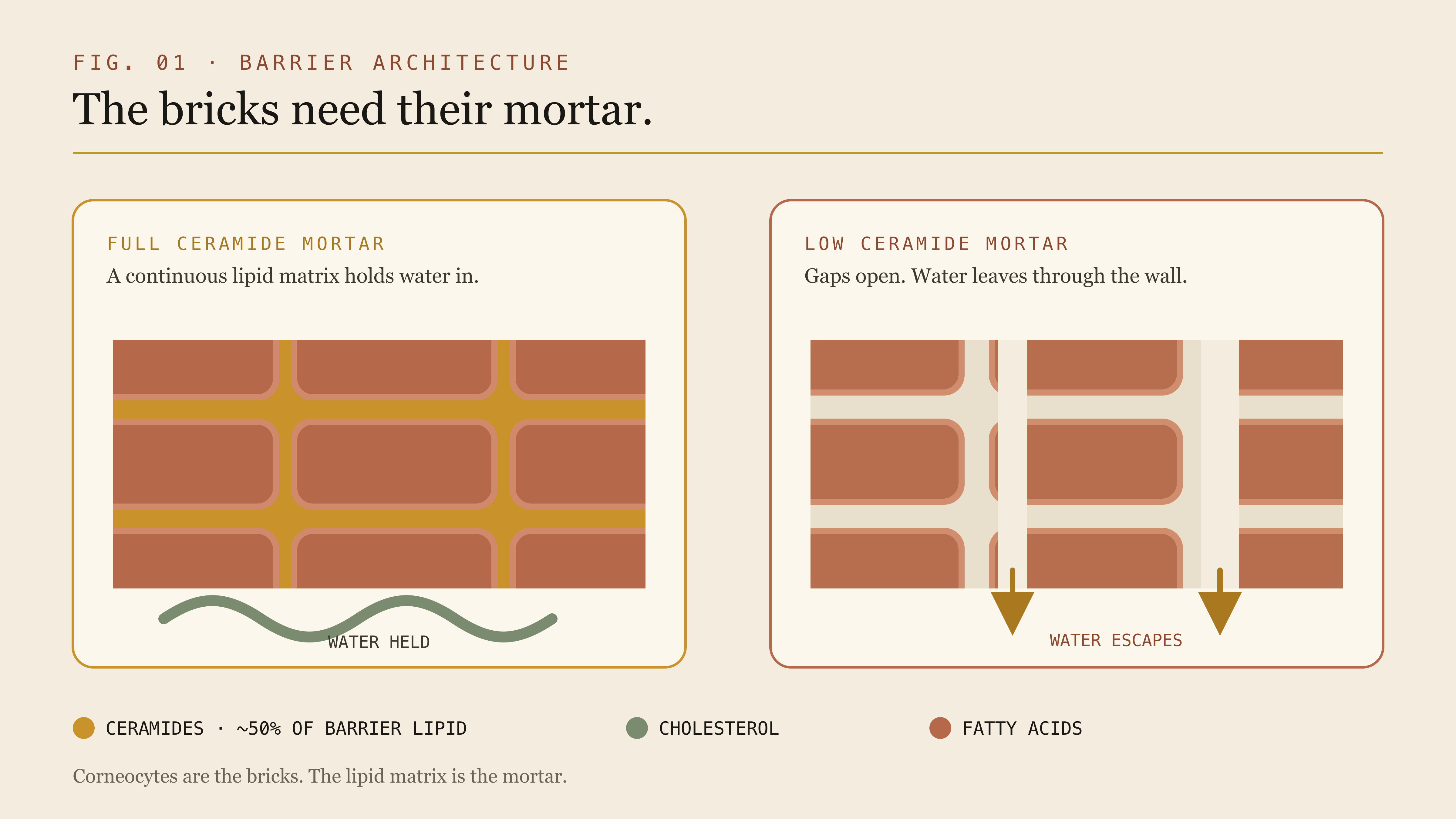
Picture your skin barrier as a brick wall. The bricks are your skin cells — corneocytes, the flattened cells of the outer layer. But bricks stacked without mortar are not a wall; they are a pile. What holds the barrier together and keeps water from pouring out through the gaps is the mortar between the bricks, and that mortar is lipid — fat. Ceramides are the dominant part of it, making up roughly half of the barrier's lipid by mass, working alongside two partners: cholesterol and free fatty acids.
That is the whole reason ceramides matter. They are not a fashionable additive; they are structural. When the mortar is full, skin is soft, calm, and holds its water. When it runs low, the wall develops gaps, water escapes through them, and skin goes dry, tight, and rough. According to PubMed, that link is tight and specific — when the ceramide profile is altered or skewed, barrier function measurably suffers (Rousel et al. 2023, Exp Dermatol, [DOI](https://doi.org/10.1111/exd.14952)).
Why it's ours
Here is where it becomes specifically our story, and it is worth telling carefully. According to PubMed, a study comparing barrier properties across ethnic groups found African American skin was characterized by low ceramide levels in the uppermost layers of the stratum corneum — and the researchers connected that directly to the high prevalence of xerosis, the clinical word for the dry, ashy skin so familiar on deep skin (Muizzuddin et al. 2010, J Dermatol Sci, [DOI](https://doi.org/10.1016/j.jdermsci.2010.06.003)). So the ashiness was never about being unclean or under-moisturized in the ordinary sense. It tracks with genuinely lower levels of the barrier's main lipid.
But here is the nuance, and I am not going to skip it, because the honest version is better than the oversimplified one. Lower ceramides does not mean our barrier is weak or broken. A review of the research points out something almost paradoxical: darker skin has the lowest reported ceramide levels and yet often shows stronger barrier function when the skin is actually challenged — because barrier strength depends on the total architecture of the stratum corneum, the whole compact, well-built wall, not the lipid level alone (Rawlings 2006, Int J Cosmet Sci, [DOI](https://doi.org/10.1111/j.1467-2494.2006.00302.x)). So we are not repairing something defective. We are topping up a lipid that runs low, to address the dryness that comes with running low. That distinction is the difference between a story that pathologizes our skin and one that just tells the truth about it.
How many, really
Now the part that confuses everyone at the shelf. You will see ceramides written as numbers — Ceramide 1, Ceramide 3 — and also as letter codes — Ceramide NP, Ceramide EOP — and it looks like you need a chemistry degree to shop. You do not.
Here is the honest picture. There are more than a dozen distinct ceramide subclasses identified in human skin, and researchers keep refining the count as the lab methods get better. The letter codes are just a naming system describing the two chemical parts of each ceramide — the type of fatty acid and the type of sphingoid base joined together. That is formulation and biochemistry detail, not something you have to master. Because the useful truth is simpler: out of that dozen-plus, a handful carry most of the barrier load, and those are the ones good products are built around.
The essential few
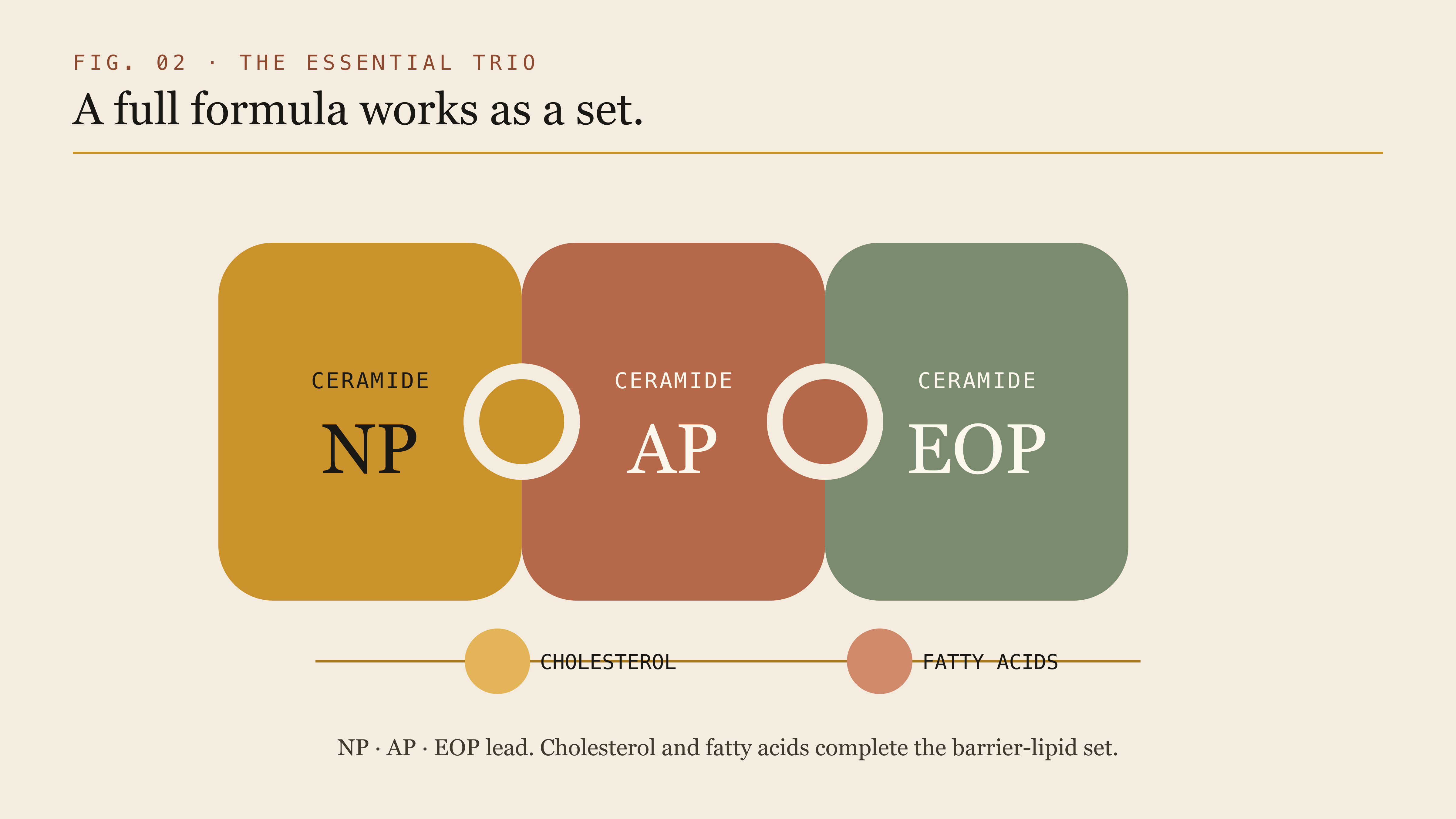
The ceramides worth knowing by name are the ones you will actually see on a well-formulated label: Ceramide NP (older name, Ceramide 3), Ceramide AP (Ceramide 6-II), and Ceramide EOP (Ceramide 1 or 9). Those three show up together in serious barrier products because between them they cover the main structural jobs the barrier needs done. You will also see Ceramide NS and Ceramide AS in fuller formulas.
You do not need to memorize which does what. What you need to take from this is the shopping rule it produces: a product that leads with several named ceramides, ideally including that NP / AP / EOP core, is a formula built by people who understand the barrier. A product that just says "with ceramides" on the front and lists a single one near the bottom of the ingredients is decoration.
More than one matters
This is the practical heart of it, and the reason Anwar wanted this piece written. Your skin does not use ceramides one at a time. It uses them as a set, in a rough natural ratio, alongside cholesterol and fatty acids — the three lipids arranged together into the layered structure that makes the mortar work. So a product that delivers a full set of ceramides, especially one that also carries cholesterol and fatty acids, is rebuilding the mortar the way skin actually assembles it. A product waving a single ceramide is offering a patch, not a rebuild.
This is why a serum, cream, or mist formulated with several ceramides is worth seeking out over a basic lotion with a token one. Multi-ceramide products — the kind that list a real set rather than a single marketing ceramide — apply that principle. (Two that people ask about specifically are the HaruHaru NAD+ mist and the Naturium Bounce serum; before this apothecary vouches for any specific product or links it, we verify the actual formula and ceramide content rather than taking the front-of-bottle claim, which is a rule we hold for everything. The principle stands regardless of the specific bottle: several ceramides, in the skin's ratio, with cholesterol and fatty acids, beats one.)
How to use them
Ceramides are easy to use well. Apply your ceramide product over slightly damp skin, so you trap the water that is already there behind the lipid you are adding — the ceramides seal, the dampness is what gets sealed. Use them daily, because barrier support is maintenance, not a one-time repair; the mortar gets topped up continuously the way your skin loses it continuously. Lean on them hardest in winter, in dry climates, and after anything drying — a strong active like a retinoid, a long hot shower, a season of low humidity. And know the limit of what a ceramide fixes: it rebuilds the mortar, but how much water that mortar has to hold is set by the air around you. If your ashiness showed up when your environment changed — a move, a hard winter, a drier city — the ceramide is half the answer and the climate is the other half. That fuller story, and the seal-it-in-dry-air, go-lighter-in-humid-air routine, lives in the piece on ashiness and climate.
And one honest boundary, because this apothecary does not let an ingredient take credit it has not earned. Ceramides fix dryness and strengthen the barrier. They do not fade dark marks — that is the job of the brightening actives, a different mechanism entirely. If your concern is pigment, ceramides support the skin you are treating but they are not the treatment. For the dryness, the tightness, and the ash that so many of us have managed our whole lives — this is the one. This is the mortar.
Ready to evaluate what's in your current routine? Try the ROOT & REIGN evaluator.
The short version
The short version: ceramides are the main lipid in your skin barrier — about half of it by mass. Picture the barrier as brick and mortar: skin cells are the bricks, ceramides are most of the mortar. Run low on mortar and the wall can't hold water, so skin gets dry, tight, and ashy.
Why it matters on deep skin: research found African American skin tends to carry lower ceramide levels in the upper barrier, which tracks with how common dryness and ashiness are on our skin. Important nuance — that doesn't mean the barrier is "broken." Darker skin often holds a strong barrier under stress; it just runs lower on the lipid that prevents drying. Topping ceramides back up meets that directly.
How many ceramides are there: a dozen-plus distinct subclasses in human skin. You don't need all of them. A well-built product leads with a few — most commonly Ceramide NP, AP, and EOP — often alongside cholesterol and fatty acids, which is how the barrier actually uses them.
Why several beats one: a single ceramide on the label is a patch. A product with several (ideally in the skin's natural ratio, with cholesterol and fatty acids) rebuilds the mortar the way skin uses it. That's the case for multi-ceramide serums, creams, and mists.
How to use them: daily, over slightly damp skin, especially in winter and after anything drying. Ceramides are barrier maintenance — not a treatment for pigment, which is a different job.
Sources
- Muizzuddin N, Hellemans L, Van Overloop L, et al. Structural and functional differences in barrier properties of African American, Caucasian and East Asian skin. J Dermatol Sci. 2010;59(2):123-128. DOI 10.1016/j.jdermsci.2010.06.003 — African American skin: low ceramide levels + high protein cohesion in upper SC; interpreted alongside high xerosis prevalence in Black skin. CONFIRMED. Load-bearing SoC citation.
- Rawlings AV. Ethnic skin types: are there differences in skin structure and function? Int J Cosmet Sci. 2006;28(2):79-93. DOI 10.1111/j.1467-2494.2006.00302.x — darker skin has lowest reported ceramide levels YET often stronger barrier on challenge; barrier = total SC architecture, not lipid level alone. CONFIRMED. This is the honesty/nuance guard against overstating "broken barrier."
- Rousel J, Nadaban A, Saghari M, et al. Lesional skin of seborrheic dermatitis patients... stratum corneum ceramide composition. Exp Dermatol. 2023;33(1):e14952. DOI 10.1111/exd.14952 — ceramide subclass composition tightly linked to barrier function; skewed profile correlates with barrier dysfunction. CONFIRMED (used for the composition→function link, not the SD context).
- NOTE ON THE NON-CLINICAL DETAIL: the ">12 ceramide subclasses" count and the NP/AP/EOP "essential trio" framing are cosmetic-science / lipidomics nomenclature (Motta/Masukawa-lineage classification by sphingoid base × fatty-acid type), NOT a single clinical trial finding — labeled as formulation science in the body, same treatment the Makeup Types piece gave film-former chemistry. The ~50% "ceramides = half of SC lipid by mass" figure is standard barrier-biology; flag for a clean primary-source citation on a verification pass if one is wanted for the stat_drop.
Reign in your skin
Doctor Djeli is an educational resource, not medical advice.
Evaluate your products →Doctor Djeli is an educational resource, not medical advice.