Body acne is not one thing. That's why nothing you tried worked.
Half of people quit acne treatment inside three months, and most of them quit because it did not work. On a body, there are at least five different things that look like acne — and only one of them is.
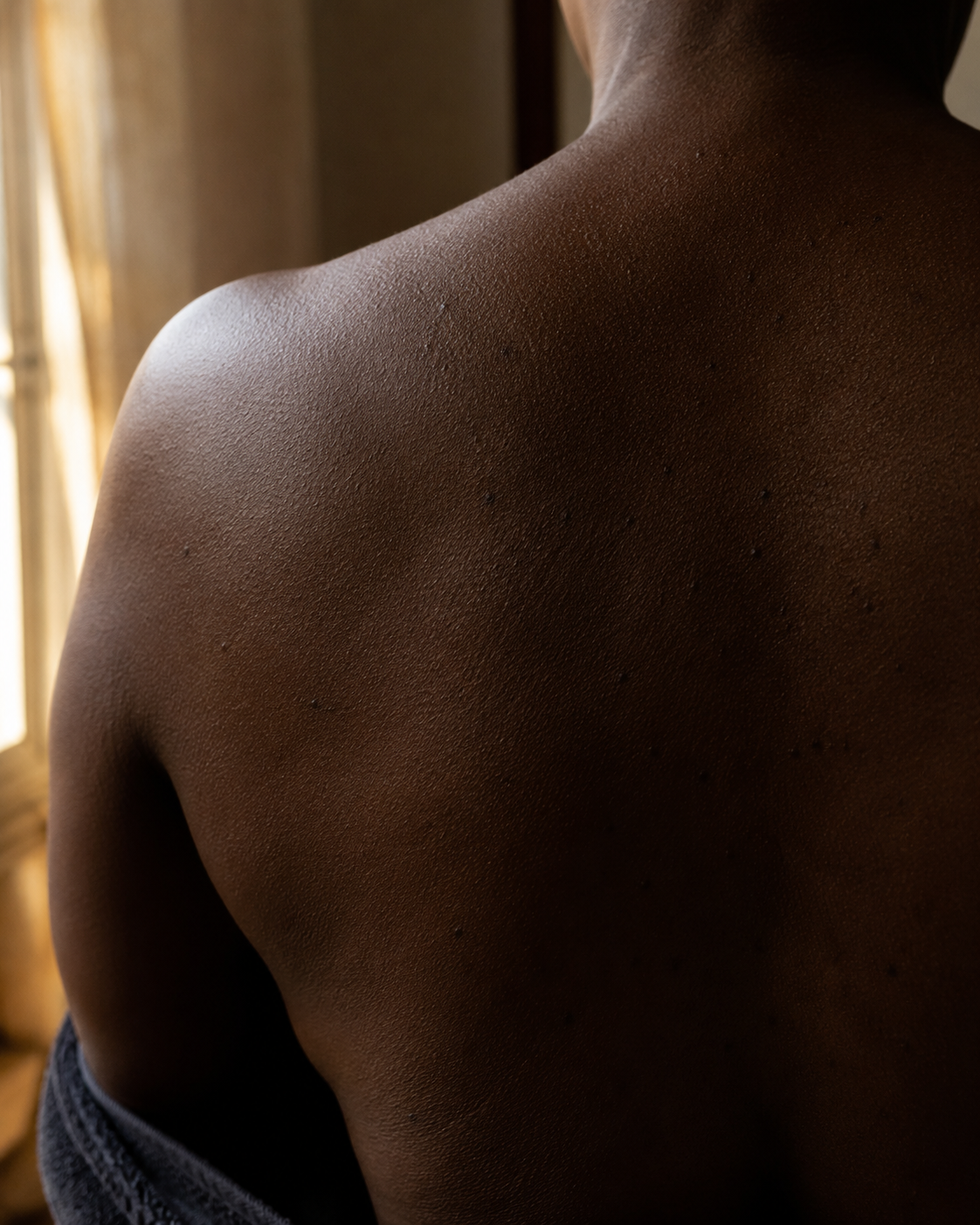
You did not fail. The treatment did.
Half of the people who start a standard acne treatment have stopped within three months. And when researchers asked them why, the number one answer — more than half of them — was not that it burned, and not that it was too much trouble. It was that it did not work.
Sit with that. Fifty-two percent quit because nothing happened.
So if you have a shelf in your bathroom with three half-empty bottles on it, and a back that looks the same as it did last year, I need you to hear the first true thing in this article: that is not a discipline problem. That is not a you problem. Half the room is standing right where you are.
There are three reasons it did not work. You are going to recognize at least one of them.
Reason one: you washed it off.
This is the cheapest fix in this article and it costs nothing, so I am putting it first.
You bought a cleanser because of what was in it. Salicylic acid. Benzoyl peroxide. You paid extra for that. And then you got in the shower, worked it into a lather, and rinsed it off in about twenty seconds, the way you have rinsed off every soap you have ever used in your life.
An active that is not touching your skin is not working on your skin. That is not a study. That is arithmetic. A wash is a delivery system with a very short contract, and if you cancel the contract at twenty seconds, you did not treat anything. You bought very expensive soap.
Leave it on. Lather it, leave it while you do something else — wash your hair, shave your legs, stand there and think about your life — and then rinse. The label on most of these products will tell you so, in small print, on the back, which is exactly where nobody looks.
Reason two: benzoyl peroxide only does one thing.
Benzoyl peroxide works. I am not going to take it away from you — it is effective, it is cheap, it is in every drugstore in America, and nothing has ever developed resistance to it. That last part matters and I will come back to it.
But understand what it is doing. It kills by oxidizing. It is a chemical crowbar. It does that one thing, it does it well, and it does not do anything else.
Now here is the part that was never explained to us. On our skin, a breakout is not one problem. It is three. There is the bump. There is the inflammation inside it. And there is the pigment that inflammation turns into — the mark that outlives the bump by a year.
Benzoyl peroxide handles the bump. It does nothing at all about the mark.
So the drug that wins every clinical trial is a drug that solves one third of our problem — and then we are surprised when we clear our skin and are still looking at a map of every spot we ever had. It cleared the fire. It never touched the smoke damage.
The one you have not been told about: azelaic acid.
Azelaic acid does four things at once.
It kills the bacteria — C. acnes and Staph epidermidis, by shutting down their protein synthesis. It unplugs the pore; it is keratolytic and comedolytic. It puts out the inflammation, by scavenging free radicals and stopping neutrophils from producing more. And it blocks tyrosinase — the enzyme that makes the mark.
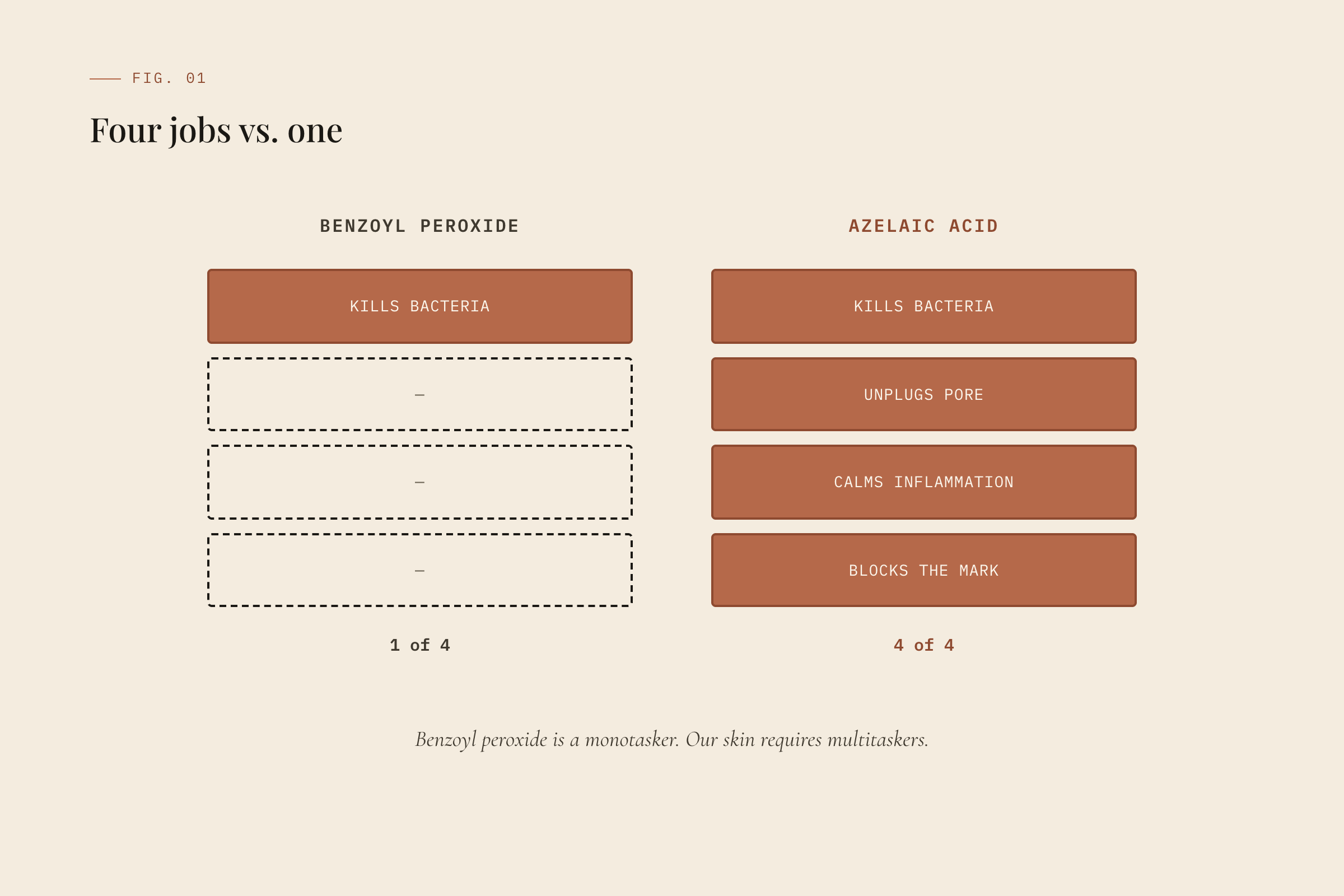
Four. Not one.
Now I am going to be straight with you, because that is the deal here. Head to head, for clearing lesions, azelaic acid is probably LESS effective than benzoyl peroxide. That is a Cochrane review, forty-nine trials, and I am not going to pretend it says something else.
But read what that trial measured. It measured lesions. It did not measure marks.
The lesion is gone in two weeks either way. The mark is there for a year. So the study answered a question that was never our question — and the mainstream dermatology reference will tell you as much if you read far enough down the page, where it says azelaic acid is "particularly useful for darker skinned patients whose acne spots leave persistent brown marks."
They wrote it down. Then nobody built the product.
Reason three — and the big one: it might not be acne.
Here is the finding that should have changed everything and changed nothing.
Researchers took three hundred and twenty people who had walked into a clinic and been diagnosed with acne by a dermatologist. Then they actually looked, under a microscope, at what was in the lesions.

Twenty-eight point eight percent of them had Malassezia — a yeast. Nearly one in three. About a quarter had it growing alongside real acne. Four percent had no acne at all. Just yeast, the whole time, being treated as acne, by a doctor, with acne medication.
The people with yeast were seven times more likely to itch. And they were about nine times more likely to have it on the upper back and along the hairline.
The upper back. Where you have it.
If the bumps are in your armpit, your groin, or under your breast — stop and read this twice.
Deep, painful, recurring bumps in those places — the ones that come back in the same spot, that hurt to the touch, that sometimes open and drain, that leave scarring behind — are the textbook presentation of hidradenitis suppurativa.
It is not acne. It will not respond to anything on your bathroom shelf. And it is ours in a way that should make you angry: hidradenitis is more than three times as common in Black people as in white people, we get more severe disease, we wait longer for a diagnosis, and we have less access to the specialists who could give us one.
People spend YEARS being told they have bad body acne. Years.
If any of that sounded like you, this is the sentence in this article that matters and the rest of it does not: take it to a dermatologist and say the word hidradenitis out loud. I am not diagnosing you. I am telling you what to say so somebody who can diagnose you actually listens.
So what do you actually do.
Slowly. That is the first instruction and the one people skip. What follows is a full routine, and if you start all of it on Monday you will be raw by Friday, and on our skin raw becomes dark. Add one thing. Give it two weeks. Add the next.
IN THE SHOWER. A body wash with a real active in it — and leave it on. Lather, walk away, come back, rinse. If you rinse in twenty seconds you have washed with soap.
AFTER YOU SWEAT. This one is mine and I want you to know that: it is reasoned, not something anybody has run a trial on. A hot, wet, sebum-loaded shirt pressed against skin is a growth medium. Not a metaphor — a growth medium. So do not sit in it. Get out of it, and if you have hot spots that break out after every workout, a light mist of hypochlorous acid on those areas — the same molecule your own immune cells make — knocks the population back before it establishes. Mist it, let it dry, do not soak it. Then shower when you can.
TREAT. This is where azelaic acid earns its four jobs. Which brings me to the problem.
The product that should exist, and does not.
Go look for an azelaic acid body lotion. I will wait.
For your FACE, azelaic is everywhere, and it tells you the number: ten percent, twelve, fourteen, and fifteen and twenty by prescription. For your BODY, you will find almost nothing — and what you do find either buries the azelaic inside a trademarked complex and reports the percentage of the COMPLEX, or uses a derivative of azelaic acid rather than azelaic acid itself and never tells you how much of that is in there either.
Learn to do this and it will serve you for the rest of your life: turn the bottle over. The front of the box is marketing. The ingredient list is the truth. If the front says azelaic acid and the list says something else, find out how much, and find out in what form. If nobody will tell you, that is your answer.
We are asking now.
Reign in your skin.
Reign in your skin.
Half the people who try to treat body acne quit within three months, and the top reason is not effort. It did not work. That is not a discipline problem. It is a targeting problem, and there are three of them.
One: you rinsed the active off in twenty seconds. That is not a treatment. That is expensive soap. Read the back of the bottle — if it says leave it on, leave it on.
Two: benzoyl peroxide kills bacteria and stops there. It never touches the mark. Azelaic acid does four jobs at once: kills, unplugs, calms, blocks the pigment. On our skin, the mark is the part that actually costs you. Benzoyl peroxide clears lesions faster in the trials. Nobody measured the marks.
Three: it might not be acne at all. Nearly one in three people diagnosed with acne actually have Malassezia, a yeast, not acne. It is monotonous, it itches, it lives on the upper back, and antibiotics make it worse by clearing out its competition. If your treatment never worked, ask your doctor about it by name.
Bumps in the armpit, the groin, or under the breast are a different conversation entirely — hidradenitis suppurativa, not acne. Say that word to a dermatologist.
Nothing here replaces your prescription. If you're on one, keep taking it. This is vocabulary for the room, not an argument against the doctor in it.
And the honest gap: nobody makes a body lotion with a disclosed, real dose of azelaic acid. Your face is worth a disclosed dose. Your back isn't. Ask for it.
Reign in your skin.
Reign in your skin
Doctor Djeli is an educational resource, not medical advice.
Evaluate your products →Doctor Djeli is an educational resource, not medical advice.