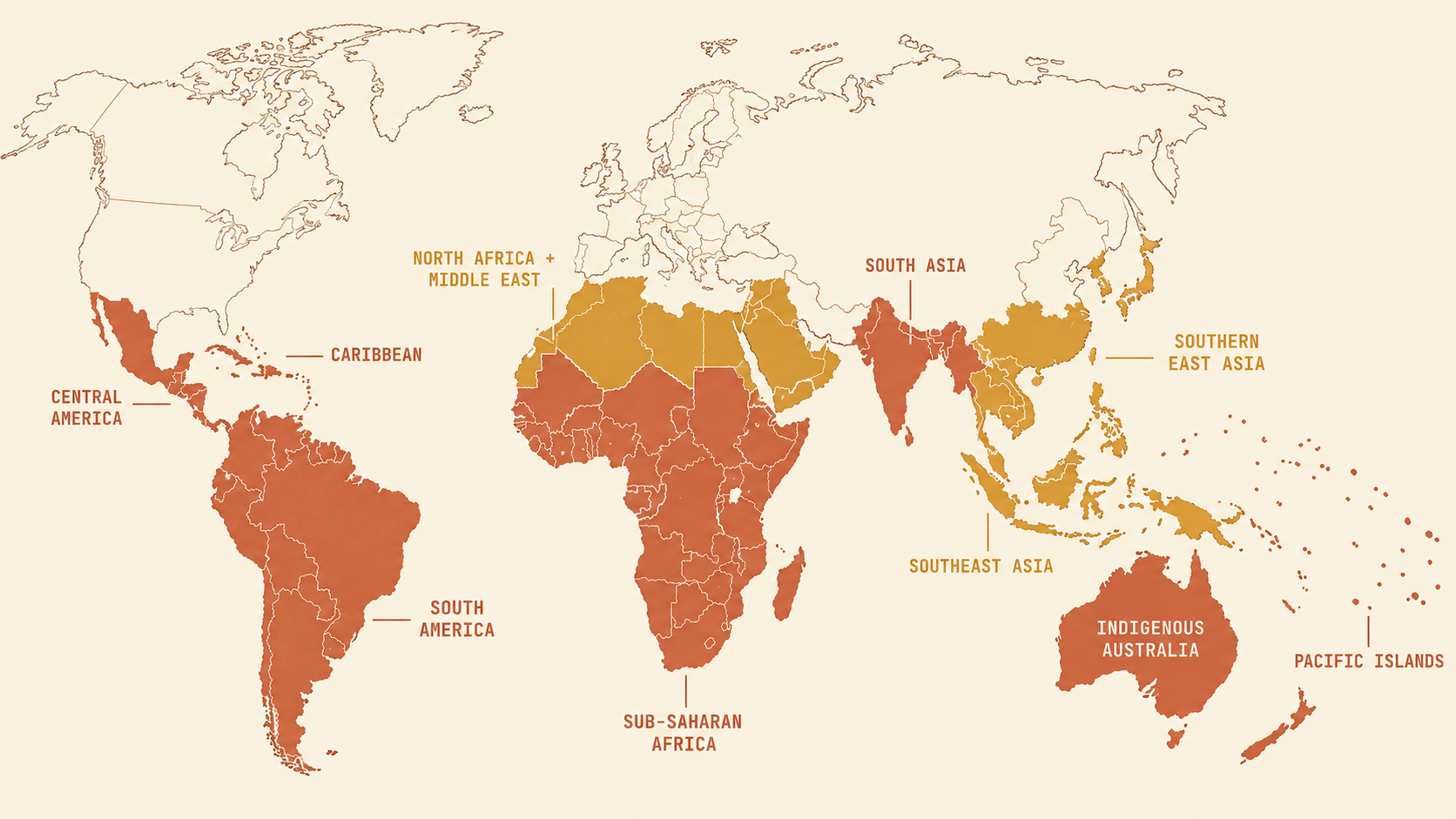
Skin of color is not the exception. It is the rule.
ROOT & REIGN is for everyone. It is specifically designed for skin of color.
Someone asked me last week if this site is for Asian people. ROOT & REIGN is for everyone. It is specifically designed for skin of color. That means Filipino people, South Asian people — Indian, Pakistani, Sri Lankan, Bangladeshi, Nepali. Indigenous Australians and Torres Strait Islander communities. Most Latina and Latinx people, depending on ancestry and how it moved through the bloodline. People of African descent across the diaspora — on the continent, in the Caribbean, in the United States, in the United Kingdom, in Brazil. Southeast Asians: Vietnamese, Thai, Indonesian, Malaysian, Cambodian. Pacific Islanders. Many East Asian populations, particularly those with deeper complexions. Middle Eastern and North African communities where hyperpigmentation and melasma are among the most common presenting dermatological concerns.
Add all of those people up and you get roughly 80% of the world. ROOT & REIGN was built for the majority.
Someone asked me last week if this site is for Asian people. ROOT & REIGN is for everyone. It is specifically designed for skin of color.
Skin of color is not a demographic. It is a biological category.
The clinical term does not mean Black skin. It does not mean African skin. It refers to skin with elevated melanin density — skin whose melanocytes produce more pigment, distribute it more broadly through the skin’s layers, and respond more forcefully when the skin is injured or inflamed. That biology is not unique to one community. It runs through most of the world.
That is not a research gap. That is a choice that has been made, repeatedly, for decades.
In 2026, an international expert consensus panel — dermatologists from China, South Africa, Brazil, India, and the United States — published a formal call to redefine how medicine approaches skin of color. Their consensus paper documented that clinical trials, dermatology education, and diagnostic tools still fail to represent these populations at anything close to their global prevalence. One mechanism. Many populations. One body of research, built almost entirely on populations for whom this mechanism rarely presents as a serious concern.
Roughly 80% of the world. One mechanism. One body of research built almost entirely on the other 20%.

The PIH mechanism operates identically across every population with elevated melanin density. One mechanism. Dozens of communities. One body of research.
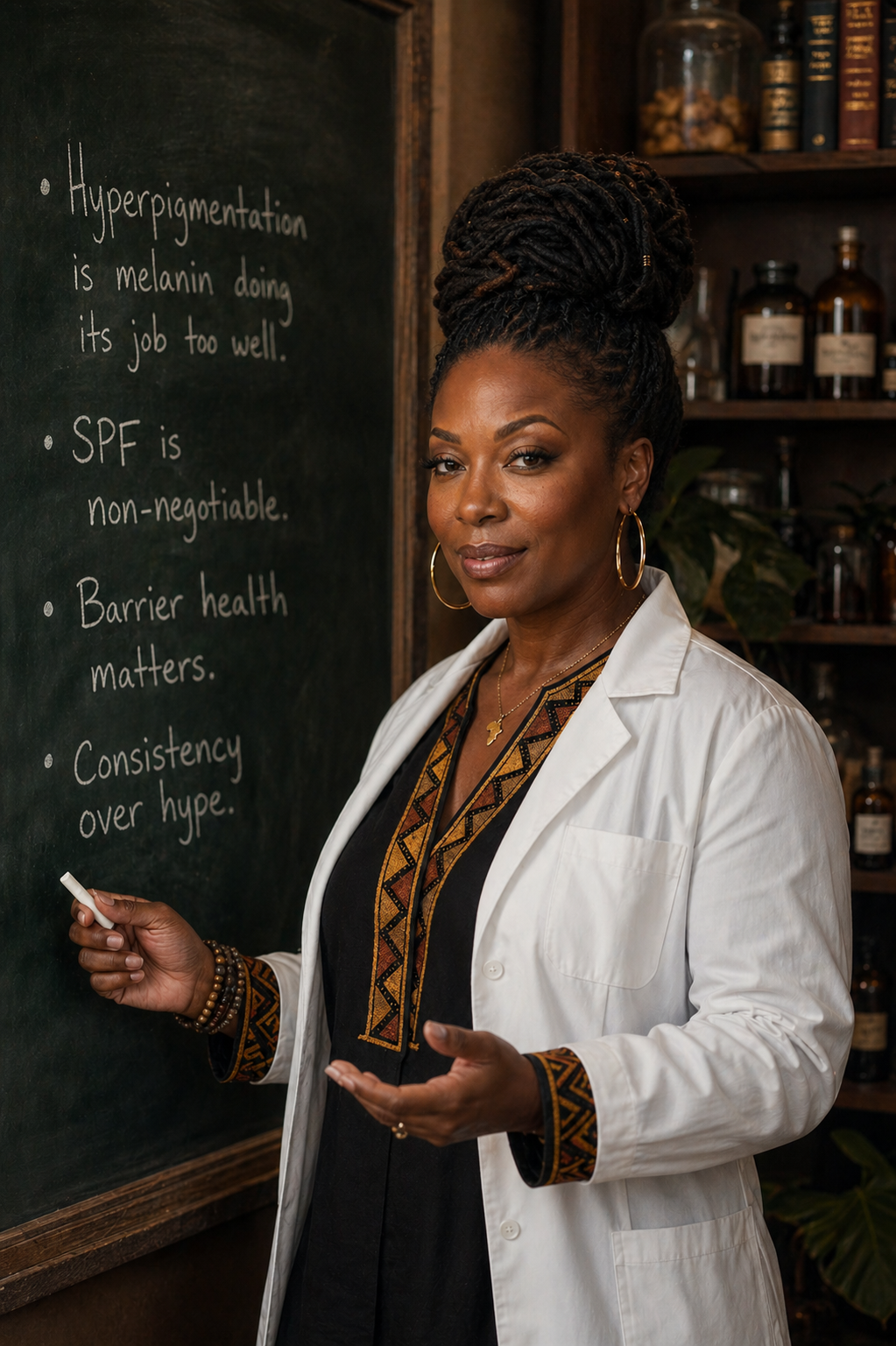
When skin with elevated melanin density experiences inflammation, the melanocytes overproduce pigment. The mark persists.
This is postinflammatory hyperpigmentation. It is not a disease. It is not a sign that skin is damaged or reactive in some exceptional way. It is what happens when skin built with more melanin does its job. The melasma that disproportionately affects South Asian women traces back to the same biological pathway as post-acne hyperpigmentation on Black skin. The dark marks after eczema flares in Filipino and Indonesian teenagers come from the same cascade. The persistent hyperpigmentation after insect bites in Indigenous communities across the tropics is the same wound-healing overshoot, on the same melanocyte-dense skin.
And skin lightening is popular in Lagos and Mumbai and Manila and São Paulo for the same reason. Colonialism installed a hierarchy that made lighter skin the visible marker of status and proximity to power — and it did this across every territory it touched, at roughly the same historical moment. The communities are different. The mechanism is the same. It was not arrived at independently across cultures. It was installed.
The tools should be built for your biology — not adapted from research done on someone else’s skin.
- Understand
Skin of color is a biological category
Elevated melanin density, not a racial or ethnic category. The PIH mechanism operates identically across Filipino, South Asian, Black, and Indigenous skin.
- Evaluate
The ROOT & REIGN evaluator reads your products against the real evidence
Calibrated for skin built with more melanin. The research the evaluator draws from was built for the populations it is actually helping.
- Read
The education hub covers the full brightening stack
Vitamin C derivatives, tranexamic acid, niacinamide, azelaic acid, hydroquinone — all explained through the lens of how Fitzpatrick IV–VI skin actually works.
- Stack
The mechanisms do not overlap
TXA intercepts the signal. Vitamin C inhibits tyrosinase. Niacinamide blocks the transfer. Azelaic acid targets hyperactive melanocytes. They compound when used together.
The research was built for 20% of the world. ROOT & REIGN was built for the majority.
The most commonly used severity scales in inflammatory dermatology rely on erythema — redness — as the primary assessment marker. These tools were developed and validated on Fitzpatrick I through III skin. On darker skin, redness either does not appear visibly or presents differently. A 2025 paper documented this directly: patients with skin of color are systematically underdiagnosed or misclassified by tools that were never designed to see their presentations clearly.
ROOT & REIGN’s evaluator is built on a single correction: your skin’s biology should be the operating assumption, not the afterthought. The mechanisms that drive hyperpigmentation are not African pathways or Asian pathways. They are the pathways of skin built with more melanin. The evaluator reads your products against what the research actually says about those pathways, for the Fitzpatrick types those pathways most directly affect. That is most of the world. It is time the tools reflected that.
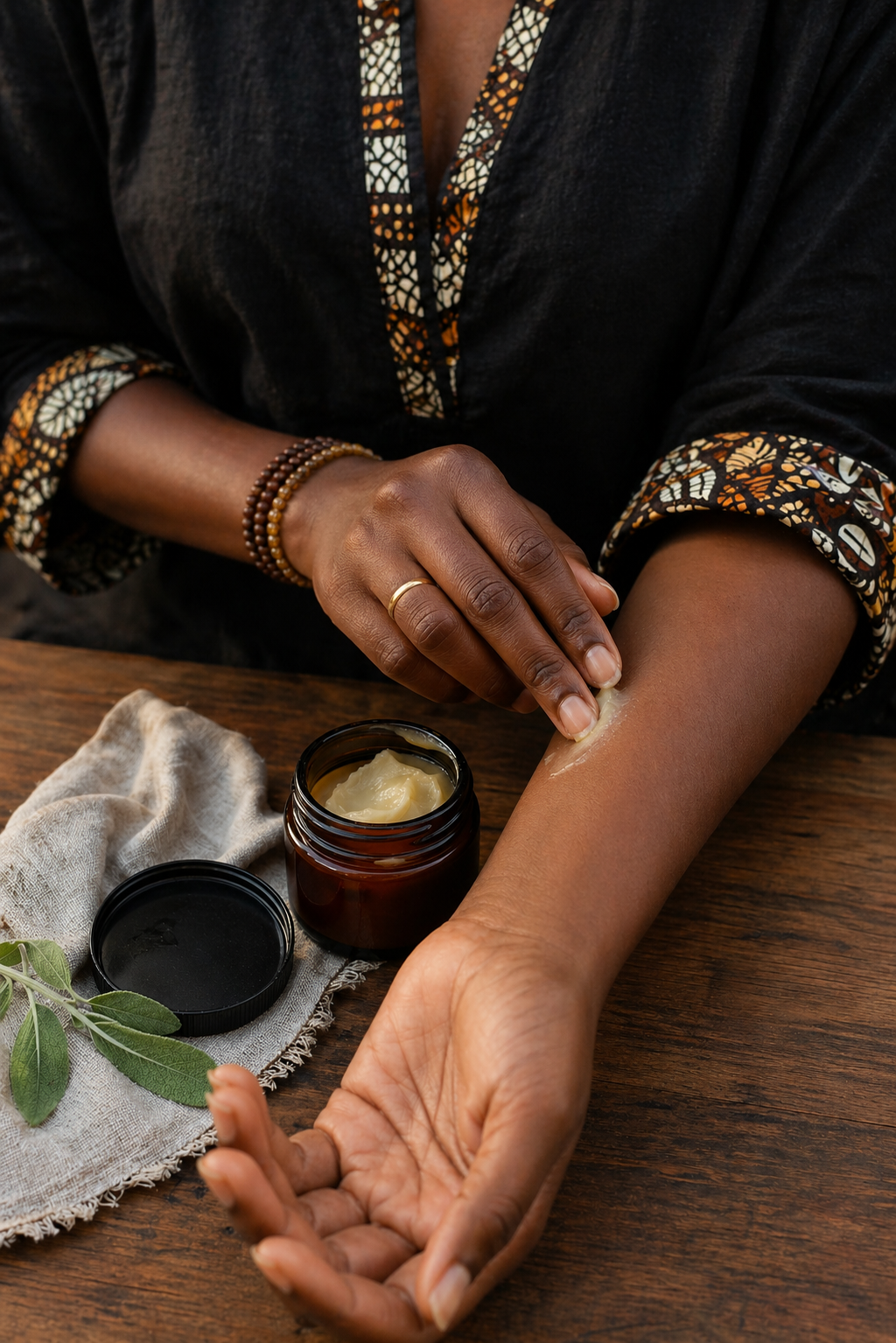
The tools should be built for your biology. Not adapted from research done on someone else’s skin.
Evaluate Your Products → Read the full education library →
Reign in your skin
Doctor Djeli is an AI, trained on evidence-based dermatology and lived expertise in melanated skin — built by a real person who navigated this firsthand. Educational resource, not medical advice.