
One molecule. Four mechanisms. The most evidence-grounded brightening foundation for melanated skin.
The rare brightening ingredient where the research was run on skin like ours.
Most ingredients in the brightening category have their evidence base built on Fitzpatrick I–III populations and get extended by inference to darker skin. Niacinamide is different. The published trials specifically include Fitzpatrick IV–VI subjects, the studies were conducted in geographies and populations where deeper skin is the default, and the mechanism — which we will get to — happens to be one of the best-suited interventions available for the central pigmentation problem on melanated skin.
This is why niacinamide shows up in almost every post-inflammatory hyperpigmentation protocol that takes Fitzpatrick IV–VI seriously. It is one of the few brighteners with both the research and the mechanism aligned.

Most brightening research was conducted on Fitzpatrick I–III skin and extended by inference. This one was actually studied on populations whose skin behaves like yours.
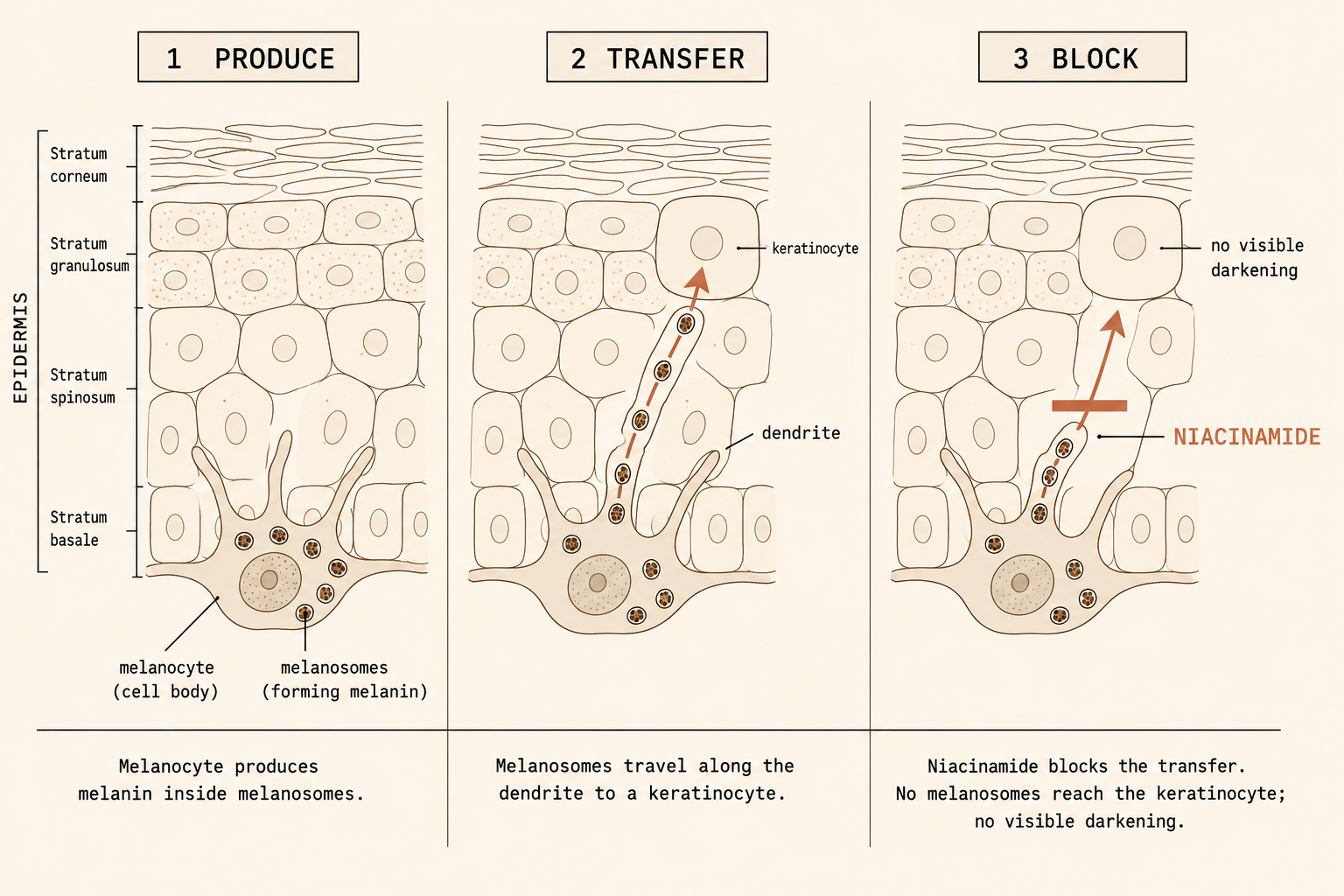
Niacinamide does not stop melanin production. It stops the transfer.
Niacinamide is the active form of vitamin B3, and unlike most brighteners, it does not work by stopping tyrosinase. Tyrosinase still produces melanin normally. What niacinamide does is interrupt the next step: the transfer of melanin from the melanocyte to the surrounding keratinocyte. Melanin is made inside specialized organelles called melanosomes, which live in melanocytes. From there, they are packaged and shipped to neighboring keratinocytes — the cells that make up the visible upper layers of skin. No transfer, no visible darkening, regardless of how much melanin the melanocyte produced.
Niacinamide is one of the few brighteners with both the research and the mechanism aligned for melanated skin.
The brightening is just one of four things niacinamide does simultaneously. It builds the skin barrier by stimulating ceramide synthesis. It is anti-inflammatory, reducing the pro-inflammatory cytokines upstream of PIH. And it improves sebum composition for people prone to acne — reducing the breakouts that become dark marks. One molecule. Four mechanisms. All of them useful for this skin.
Melanosomes carry melanin from where it is made to where it shows. Niacinamide blocks the transfer.
Trials in Fitzpatrick III–V populations — as primary subjects, not by inference.
The Hakozaki studies in the early 2000s established the brightening effect of 2–5% niacinamide on facial hyperpigmentation, with statistically significant reductions in melanin density observed over 4–8 weeks. The original studies were conducted on Japanese subjects (Fitzpatrick III–IV predominantly) and were later extended to other Asian and Latine populations.
Subsequent work tested 4–5% niacinamide head-to-head against 4% hydroquinone for melasma, with results showing comparable efficacy and significantly better tolerability. Hydroquinone has known risks in darker skin — ochronosis and paradoxical hyperpigmentation with prolonged use — that niacinamide does not carry. The combination of mechanism alignment, safety profile, and evidence base in the relevant populations makes it one of the few brighteners that has earned its position rather than been inferred into it.

The mechanism works downstream of every upstream brightener. You can stack them. They compound.
The therapeutic range is 2–10%. Five percent is the most studied for brightening.
Below 2%, the brightening effect drops off. Above 10%, some users experience flushing or mild irritation, particularly when combined with strongly acidic actives in the same routine. Niacinamide is highly stable across a wide pH range, which is why it appears in formulas alongside almost every other active — it does not require an acidic vehicle and does not degrade quickly when exposed to light or air.
A common misconception is that niacinamide cannot be combined with vitamin C. This was based on an old laboratory finding involving a reaction at high concentrations and elevated temperatures. In actual skin and at typical formulation concentrations, this interaction does not occur in any clinically meaningful way. You can use both, in the same routine, layered or in separate steps, without issue.
One of the few brighteners that earns a permanent place in the routine rather than a treatment course.
- Baseline
5% niacinamide as the structural foundation
The brightening baseline that everything else builds on. Start here before adding any other actives.
- Stack
Add TXA + vitamin C + azelaic acid
Mechanisms are non-overlapping: TXA intercepts the signal, vitamin C inhibits tyrosinase, azelaic acid targets hyperactive melanocytes, niacinamide blocks the transfer. They compound.
- Reactive
Niacinamide alone at 5%
For skin too reactive for upstream actives, niacinamide alone will produce meaningful brightening over 8–12 weeks, with no irritation risk and barrier improvement as a side benefit.
- Long-term
Keep it in the routine indefinitely
Unlike actives used in courses, niacinamide earns a permanent place. Its four simultaneous actions — brightening, barrier, anti-inflammatory, sebum quality — are continuously useful.
The mechanism, the evidence, and the safety profile all align for melanated skin.
Blocking melanosome transfer addresses the downstream step where visible darkening actually occurs. For skin that produces a robust melanin response to any injury, intervening at the visibility step — rather than the production step — is structurally well-suited to the problem. And the evidence comes directly from the populations it is supposed to help, not from inferences built on Fitzpatrick I–III trial data.
Reactive skin tolerates niacinamide where it does not tolerate higher-percentage L-ascorbic acid, retinoids during introduction, or some of the older brighteners. For skin where the cost of any irritation event is a new dark mark, the safety profile is part of the efficacy. If you are looking for the single ingredient that does the most things at once for skin like ours — barrier, brightness, inflammation reduction, sebum quality — it is this one.
If you are looking for the single ingredient that does the most things at once for skin like ours, it is this one.
Evaluate Your Products → Not sure what you’re using? Evaluate it →
Reign in your skin
Doctor Djeli is an AI, trained on evidence-based dermatology and lived expertise in melanated skin — built by a real person who navigated this firsthand. Educational resource, not medical advice.