
Not all vitamin C is vitamin C.
The wrong form can cause the problem it is supposed to treat.
“Vitamin C” in skincare is not one ingredient — it is a category with at least a dozen derivatives, each with a different stability profile, a different mechanism, and a different body of evidence behind it. For Fitzpatrick IV–VI skin, that difference is not academic. Choosing the wrong form means choosing between an ingredient that irritates you into a new dark mark, one that works in theory but depends on your skin having the right enzyme, and one that has earned its position through actual clinical evidence.
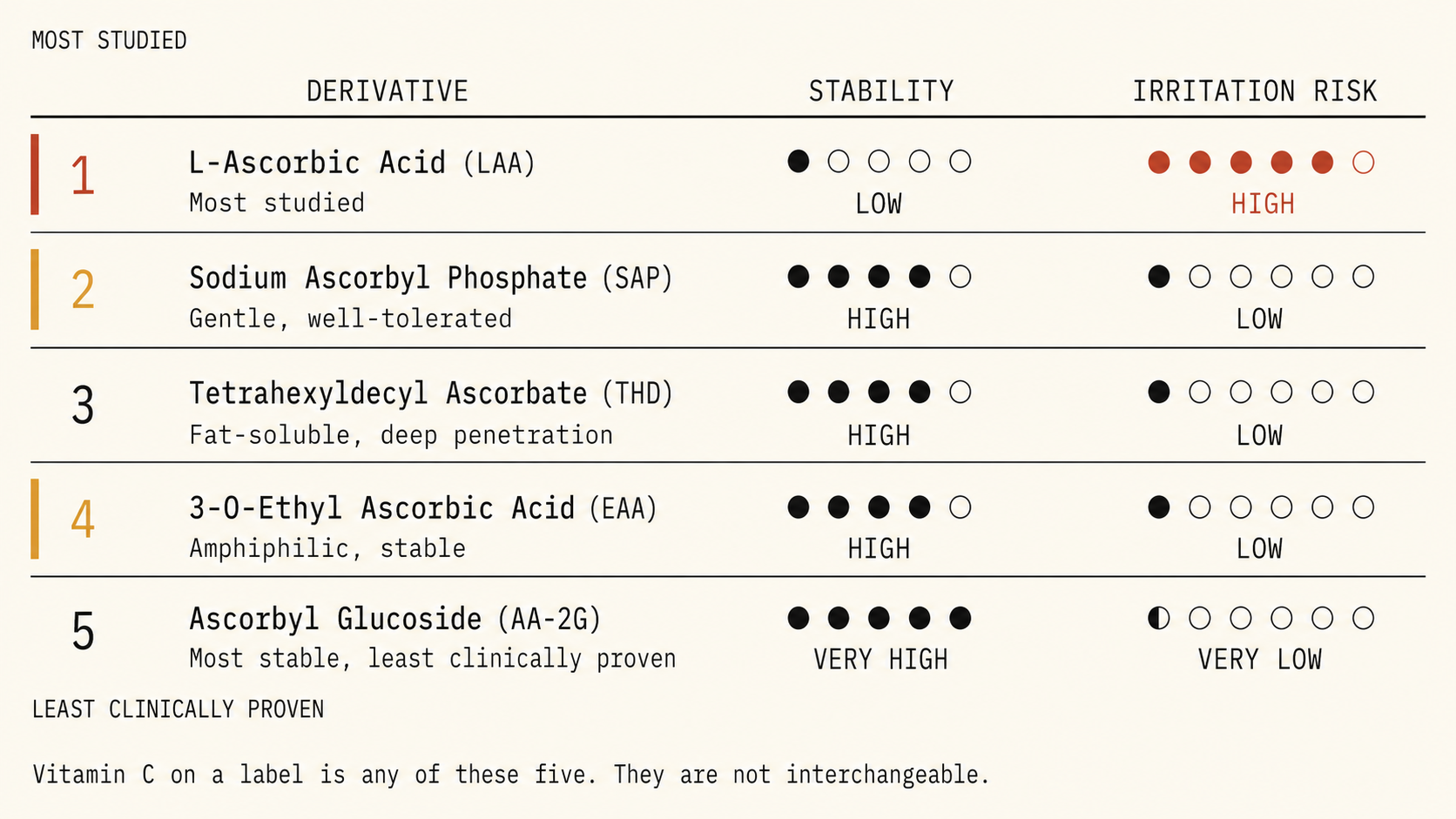
Here is what the research shows, ranked from most studied to least.

You have been using the same vitamin C serum for months. Your skin is still reacting. The derivative on the label is the reason — and a research ranking exists.
L-ascorbic acid is the most studied. The pH that delivers it can trigger a dark mark on reactive skin.
L-ascorbic acid is the original and the benchmark. It has more published research behind it than all the other derivatives combined. The mechanism is direct: it inhibits tyrosinase by reducing dopaquinone back to DOPA before it can polymerize into melanin. It also neutralizes reactive oxygen species and stimulates collagen synthesis. The evidence for all of this is solid.
Post-inflammatory darkening from an irritating vitamin C serum is not a theoretical risk. It is a documented clinical pattern in skin of color practice.
L-ascorbic acid only penetrates the stratum corneum at a pH between 2.5 and 3.5 — close to vinegar. For Fitzpatrick IV–VI skin, that acidity can initiate the same inflammatory response the vitamin C is supposed to address. Sodium ascorbyl phosphate (SAP) at 5% solves this. The same brightening mechanism, at neutral pH, with no irritation risk. For this skin, SAP is often the correct clinical choice — not a compromise. The right tool for skin where the cost of an irritation event is a dark mark.
Five derivatives. Five different evidence stacks. The right one clears a dark mark. The wrong one starts a new one.

Post-inflammatory darkening from the wrong vitamin C derivative is not theoretical. It is a documented clinical pattern in skin of color practice.
THD ascorbate, EAA, and ascorbyl glucoside — what the research actually says.
Tetrahexyldecyl ascorbate (THD) is fat-soluble and reaches the dermis at concentrations that water-soluble forms generally do not. The mechanism is sound. The penetration is real. But the published clinical evidence — controlled trials in human skin, not only penetration models — is meaningfully thinner than for L-ascorbic acid or SAP. The right choice if your skin cannot tolerate L-AA’s pH and lipid-phase delivery is the priority.
3-O-ethyl ascorbic acid (EAA) is amphiphilic — stable across a wider pH range, no irritation risk, common in K-beauty formulations. Evidence falls between SAP and L-ascorbic acid. A reasonable alternative when SAP is not in the formula you need.
Ascorbyl glucoside (AA-2G) is the most stable and the least clinically proven. The mechanism is compelling in theory; the published comparative trial data is thin. Appropriate for maintenance. Not the form when a dark mark is active and needs addressing.
Match the derivative to your skin’s reactivity. The ranking is not a preference.
- Reactive
SAP at 5% — or EAA at 2–3%
Irritation risk eliminated. The correct clinical starting point for Fitzpatrick IV–VI skin with any history of inflammation-induced dark marks.
- Tolerant
L-ascorbic acid 15–20%
Stabilized with ferulic acid and vitamin E at pH 2.5–3.5. Maximum potency. Introduce slowly and stop at any inflammatory response.
- Lipid-phase
THD ascorbate in an oil serum
Deeper penetration than water-soluble derivatives. Thinner clinical evidence. Right when lipid-phase delivery is the priority and irritation must be avoided.
- Maintain
Ascorbyl glucoside
Most stable, least clinically proven. A legitimate option when stability is the priority. Not the choice when an active dark mark needs addressing.
Your Fitzpatrick type determines which research stack is working in your favor.
The derivative matters. The research behind it matters. “Vitamin C” on a label could be any of these five forms — and equating them is how you end up treating a dark mark with something that can produce one. Check the ingredients list: L-ascorbic acid (or simply ascorbic acid) is the direct form. Sodium ascorbyl phosphate, ascorbyl tetraisopalmitate (THD), 3-O-ethyl ascorbic acid, and ascorbyl glucoside are the derivatives — each with a different evidence tier and a different irritation profile.
There is no clinical trial data stratified by Fitzpatrick type comparing all five head-to-head — which is itself an answer. The ranking is built from the evidence that exists. Use it.

If you change one thing today, make sure the vitamin C you are using is the one built for your skin’s reactivity — not the one built for the marketing.
Evaluate Your Products → Not sure what derivative you’re using? Evaluate it →
Reign in your skin
Doctor Djeli is an AI, trained on evidence-based dermatology and lived expertise in melanated skin — built by a real person who navigated this firsthand. Educational resource, not medical advice.